

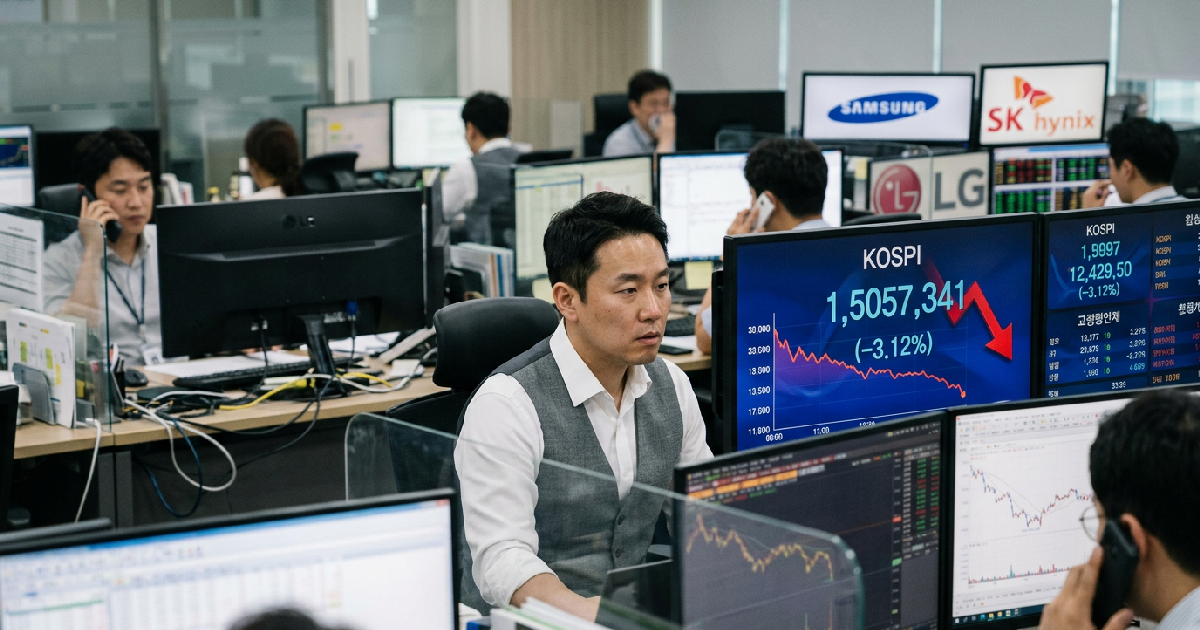
South Korean equity markets plummet as tech stocks retreat on June 8
South Korean equity markets plummeted on Monday, June 8, 2026, as a sharp retreat in technology stocks spread across the Asia-Pacific region. The plunge in the South Korean index has intensified concerns regarding a broader sell-off in the tech sector, which has historically leaned on Seoul as a barometer for global hardware and semiconductor demand.
This downward pressure comes as institutional investors appearing to reassess valuations following a period of sustained growth in the industry.
The market movement reflects a cooling sentiment among traders who are monitoring the cyclical nature of the tech sector. South Korea’s heavy concentration of electronic manufacturers means its domestic benchmark often acts as a leading indicator for global supply chain health. As regional volatility rises, the impact is expected to reach international exchanges, particularly those with high exposure to semiconductor components and consumer electronics production.
While traditional tech stocks faced selling pressure, the broader financial environment remains intertwined with shifts in emerging technologies. Recent market data shows how capital is being repositioned across various asset classes. For instance, digital assets have seen capital diverted as investors move away from speculative trades in favor of more stable holdings amid the current tech-led uncertainty.
South Korea index serves as global tech barometer
The sell-off in Seoul is particularly impactful because the South Korean index is dominated by major memory chip producers and consumer electronics exporters. When these companies see significant price drops, it frequently forecasts similar downturns in Western markets like the Nasdaq. Analysts suggest the current plunge indicates a shift in how the market views the near-term profitability of hardware manufacturers.
Trading activity during the session suggests that the selling pressure is largely driven by institutional desks. This professional retreat often signals a deeper concern over macroeconomic fundamentals rather than short-term retail fluctuations. The industry is currently contending with high capital expenditure costs and a global consumer market that may be reaching a point of saturation for high-end devices.
The ripples of this volatility are already being felt in related high-growth sectors. Recent reports have highlighted adjustments in industrial valuations, showing that when the primary tech engine in Asia slows down, the correction often bleeds into middle-market and private equity assessments. This cross-sector impact demonstrates the interconnectedness of modern global trade.
Supply chain adjustments and memory pricing pressure
A primary catalyst for the South Korean market decline is the potential for a shift in the memory chip cycle. After several years of tight supply, some indicators point toward an inventory build-up among major suppliers. If demand for server and consumer electronics fails to meet expectations, the resulting surplus could threaten the profit margins of the region’s top exporters.
There are also signs that large-scale cloud infrastructure providers are beginning to optimize their current hardware stacks rather than initiating massive new orders. This pause in corporate spending directly impacts the order books of South Korean firms. Without a steady stream of large-scale infrastructure investments, the high valuations maintained by tech firms are coming under renewed scrutiny.
Regional contagion and trade partner reactions
The South Korean plunge has not remained isolated, as neighboring markets in Japan and Taiwan also reported declines in their tech-heavy sectors. The integrated nature of the Asian electronics supply chain ensures that a disruption in one major hub creates a domino effect. When Seoul’s benchmark dips significantly, it often triggers automated sell-offs in regional ETFs and index-tracking funds.
Furthermore, broader geopolitical tensions are continuing to influence investor confidence across global shipping and trade routes. While not directly related to the tech sell-off, ongoing maritime disruptions in the Middle East have added a layer of logistical complexity that weighs on the sentiment of multi-national tech exporters. Investors are increasingly calculating these “tail risks” into their portfolio models for the second half of 2026.
Outlook for the third quarter of 2026
As the market moves toward the third quarter, the performance of the South Korean index will be critical in determining the trajectory of the MSCI Emerging Markets index.
If the tech sell-off continues to widen, it may lead to a more permanent rotation of capital out of growth-oriented technology and into defensive industries seperti utilities and healthcare. This shift would represent a significant pivot from the bull market seen in early 2025.
And while some analysts view the current plunge as a much-needed correction to over-inflated price-to-earnings ratios, the short-term outlook remains cautious. The ability of South Korean manufacturers to manage inventory levels and maintain margins through this volatility will be the defining factor for the region’s financial stability.
For now, the global market’s eyes remain fixed on the opening bells of the world’s major financial centers to see if the sell-off persists.