

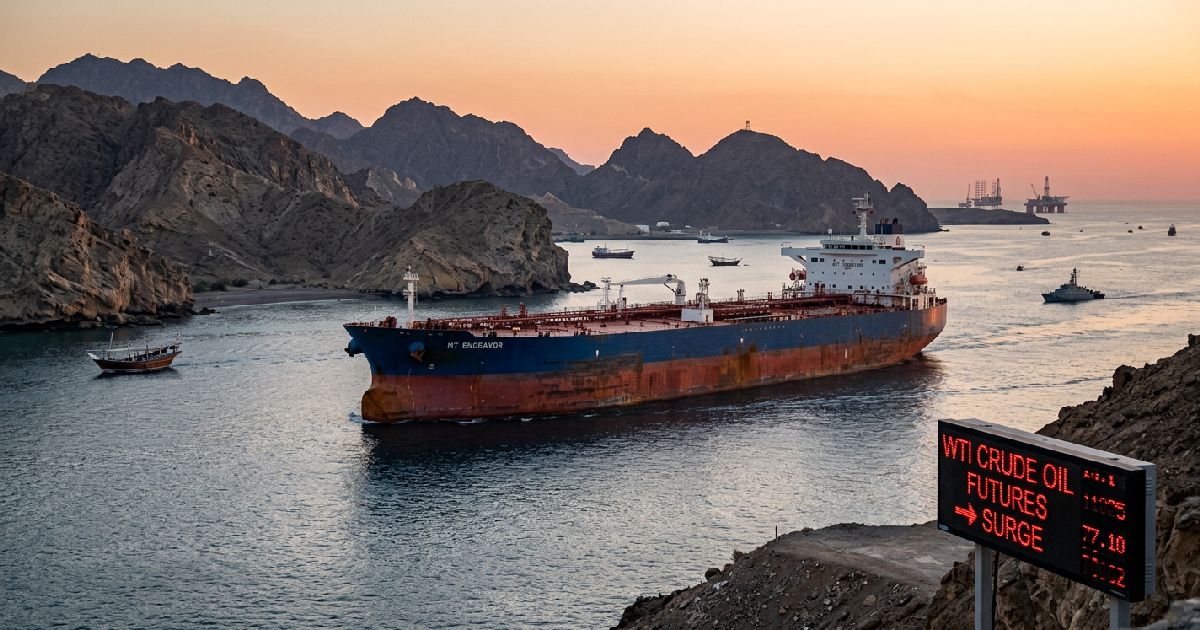
Iran suspends US talks, blocks Strait of Hormuz; WTI crude up 5%
Iran suspended negotiations with the United States on June 1, 2026, and announced a complete blockade of the Strait of Hormuz, causing WTI crude oil futures to surge 5% to $91.74 per barrel. The Iranian state-affiliated agency Tasnim reported that Tehran will not return to diplomatic talks until Israel halts military operations in Gaza and Lebanon and withdraws from occupied Lebanese territories.
International benchmark Brent crude also reacted to the escalating tension, rising 2.4% to $93.33 per barrel in early trading on Monday. The market volatility comes as oil prices previously fell on hopes that an enduring agreement could be reached. Iran has now signaled intentions to open “other fronts,” specifically mentioning the Bab el-Mandeb Strait, a vital trade route connecting the Red Sea to the Gulf of Aden.
The sudden diplomatic halt follows a weekend of intensified ground combat in southern Lebanon. Israeli Prime Minister Benjamin Netanyahu confirmed his forces captured the medieval Beaufort Castle, calling the advancement a “decisive shift” in the offensive against Hezbollah. Despite these escalations, a fragile ceasefire between the U.S. and Iran has been maintained since April 7, 2026, though officials warn it remains under severe pressure.
Energy markets confront re-closure of the Strait of Hormuz
The Strait of Hormuz remains the primary artery for global energy, handling roughly 20% to 25% of the world’s seaborne oil. This current closure follows a pattern of disruption; Iran originally closed the waterway at the start of the war on February 28, 2026. While passage was briefly opened in mid-April during a truce, Tehran reinstated the blockade on April 18 after the U.S. refused to lift its own naval restrictions.
Economic analysts are concerned that a permanent breakdown in peace talks could lead to catastrophic price levels. Jorge León, head of geopolitical analysis at Rystad Energy, warned that Brent could reach $180 per barrel by August if the conflict intensifies. Such an outcome would likely trigger a global recession, particularly hitting emerging markets in Asia and European economies already struggling with supply disruptions.
The U.S. military continues to enforce its own maritime blockade against Iran, which began on April 13, 2026. On May 30, U.S. forces fired a missile into the Lian Star, a Gambia-flagged merchant vessel, after it ignored more than 20 warnings while sailing toward an Iranian port. Since the blockade’s inception, U_S. naval forces have redirected 116 vessels and disabled six commercial ships to prevent cargo from reaching the Islamic Republic.
White House maintains optimism despite failed Islamabad talks
President Donald Trump addressed the standoff on Monday via Truth Social, suggesting that Iran “really wants to make a deal.” He urged observers to “relax,” claiming the situation would work out in the end. However, reports from Axios suggest the administration recently requested amendments to proposed deal terms, particularly concerning Iran’s nuclear material, complicating the path to a formal treaty.
The diplomatic stalemate is rooted in the collapse of the Islamabad Talks earlier this year. Mohammad Baqer Qalibaf, the Iranian parliament speaker, has insisted that a ceasefire is only logical if the U.S. lifts its naval blockade. This mirrors comments from Iranian President Masoud Pezeshkian, who stated his nation would not participate in negotiations conducted under the threat of economic blockades or military force.
Market indicators and shifted price forecasts for June 1
Financial institutions are revising their outlooks as the war, which began on February 28, enters a new phase of uncertainty. Goldman Sachs noted that while supply shocks push prices higher, weak retail sales data in China and Europe could dampen demand. This creates a “two-sided” risk for their fourth-quarter forecast of $90 for Brent and $83 for WTI crude.
The following oil price movements were recorded on June 1, 2026:
- WTI crude oil futures: Surged 5% to reach $91.74 per barrel.
- Brent crude: Rose 2.4% to $93.33 per barrel in early trading.
- US benchmark crude: Gained 2.8% to reach $89.76 per barrel.
- Previous context: WTI was trading at $92.03 per barrel on May 28, up 3.78%.
Investors are increasingly cautious as capital migrates away from riskier assets. For instance, Bitcoin prices have dropped to $75,406 as quantum technology and AI developments divert traditional capital. Market participants are now prioritizing safe-haven assets as the “recession scenario” of $180 oil becomes a more discussed possibility among commodity traders.
Strategic implications of the Bab el-Mandeb threat
U.S. War Secretary Pete Hegseth clarified the American position on May 30, stating that any resolution must leave the Strait of Hormuz open and free of tolls. President Trump has also demanded that remaining mines in the waterway be destroyed. The U.S. maintains that freedom of navigation is a red line, yet the enforcement of its own blockade on Iranian ports remains a central point of contention for Tehran.
If Iran follows through on its threat to block the Bab el-Mandeb Strait, the crisis would engulf a second critical maritime chokepoint. This would effectively bottleneck both ends of the Red Sea, creating a compounding effect on global shipping costs. With Israeli forces moving deeper into Lebanon, the likelihood of a broader regional conflict involving Iranian proxies grows, leaving the global energy market in its most precarious state since the war began.