

Supply chain resiliency increasingly prioritised over cost in perma-crisis era
Corporate logistics leaders are abandoning traditional cost-saving models as supply chain resiliency increasingly outweighs the pursuit of low-cost, just-in-time inventory management. Executives like Christopher McCarney, U.S. Principal at KPMG, and Dheera Anand, Partner at Bain & Company, report a fundamental shift in strategy following a relentless cycle of global disruptions including the COVID-19 pandemic, the Ukraine war, and more recently, the Iran war that began this February.
The “perma-crisis” environment is forcing a dramatic rethink of how goods move across borders. According to a May 1 survey by KPMG, 73% of businesses are now planning a comprehensive transformation of their supply chain operating models within the next 36 months. This shift marks the end of an era where shaving cents off unit costs was the primary metric of success for global procurement teams.
Recent geopolitical volatility has accelerated this trend significantly. In April, the U.S. administration issued proclamations affecting the importation of aluminum and copper, while a May 1 threat to increase tariffs by 25% on European vehicles added to the atmosphere of uncertainty. These policy shifts, combined with US naval forces redirecting commercial vessels during maritime blockades, have made cost-efficient planning nearly impossible for many multinational firms.
Global disruptions dismantle the just-in-time logistics model
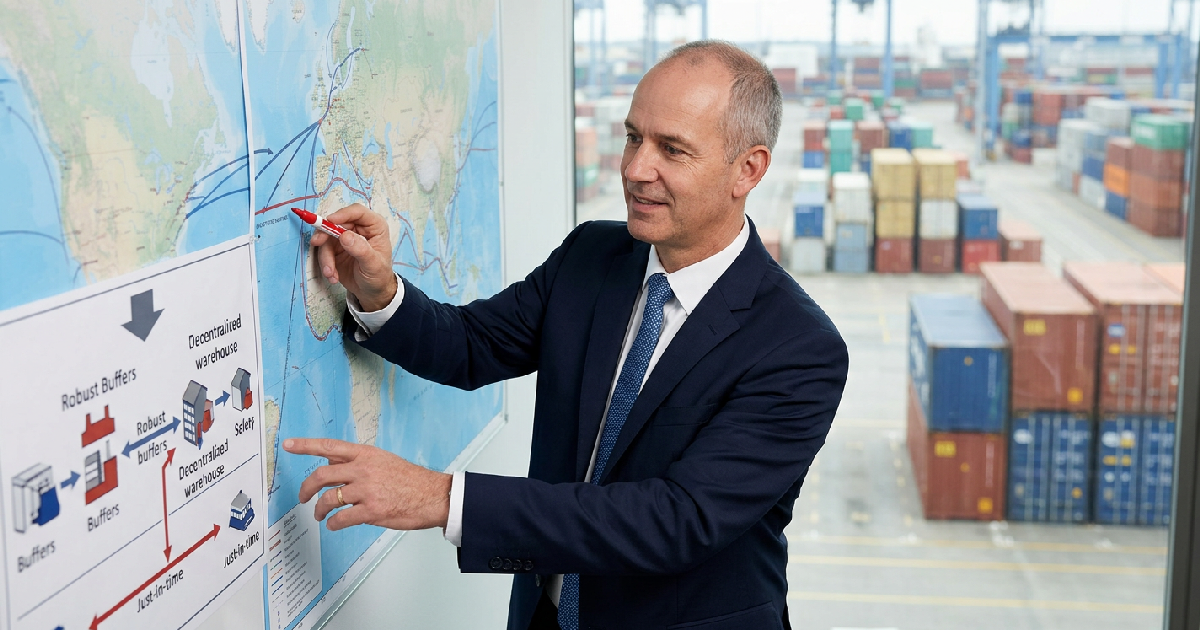
For decades, the just-in-time (JIT) model served as the gold standard for efficiency, allowing companies to minimize storage costs by receiving goods only as needed. However, Dheera Anand of Bain & Company notes that companies must now plan for “regularly occurring similar shocks” rather than treating them as isolated incidents. The transition to a “just-in-case” strategy involves holding higher inventory buffers and diversifying supplier bases.
The cost of these disruptions is staggering. Reports from April 2022 highlighted that the Ukraine war risked a 10% shortfall in global wheat supply and a 50% gap in sunflower oil. In some sectors, hospitality contacts reported a 90% surge in vegetable oil prices. These price spikes, coupled with tenfold increases in container delivery pricing in certain regions, have proved that a “cheap” supply chain is often the most expensive when it fails.
Rising importance of revenue assurance over efficiency
Finance leaders are becoming more involved in these logistics decisions than ever before. A 2022 Protiviti study found that 45% of CFOs and VPs of finance were moving away from efficiency-based models toward revenue assurance models. The goal is no longer just to save money on the front end, but to ensure that products actually reach the customer so revenue can be recognized.
This shift is visible in corporate boardrooms. KPMG reports that a majority of organizations now hold regular C-suite meetings specifically focused on supply chain developments. Management is increasingly willing to pay a premium for stability, with Christopher McCarney stating, “I think there’s a willingness to pay for resilience.”
Cybersecurity and geopolitical risk dominate the corporate agenda
While physical blockades and wars are visible threats, digital risks have become equally potent. The Allianz Risk Barometer now ranks cybersecurity as the top threat to business continuity, surpassing economic market fluctuations and environmental concerns. A February ransomware attack on UnitedHealth Group illustrated the stakes, with estimated financial impacts reaching as high as $2.45 billion.
Geopolitical risk management has also become a top priority for 71% of supply chain professionals, according to a Keelvar whitepaper titled “Turning Chaos into Control.” Companies are looking for ways to insulate themselves from erratic trade policies and regional conflicts. For example, some firms are investing in domestic infrastructure, such as the new US rare earth plant planned by Posco International to reduce reliance on fragile overseas networks.
The role of scenario planning in mitigating shocks
Data-driven preparation is proving to be the most effective hedge against the perma-crisis. McKinsey research indicates that sound scenario planning can cut the impact of supply chain disruptions in half for the 37% of companies that actively utilize such strategies. This involves modeling various “what-if” scenarios, ranging from sudden port closures to new trade tariffs.
Richard Chambers, Senior Advisor at AuditBoard, suggests that the “foundational rules for risk management” have been permanently altered. He argues that the shakeup of U.S. policy over the last year is merely the latest chapter in a crisis period that started with the pandemic. The focus has moved from reacting to individual events to building an inherently flexible infrastructure.
Corporate investment pivots toward long-term network durability
The financial reality of the perma-crisis era is that extra costs—such as fuel surcharges, special equipment, and emergency shipping—now account for 15% to 30% of base transport costs. To combat this, 83% of professionals now list “overcoming supply chain disruptions” as their primary agenda item. This outweighs even the pressure to combat inflation and rising costs for 77% of respondents.
Investment is also flowing into regional manufacturing and localized hubs to shorten the distance goods must travel. This “near-shoring” strategy is a direct response to the volatility seen in the Red Sea, where cargo ship seizures have become a recurring threat to East-West trade routes. While this often leads to higher labor or production costs, it offers a level of certainty that the previous globalized model could not guarantee.
As companies move forward, the emphasis on resiliency is expected to persist regardless of short-term market improvements. Christopher McCarney of KPMG warns that there is no “settling down” on the horizon. “There’s always going to be another event,” he said, “and the best time to modernize is right now.” This sentiment reflects a broader corporate consensus: in an era of constant crisis, the most resilient supply chain is the only one that can truly be called profitable.