

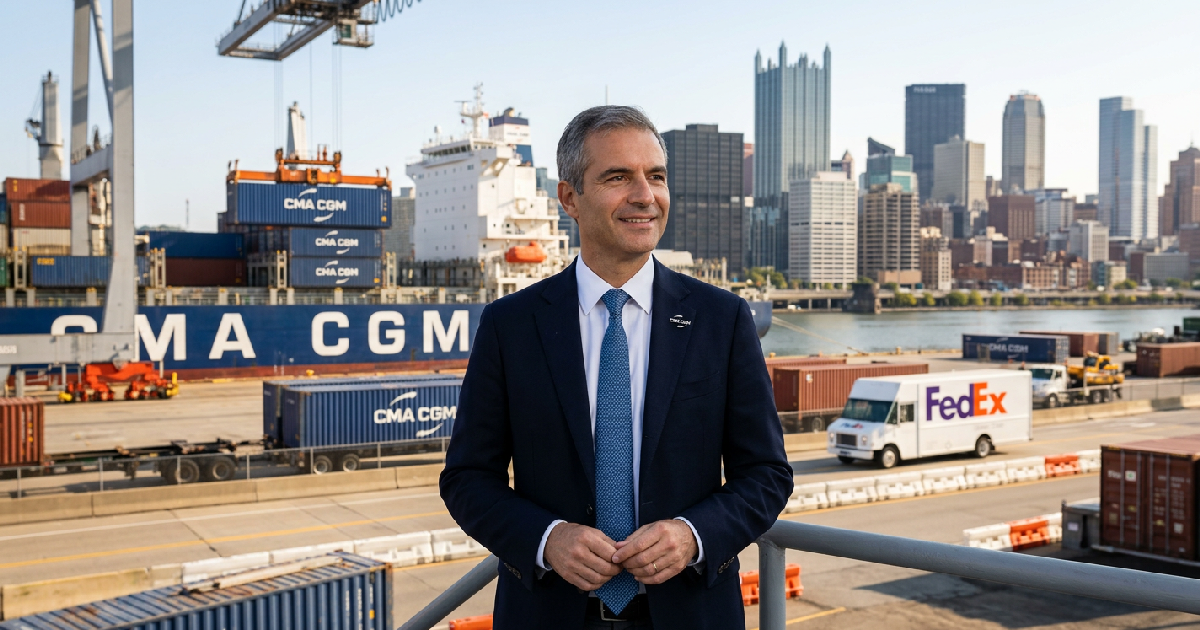
Rodolphe Saadé’s group acquires FedEx Supply Chain for $1.4 thousand million
French shipping behemoth CMA CGM Group has officially reached an agreement to acquire FedEx Supply Chain from FedEx Corp for an enterprise value of $1.4 billion, the companies announced on July 1, 2026.
The all-cash transaction will see the Pittsburgh-based subsidiary integrated into CEVA Logistics, the contract logistics arm of the Marseille-based group, nearly tripling its footprint in the North American market.
CMA CGM Group strengthens North American logistics presence via acquisition
Alongside the sale, Chairman and CEO Rodolphe Saadé of CMA CGM and President and CEO Raj Subramaniam of FedEx signed a multi-year commercial partnership that establishes CMA CGM as a preferred ocean carrier for the American delivery giant.
The deal represents a significant pivot for FedEx Corp, which has spent the last year aggressively slimming down its operations to focus on its core air and ground parcel business. By offloading its third-party logistics (3PL) division, the company is walking away from a sector it entered just over a decade ago.
For the CMA CGM Group, the acquisition is the latest in a series of high-profile expansions aimed at transforming the world’s third-largest ocean carrier into a comprehensive end-to-end global supply chain provider. The move comes as logistics firms globally face pressure to stabilize margins following the post-pandemic freight volatility.
Industry observers view this as a strategic realignment of two titans. While FedEx retreats to what it does best—moving high-priority parcels—CMA CGM is doubling down on the physical infrastructure of warehousing and fulfillment.
The acquisition includes nearly 10,000 employees and a vast network of facilities that handle everything from medical device distribution to automotive parts returns. By the time the ink dries later this year, CEVA Logistics will boast a combined workforce of 20,000 people across 240 distinct locations in North America alone.
The acquisition of FedEx Supply Chain serves as an accelerator for the CMA CGM Group’s long-term strategy to own every link in the global trade chain. Under the leadership of Rodolphe Saadé, the company has transitioned from a pure-play maritime carrier into a diversified logistics house.
This specific deal allows CEVA Logistics to absorb a ready-made network that specializes in complex services like reverse logistics, recycling, and high-touch fulfillment. For a company like CMA CGM, which recently watched as US naval forces redirect commercial vessels during geopolitical tensions, diversifying into land-based asset management provides a critical hedge against ocean-side volatility.
Key details
The Pittsburgh-based FedEx Supply Chain was originally built upon the 2015 acquisition of Genco Supply Chain Solutions. At the time, it was intended to help FedEx compete directly with the contract logistics divisions of UPS Inc. and DHL Group. However, the division struggled to find its footing within the broader FedEx network.
By selling to CMA CGM, FedEx can now direct its capital expenditure toward its high-value verticals. This includes specialized delivery for the healthcare and aerospace industries, where the margins are traditionally higher than in general 3PL warehousing.
CMA CGM’s expansion hasn’t been limited to North America. The group has been on a buying spree since acquiring CEVA Logistics in 2019, picking up Ingram Micro’s CLS division, the automotive specialist GEFCO, and several regional players in the Middle East and Asia.
This latest $1.4 billion check confirms that North America remains the primary battleground for the group’s ambitions. The deal is expected to close before the end of 2026, pending customary regulatory approvals from authorities in both the United States and Europe.
Expanding the CEVA Logistics footprint across 240 locations
The sheer scale of the combined entity is difficult to overstate. After the integration, CEVA Logistics will manage a total of 150 warehouses in the North American region. This physical footprint allows the company to offer localized distribution solutions to retailers and manufacturers who are increasingly looking for “near-shoring” options to avoid long-lead maritime delays.
The integration of 10,000 new team members brings the total headcount for CMA CGM’s North American logistics arm to 20,000, creating one of the most significant workforces in the industry.
Beyond simple storage, the FedEx Supply Chain assets bring specialized expertise in transportation management and fulfillment. For many enterprise clients, this means a single point of contact for cargo moving from a factory in Southeast Asia, across the Pacific on a CMA CGM vessel, and into a Pittsburgh or Dallas warehouse managed by CEVA.
This “one-stop shop” model is a direct challenge to traditional freight forwarders who do not own their own ships or warehouse networks.
Commercial partnership between FedEx and CMA CGM signals deeper cooperation
The $1.4 billion sale is only one half of the story. The two companies have also entered into a series of non-exclusive commercial agreements designed to optimize their respective networks.
CMA CGM will serve as a preferred ocean carrier for FedEx Corp, a move that provides the French carrier with guaranteed volumes while giving FedEx better visibility and priority on major shipping lanes.
This type of cooperation mirrors the broader industry trend of “co-opetition,” where rivals collaborate on infrastructure and capacity while competing for end customers.
Key details
Air cargo was also a key highlight of the announcement. The companies plan to collaborate on air cargo capacity solutions, which could involve shared space on freighter flights to maximize aircraft utilization. This is particularly relevant as global trade patterns shift and e-commerce demands faster transit times.
Just as we have seen TFI International valuation rise after successful strategic adjustments, this partnership aims to unlock hidden value in both companies’ aviation assets.
Rodolphe Saadé, Chairman and CEO of the CMA CGM Group, noted that the partnership reflects a 25-year commitment to the United States. He emphasized that the deal reinforces the resilience of the American supply chain by providing more integrated solutions at a time when the global economy is increasingly fragile.
The phasing of these commercial agreements will take place between 2026 and 2028, ensuring a gradual and stable integration of the two giants’ global networks.
FedEx Corp prioritizes healthcare and automotive high-value verticals
For President and CEO Raj Subramaniam, the divestment is about sharpening the FedEx focus. The company has spent the last year undergoing a massive transformation under its “DRIVE” program, aimed at stripping out billions of dollars in structural costs.
This follows the major move last month where the company spun off its FedEx Freight division into a standalone less-than-truckload (LTL) carrier. By shedding the 3PL arm, FedEx can now devote its full energy to high-growth areas like data centers and precision medicine logistics.
The healthcare sector, in particular, requires temperatures-controlled environments and strict regulatory compliance that the general 3PL division was not always optimized to handle. Similarly, the aerospace and automotive sectors demand highly specialized, time-sensitive delivery that fits more naturally within the FedEx Express and Ground networks.
Key details
By streamlining the portfolio, Subramaniam believes FedEx can improve its financial flexibility and deliver better value to shareholders who have been calling for a more focused operating model.
This shedding of non-core assets is a road well-traveled in the logistics space. UPS sold its freight division to TFI International in 2021 for similar reasons.
The market reaction to these “de-cluttering” moves has generally been positive, as investors prefer companies that dominate a specific niche rather than those that attempt to be everything to everyone at the expense of profit margins.
The capital raised from the $1.4 billion sale likely will be reinvested into FedEx’s “Network 2.0” initiative, which integrates its disparate delivery segments into a single, cohesive system.
Projected impact and future of the North American supply chain
As the acquisition nears completion, the competitive landscape of North American logistics will look fundamentally different. CEVA Logistics is now positioned as a top-tier player that can compete with the likes of Kuehne+Nagel and DHL Supply Chain on American soil. This shift comes as the global logistics industry remains in a state of flux.
While some sectors are struggling, others are thriving; earlier this year, companies like Posco International revealed plans for major US investments, indicating that industrial demand remains robust despite economic headwinds.
The deal also highlights the increasing dominance of ocean carriers in the land-side logistics space. Armed with the massive profits generated during the supply chain crisis of 2021-2022, shipping lines like CMA CGM and Maersk have become the primary consolidators in the industry.
They are no longer content to wait at the dock; they want to manage the cargo until it reaches the consumer’s doorstep. This vertical integration provides them with better data, higher margins, and a more “sticky” relationship with enterprise clients who prioritize reliability over the lowest possible freight rate.
Key details
For the 10,000 employees transferring from FedEx to CEVA, the transition will likely bring new opportunities within a global organization that views contract logistics as its primary growth engine. While many logistics roles are seeing increased automation, the human element remains vital for the complex returns and recycling programs managed by the Pittsburgh-based unit.
As CMA CGM continues to invest in the United States, this $1.4 billion deal will likely be remembered as the moment the company truly cemented its status as an American logistics powerhouse.
The financial and legal teams involved in this transaction represent a “who’s who” of international corporate finance. Morgan Stanley and Messier & Associés served as financial advisors to CMA CGM, with Cleary Gottlieb providing legal counsel. On the FedEx side, JPMorgan acted as the lead financial advisor, while Baker McKenzie handled the legal complexities.
The involvement of such high-level advisory firms underscores the complexity and international significance of the deal, which must navigate the regulatory frameworks of multiple jurisdictions before the year is out.