

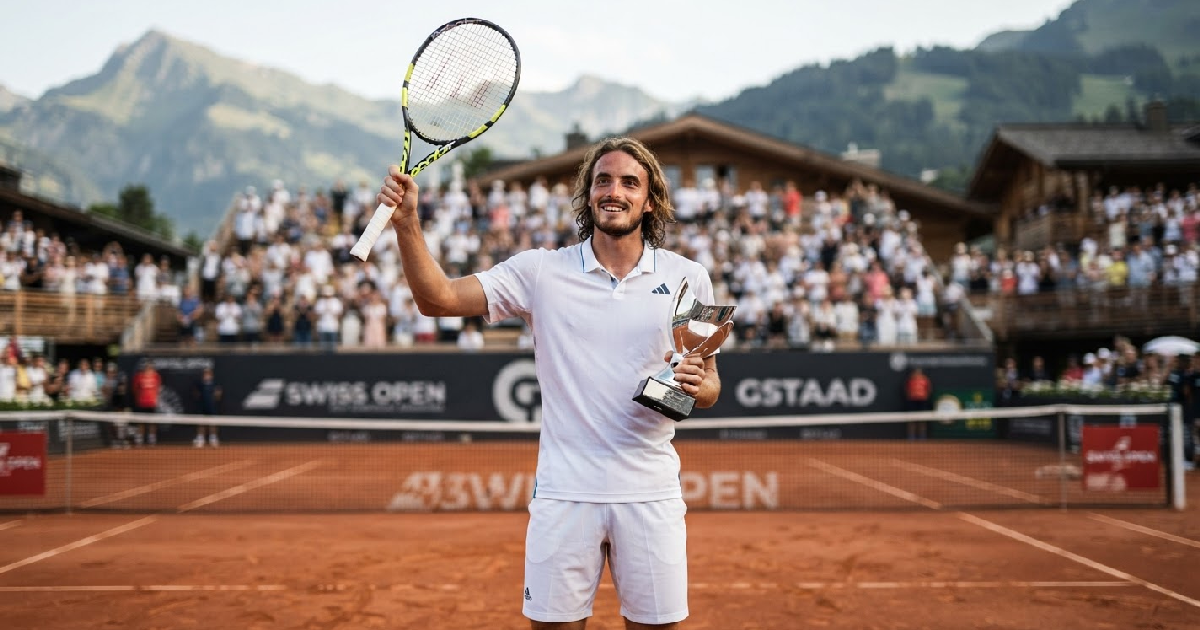
Stefanos Tsitsipas commits to Babolat racket for 2026 season after Swiss Open win
Greek tennis star Stefanos Tsitsipas recently ended a 505-day ATP title drought, securing his 13th career trophy at the Swiss Open in Gstaad on Sunday. This victory comes as Tsitsipas makes a definitive racket decision, officially transitioning to the Babolat Pure Aero 98 for the 2026 season, a strategic move aimed at revitalizing his performance after a challenging 2025 campaign.
The two-time Grand Slam finalist defeated Raphael Collignon 6-4, 6-7, 6-3 in the Gstaad final, marking his first ATP title in over 16 months. His commitment to the new Babolat racket, widely reported by Greek tennis website Tennis24, is a significant shift after using Wilson equipment throughout his professional career.
Tsitsipas embraces Babolat Pure Aero 98
Stefanos Tsitsipas has made a complete overhaul of his equipment, moving from his long-standing Wilson Blade 98 to the Babolat Pure Aero 98 ahead of the 2026 season. This change signifies the end of a long partnership with Wilson, a brand he had used since turning professional.
The definitive switch to the Babolat Pure Aero 98 was made during the 2025 preseason, with reports of the change emerging around late December 2025. He first experimented with a blacked-out Babolat prototype in February 2025, when he notably won the ATP 500 title at the Dubai Tennis Championships, a significant highlight in an otherwise difficult year.
Engineering for power and spin
The choice of the Babolat Pure Aero 98 is a deliberate tactical move, as this model is well-known for its ability to generate substantial power and spin. This aligns perfectly with the evolving demands of modern professional tennis, where these attributes are increasingly crucial for success.
Compared to his previous Wilson Blade 98, which featured an 18×20 string pattern, the Babolat Pure Aero 98 boasts a more open 16×20 string pattern. This design is specifically engineered to enhance spin potential and deliver easier access to power, which could particularly benefit his renowned one-handed backhand.
Tsitsipas has also changed his strings to complement the new racket, indicating a comprehensive approach to his equipment adjustment. He cited improved comfort and greater adaptability to varying tennis balls and court speeds as key reasons for the overhaul, expressing confidence that the new racket has added a “notch” to his game in terms of speed, RPMs, and power.
Navigating a difficult 2025 season
The 2025 season proved to be particularly challenging for Stefanos Tsitsipas, as his performance saw a notable dip across the tour. He concluded the year ranked 34th in the ATP Rankings, marking his lowest year-end position since 2017.
Throughout 2025, Tsitsipas recorded an underwhelming 22-18 win-loss record and finished outside the top 10 of the ATP Rankings for a second consecutive year. A recurring back issue also hampered his play during the latter half of the season, contributing to his struggles for consistency.
Before his victory at the Dubai Tennis Championships in February 2025, his last semi-final appearance had been seven months prior, and his last final ten months prior. The Dubai win, achieved with the experimental Babolat prototype, stood out as one of his few positive results in what was largely described as an “unsuccessful” year.
Coaching team adjustments
Beyond the equipment changes, Tsitsipas has also restructured his coaching setup, a recurring theme throughout his career. In June 2026, he permanently ended his coaching partnership with his father, Apostolos Tsitsipas, who had been his primary mentor for many years.
Tsitsipas stated that his father’s presence was “no longer helping him evolve as a player,” signaling a clear need for a new direction. This decision followed a brief two-month coaching stint in 2025 with Goran Ivanišević, after which he had briefly returned to his father’s guidance.
He is now working under the guidance of Thomas Perrin, with renowned coach Patrick Mouratoglou providing supervision. These significant personnel changes, alongside the equipment overhaul, demonstrate Tsitsipas’s determined effort to regain his top form and competitive edge.
The 2019 racket narrative revisited
While reports, including comments from Nick Monroe on the ‘Big T Podcast’, suggested Tsitsipas was returning to a specific “2019 racket” he used when he won the ATP Finals, the definitive information points to a new Babolat model. The narrative of revisiting a successful period, however, highlights his desire to recapture past glory.
In 2019, the year he won the ATP Finals, Tsitsipas notably used a Wilson Blade 98 18/20. His pro stock version of this racket was a substantial piece of equipment, weighing approximately 340 grams strung, with a swing weight of 339, and strung with Luxilon 4G at around 24 kg (53 lbs).
The current switch to the Babolat Pure Aero 98 represents a new engineering choice rather than simply retrieving an identical older model from storage.
This is not Tsitsipas’s first equipment experimentation; he previously changed rackets before winning in Dubai last year, only to revert soon after. However, the current commitment to the Babolat Pure Aero 98 appears to be a more resolved and strategic decision, focusing on tangible benefits for his game rather than a nostalgic return to specific older gear.
Looking ahead: building momentum in 2026
With the Swiss Open title now secured and the Babolat Pure Aero 98 firmly in his hands, Stefanos Tsitsipas is focused on building significant momentum for the rest of 2026. The confidence boost from breaking his long title drought, combined with the reported physical benefits and enhanced playability of his new racket, could prove pivotal.
His 2026 season is set to begin at the United Cup, where he’ll team with fellow Greek player Maria Sakkari. Following that, he’s expected to participate in the Adelaide International before heading to the Australian Open. These early tournaments will serve as crucial testing grounds for his new equipment and coaching dynamic, as he aims to climb back up the ATP Rankings.
The tennis world will be watching closely to see if these comprehensive adjustments, including his renewed focus on specific racket characteristics, will finally unlock his full potential. Tsitsipas, at 27 years old, remains a formidable talent capable of challenging for Grand Slam titles, and this equipment shift is a clear statement of intent.