

New Honda F1 Engine Debuts Early with Aston Martin
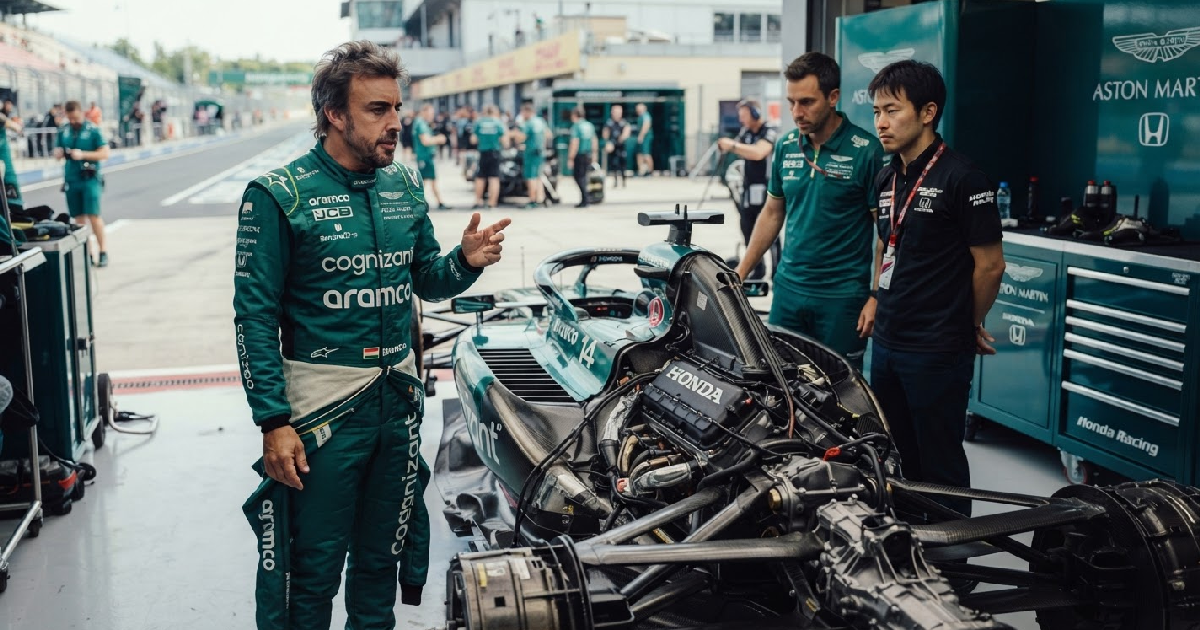
Formula 1 is seeing a crucial technical step as Honda announced the early track debut of its new F1 engine. It will run with Aston Martin during a filming day this Wednesday at the Hungaroring, a move that pushes the updated power unit onto the tarmac ahead of its planned race introduction.
The official debut of the engine was slated for the Dutch Grand Prix, scheduled for August 21-23. But this accelerated schedule provides Aston Martin a vital window to gather critical initial data and integrate the advanced engine into their AMR26 chassis.
Aston Martin to run new Honda F1 engine at Hungaroring
Honda’s advanced F1 power unit, originally slated for its competitive debut after the Formula 1 summer break, will now undergo its initial shakedown at the Hungaroring. This pivotal test takes place on Wednesday at the same venue that recently hosted the Hungarian Grand Prix.
This early rollout allows both Honda and Aston Martin to collect essential real-world performance data. They can also assess the engine’s integration with the B-spec AMR26, which already demonstrated significant pace improvements in Hungary.
Why an early engine shakedown matters
While a filming day inherently restricts the amount of running and the types of tyres allowed, it still offers invaluable information. Teams routinely use these controlled sessions to check systems, gather initial aerodynamic data, and ensure seamless operation of new components.
For Honda, this presents a crucial opportunity to validate months of engine development and collect vital real-world data. This step is particularly essential before the power unit’s official competitive debut.
Shintaro Orihara, Honda trackside general manager and chief engineer, confirmed the revised timeline. “In Hungary, we have been supporting the team with the power unit integration,” Orihara stated, detailing the collaborative pre-existing efforts. He added that they’ve “also been able to collect vital data, which will help us come to the next race.”
Context from the Hungarian Grand Prix performance
The timing of the new Honda F1 engine’s debut couldn’t be more opportune for Aston Martin. The team unveiled a significantly updated B-spec AMR26 car at the Hungarian Grand Prix, which immediately delivered positive results on track.
The improvements were clear in both qualifying and race trim, providing a much-needed boost. Lance Stroll, Aston Martin’s Canadian driver, finished 13th in Budapest, impressively placing directly ahead of his more experienced teammate, Fernando Alonso.
Fernando Alonso’s optimistic outlook for AMR26
Two-time world champion Fernando Alonso managed to break into Q2 for the first time this year during Hungarian GP qualifying. His performance signaled a genuine uptick from the team’s recent struggles, injecting renewed confidence into the Aston Martin garage.
Alonso acknowledged the positive impact of the B-spec car. “I think it was a good step forward, both in quali and the race,” he said, reflecting on the weekend. “So yes, a new baseline to work with for the second part of the year.”
The veteran Spaniard also expressed satisfaction with the team’s development efforts. “The correlation is good and the performance gains are there, what we expect,” Alonso confirmed. This indicates that simulated improvements are translating effectively to on-track results, a critical validation for any Formula 1 team.
Outperforming key F1 rivals in Hungary
Alonso also noted the AMR26’s potential. “It’s obviously early days with this new car. It’s a completely new car, new concept, so more to come maybe on setup, optimisation and things like that.” This suggests there’s still untapped performance within the new package that the team can unlock.
The Hungarian outing saw Aston Martin outperform rivals such as Cadillac, Williams, and Haas. This performance uptick creates a strong foundation for integrating the new Honda power unit. Alonso is keenly anticipating the next race, stating, “next race is also with the engine upgrade, will be an interesting check in Zandvoort, where we are and what we can fight for.”
Strategic implications for the F1 season
Honda had previously lined up the first race after the F1 summer break, the Dutch Grand Prix, as the event it would deliver its power unit updates. This would be its first permitted under the Approved Development Unit Homologation (ADUO) regulations.
But the decision to run it during a filming day now shows a strategic effort to gain an early advantage. Orihara further elaborated on the early introduction, confirming the immediate plans. “Before then, during Wednesday’s filming day, we will run the new engine in the AMR26 for the first time, before the summer shutdown commences,” he said.
Navigating ADUO regulations with early testing
ADUO is a crucial regulatory framework governing engine development in Formula 1. It dictates when manufacturers can introduce upgrades to their power units throughout the season, aiming to control costs and maintain competitive balance among the teams.
The early filming day provides a critical dress rehearsal for the new engine. It helps ensure any potential integration issues can be identified and addressed away from the intense pressure of a race weekend. This careful preparation aims to hit the ground running at Zandvoort.
Honda and Aston Martin’s shared future ambitions
This early engine debut marks a pivotal moment for the Aston Martin-Honda partnership. It demonstrates a shared commitment to aggressive development and a desire to climb the Constructors’ Championship standings in Formula 1.
The synergy between the improved AMR26 chassis and the upgraded Honda power unit could unlock significant performance gains. As teams head into the second half of the season, every tenth of a second will undoubtedly count in the fierce battle for points and prestige.
This aggressive testing schedule, particularly with a significant update like a new power unit, underscores the relentless development race in Formula 1. Teams are constantly pushing boundaries to find marginal gains, and a new power unit specification represents a substantial leap in performance potential.
Looking ahead to the Dutch Grand Prix
The Dutch Grand Prix at Zandvoort, scheduled for August 21-23, will serve as the true competitive test for this combined package. It’s a circuit renowned for its challenging corners and passionate home crowd, making it a demanding debut for any new component.
The next few races, starting with Zandvoort, will provide a clearer picture of just how much ground Aston Martin and Honda have gained. Their proactive filming day aims to maximize their potential as the competitive season progresses.
While Red Bull and McLaren currently dominate headlines, improvements from teams like Aston Martin could tighten the midfield battle even further. A stronger Aston Martin means more competition for points and potentially more unpredictable race outcomes as the championship continues.