

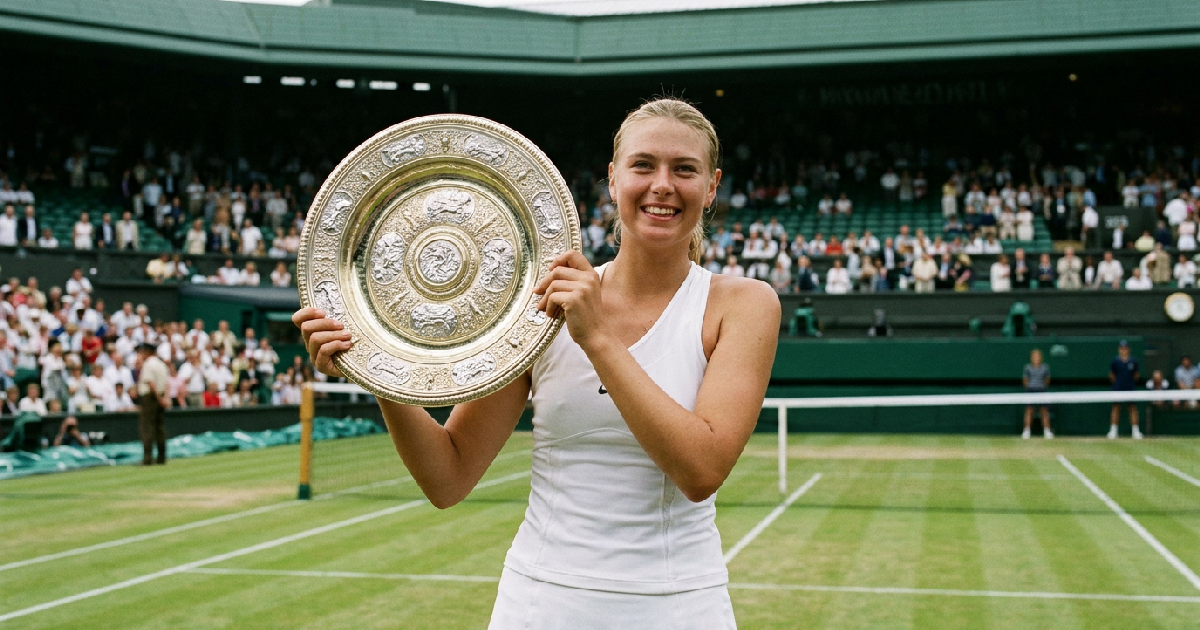
Maria Sharapova’s Shock 2004 Wimbledon Final Victory Over Serena Williams
On July 3, 2004, a then 17-year-old Maria Sharapova delivered one of tennis’s most stunning Grand Slam upsets, defeating two-time defending champion Serena Williams in the Wimbledon final. The Russian teenager, making her debut in a major championship match, secured the Venus Rosewater Dish with an emphatic 6-1, 6-4 victory on Centre Court.
This momentous win not only marked Sharapova’s first career Grand Slam title but also brought an end to Williams’s impressive 20-match winning streak at the All England Club, a run that had extended since 2001. The unexpected triumph instantly catapulted Sharapova from a rising prospect into a global sporting phenomenon, changing the trajectory of her career and the landscape of women’s tennis.
The historic Wimbledon upset
The 2004 Wimbledon final saw Serena Williams, a dominant force who had claimed the previous two titles at SW19 by beating her older sister Venus, arrive as the overwhelming favorite. However, Maria Sharapova, who had impressively overcome former champion Lindsay Davenport in a hard-fought semi-final (2-6, 7-6, 6-1), was brimming with confidence.
Spectators on Centre Court were ready for a fierce baseline battle, a clash between Williams’s raw power and Sharapova’s flat, piercing groundstrokes. The British crowd quickly took notice of Sharapova’s aggressive style and vocal grunts, a hallmark that would define her competitive presence for years.
From the outset, Sharapova displayed remarkable composure, showing no signs of nerves despite the enormity of the occasion. She attacked almost every ball, dictating rallies with pace and precision. Williams, visibly surprised by the Russian’s rapid ball striking, committed more unforced errors than usual.
Sharapova capitalised fully on these mistakes, hitting numerous winners to seize the opening set convincingly, 6-1. It was a statement performance that immediately put the American on the back foot, confounding expectations for what many presumed would be a routine Williams victory.
Key details
Serena Williams, a competitor of unparalleled tenacity, mounted a vigorous fightback in the second set. She managed to break Sharapova’s serve, establishing a 4-2 lead and appearing to regain control of the match. But the Russian showed immense resolve, breaking back immediately to level the score.
The turning point in the second set came with the score at 4-4. Williams poured all her strength into a lengthy 14-point game, battling to hold her serve. Despite saving three break points, she eventually succumbed, losing her serve and handing Sharapova the crucial advantage.
Sharapova remained laser-focused, serving out the match moments later after Williams missed a final return. The victory wasn’t just a win; it was a coronation. She was no longer just “the new Kournikova” but Maria Sharapova, Wimbledon champion, the first Russian woman to triumph at the All England Club, and the third youngest woman to win there in the Open Era.
Her initial reaction was pure, unadulterated joy. Sharapova briefly knelt on the hallowed grass before shaking hands with Williams. She then climbed into the stands to embrace her father, Yuri, and attempted to call her mother, Yelena, who was in Florida, though bad reception foiled that final celebratory attempt.
Sharapova’s meteoric ascent and public profile
Maria Sharapova’s journey to professional tennis stardom began at a very young age. Born in Siberia in 1987, she started playing tennis in Sochi before her father, Yuri, moved her to Florida when she was just seven, aiming to provide her with the best possible training opportunities. She turned professional at 14, swiftly climbing inside the top 200 within a year.
Her breakthrough season arrived in 2003, featuring a semi-final appearance in Birmingham and a fourth-round run at Wimbledon, where she fell to Svetlana Kuznetsova in a tight three-setter. That same year, she clinched her first two WTA titles in Tokyo and Québec, finishing the season ranked world No. 32.
Leading up to her historic Wimbledon victory in 2004, Sharapova had already shown her grass-court prowess by winning in Birmingham, defeating Tatiana Golovin in the final. These early successes, coupled with her striking appearance, led to frequent comparisons with fellow Russian player Anna Kournikova.
Sharapova, however, always dismissed these comparisons. Kournikova, despite her immense popularity and similar blonde, tall physique, never won a professional title and transitioned more into a modelling career. Maria was resolute in her ambition to be a Grand Slam champion, a path she decisively validated on that July afternoon.
Serena Williams’ reign before the upset
Serena Williams, born in 1981, was already a titan of the sport by 2004. Her older sister, Venus Williams, had boldly predicted early in her own career in 1997 that Serena would be her main rival for the top ranking. Experts initially doubted the claim, but Venus’s foresight quickly proved accurate.
Serena’s true breakthrough year was 1999. She secured her first title in Paris Coubertin at 17, beating Amelie Mauresmo, and reached the Miami final in the first-ever all-sister final, losing to Venus. More significantly, she claimed her first Grand Slam title at the US Open, beating Martina Hingis in the final, a feat achieved before her older sister.
Between the 2002 French Open and the 2003 Australian Open, Serena achieved an extraordinary feat known as the “Serena Slam.” She won all four Grand Slam tournaments consecutively, defeating Venus in each of those major finals. It was a period of unparalleled dominance that cemented her status as the world’s premier player.
However, 2004 presented some challenges for Williams. She had undergone knee surgery at the end of 2003 and appeared somewhat less dedicated to tennis, exploring other interests including fashion. Despite this, she had recently reached the quarter-finals at Roland-Garros, signalling she was still a formidable contender at any major.
The enduring allure of the All England Club
Wimbledon stands as the oldest and arguably most prestigious tennis tournament globally, held annually by the All England Lawn Tennis and Croquet Club since 1877. The tournament moved to its current iconic location in 1922, which also saw the construction of its revered Centre Court.
This court, with its famous Rudyard Kipling quote above the entrance, has been the battleground for countless legendary matches and champions.
Distinctly, Wimbledon has maintained its original grass surface, a characteristic that sets it apart from other Grand Slams. While the US Open and Australian Open transitioned to hard courts in the 1970s and 1988 respectively, Wimbledon has steadfastly preserved its traditions. These include its unique surface, which often favours serve-and-volley players, and its iconic all-white dress code, adding to its timeless charm and challenge.
The aura of playing on Centre Court, particularly in a final, is immense. It’s a stage where pressure can overwhelm even the most seasoned champions. For a 17-year-old making her debut, the mental fortitude required to perform at Maria Sharapova’s level was extraordinary. It underscored her immense potential and her steely determination that day.
Legacies forged and future rivalries defined
Maria Sharapova’s stunning Wimbledon triumph marked the beginning of a remarkable career, though her rivalry with Serena Williams would take a very different turn. While Sharapova did defeat Williams again at the 2004 Masters Cup (4-6, 6-2, 6-4), that victory proved to be her last against the American.
Serena would go on to win their next 19 encounters, often dominating the Russian in straight sets. Current tennis events still see major players facing tough challenges, much like Serena did that day.
Sharapova, however, continued to build an impressive legacy. She reached world No. 1 for the first time in August 2005, holding the top spot for a total of 21 weeks throughout her career, last in July 2012. She also became one of the highest-paid female athletes globally, leveraging her on-court success into significant endorsement deals.
Her career culminated in achieving a coveted career Grand Slam, winning all four major titles. After Wimbledon, she triumphed at the US Open in 2006 (defeating Justine Henin 6-4, 6-4), the Australian Open in 2008 (edging Ana Ivanovic 7-5, 6-3), and the French Open in both 2012 (beating Sara Errani 6-3, 6-2) and 2014 (overcoming Simona Halep 6-4, 6-7, 6-4).
Key details
Her career wasn’t without its obstacles. Repetitive shoulder injuries plagued her, particularly impacting her 2009 and 2010 seasons. Later, in 2016, she faced a 15-month doping ban following a failed drug test. Despite a determined return in 2017, climbing back to world No. 25 and reaching the 2018 French Open quarter-finals, she ultimately retired in February 2020.
Serena Williams, on the other hand, continued to amass an unparalleled record. She added five more Wimbledon crowns to her collection in 2009, 2010, 2012, 2015, and 2016. These seven Wimbledon titles contributed to her Open Era record of 23 Grand Slam singles titles overall, a testament to her enduring dominance in the sport.
Her final Grand Slam title came at the 2017 Australian Open, where she famously defeated her sister Venus for the seventh time in a major final, 6-4, 6-4, while pregnant. After taking a break for maternity leave, she returned to the tour in 2018.
Though she reached four Grand Slam finals as a mother, much like other athletes facing intense competition, she wasn’t able to secure another major title before her eventual retirement.
The 2004 Wimbledon final remains a pivotal moment, not just for the immediate shock of the outcome, but for setting the stage for two careers that would define an era of women’s tennis. Sharapova’s youthful triumph ignited a global brand, while Williams’s response to the defeat showcased the resilience that fuelled her unparalleled success over two decades.