

jaguars defense challenges eagles offense oct 11 2026
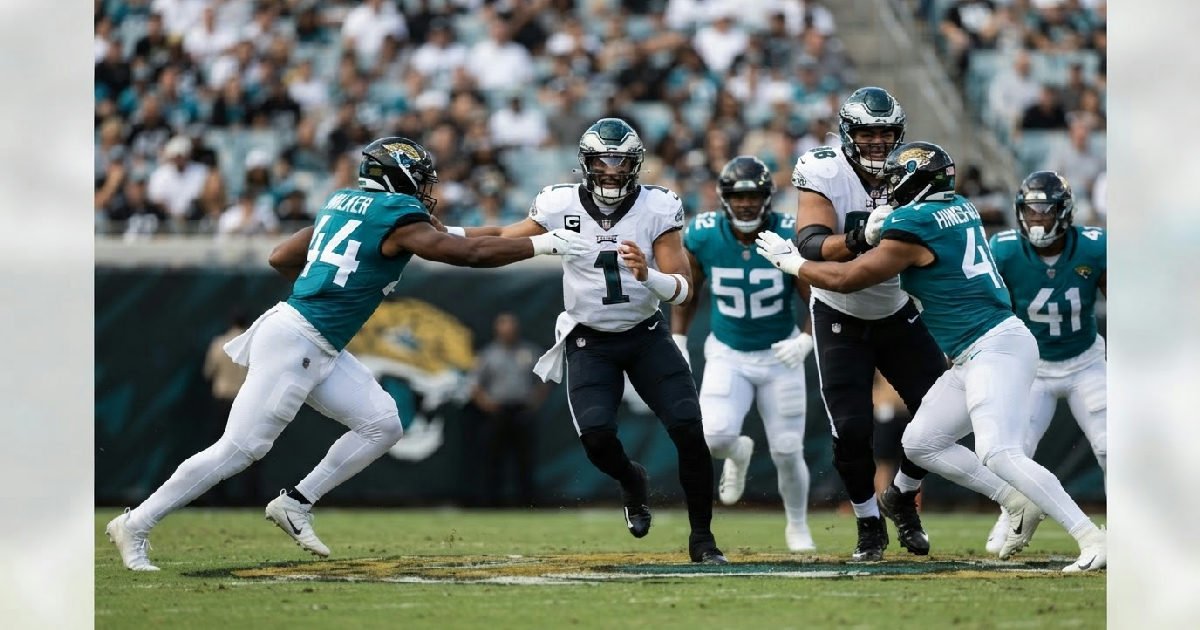
The formidable Jacksonville Jaguars’ defense poses a significant challenge for the Philadelphia Eagles’ offense, necessitating a sharp strategic shift ahead of their impending clash. An in-depth film preview, released today, October 11, 2026, meticulously examines the Jaguars’ well-coached unit, emphasizing its capability to disrupt opposing schemes and expose any offensive inconsistencies.
This analysis spotlights crucial matchups involving key players like Josh Hines-Allen, Travon Walker, Jordan Mailata, and Jalen Hurts, whose performances are poised to determine the game’s outcome.
Jaguars defense challenges Eagles’ pass rush
Philadelphia’s offense, which has grappled with maintaining consistency this season, confronts a defense excelling in fundamental play. The Jaguars can generate substantial pressure with just four rushers, deploy diverse coverages, and make running the football exceptionally difficult.
These factors create a high-stakes scenario where the Eagles must protect their quarterback long enough to exploit any secondary vulnerabilities. This tactical challenge highlights the critical nature of strategic decisions in sports.
At the core of the Jacksonville Jaguars’ defensive prowess is their ability to generate significant pass rush without frequently resorting to blitzes. Their pressure rate stands at 36.5% through four games, despite blitzing on only 26.9% of dropbacks. This efficiency grants defensive coordinator Anthony Campanile considerable freedom, with seven defenders available to cover routes behind the front.
This approach compels opposing offensive coordinators to constantly account for pressure, even when facing standard four-man rushes. It complicates protection schemes and demands swift decisions from the quarterback. The Eagles, in particular, will need their offensive line to be exceptionally disciplined to avoid breakdowns leading to sacks or hurried throws.
The freedom Campanile gains by not needing to blitz heavily allows him to deploy complex coverage rotations and disguise his intentions pre-snap. This can confuse quarterbacks attempting to read the defense, potentially leading to miscommunications with receivers or holding the ball too long against an incoming rush.
Key Jaguars Defensive Metrics (Through 4 Games)
Elite Edge Rushers Create Havoc
Josh Hines-Allen stands out as the Jaguars’ premier pass rusher, routinely operating from the defensive right on approximately 83% of his pass-rush snaps. This predictable alignment sets up a direct and challenging matchup for Philadelphia Eagles left tackle Jordan Mailata.
Mailata will bear a significant burden, as providing consistent help on both edges could limit the Eagles’ ability to send enough receivers downfield to stretch the defense.
Travon Walker adds another dimension to the Jaguars’ defensive line. While he primarily rushes from the defensive left, often pitting him against Eagles right tackle Markel Bell, Walker also demonstrates versatility. He moves to the opposite side and shifts inside, meaning the Eagles cannot assume the two primary threats will remain on opposite edges. They must precisely identify and communicate the danger on every snap.
Pressure Without the Blitz
The Jaguars’ capacity to generate pressure with just four rushers frees up their coordinator to drop more players into coverage, a luxury not often afforded to teams heavily reliant on the blitz. This strategic advantage means quarterbacks face discomfort even when the Jaguars aren’t sending five or six defenders. It also allows them to show blitz looks, potentially creating confusion, before dropping players into coverage.
Eagles quarterback Jalen Hurts will need robust protection checks and immediate passing options available, even against a defense that typically rushes four. Film analysis reveals instances where Travon Walker and Josh Hines-Allen line up together, still generating pressure with four rushers. This highlights the sophisticated nature of their defensive fronts, aiming to collapse the pocket and prevent the ball from getting out.
Secondary Presents Mixed Bag for Eagles’ Attack
While the Jaguars’ pass rush often masks some of their secondary issues, there are identifiable strengths and weaknesses for the Eagles to consider. Their backfield employs a variety of zone coverages, including Cover 3, Cover 4, and Cover 6. They often rotate from a two-high shell into Cover 1 or Cover 3 post-snap, meaning Hurts cannot rely on pre-snap reads alone to determine safety alignments.
This post-snap movement necessitates that Jalen Hurts processes information quickly and accurately, often requiring him to make throws into tight windows or adjust his target based on evolving coverage. Receivers must also adeptly recognize these rotations and adjust their routes accordingly. This demands excellent chemistry and timing within the passing game.
The fluid nature of these coverages means that what appears to be an open lane pre-snap can quickly close, making deep shots a riskier proposition if protection isn’t sustained. The Eagles will need to employ schemes that either attack these zones before they fully develop or exploit the seams that emerge during coverage transitions.
Travis Hunter’s Impact and Emerging Talent
The development of Travis Hunter into an outstanding cornerback has significantly bolstered the Jaguars’ secondary. Hunter exhibits exceptional ball skills and athleticism, allowing him to close space rapidly and attack the football effectively. He’s proven particularly adept at the catch point, making contested throws a high-risk proposition for opposing quarterbacks.
However, Hunter is still a young player. Veteran receivers have occasionally exploited moments of hesitation as he turns, or used physical contact to disrupt his balance. He can also be overly aggressive in jumping routes. Despite these minor flaws, challenging Hunter with hopeful, contested throws remains a dangerous strategy for any offense.
Exploitable Corners and Deep Ball Opportunities
Conversely, Jarrian Jones and Montaric Brown appear to be more inviting matchups within the Jaguars’ secondary. Film review indicates that Jones struggles with locating the football and defending vertical routes, a weakness opponents have consistently targeted. The Eagles could aim to force him into turning and running downfield, compelling him to find the ball in flight.
Montaric Brown, another outside corner, has also allowed significant gains, with speed identified as a primary concern in his scouting profile. Since both Jones and Brown play on either side, the Eagles’ receivers will need to identify their specific matchup on each play rather than assuming a fixed pairing.
Opportunities behind aggressive safeties, especially on post routes, have also surfaced. The Jaguars’ deep-pass EPA allowed ranks 25th through four games, confirming that explosive plays downfield are possible, provided the protection holds up long enough for routes to develop.
Stifling Run Defense Demands Offensive Creativity
The Jaguars’ run defense is exceptional, largely due to the disruptive presence of nose tackle DaVon Hamilton. He proves difficult to move, effectively blowing up inside runs before offensive lines can establish their blocks. This disruption funnels ball carriers, keeping linebackers like Ventrell Miller free to make plays.
Hamilton’s ability to consistently occupy multiple blockers or penetrate the backfield directly forces running backs to alter their intended paths. This often sends them into the waiting arms of unblocked linebackers, fundamentally breaking down the core principles of most run schemes. These schemes typically rely on creating clear lanes for ball carriers.
The ripple effect of Hamilton’s dominance means the Jaguars’ linebackers, particularly Ventrell Miller, are consistently clean to scrape and make tackles. This collective strength up the middle severely limits an offense’s ability to gain consistent yardage on the ground, placing immense pressure on the passing game to pick up the slack.
Interior Dominance and Linebacker Support
DaVon Hamilton’s ability to command the interior makes him a cornerstone of the Jaguars’ run-stopping unit. He stifles rushing lanes, enabling the linebackers to remain in position and finish tackles. This central force significantly reduces an offense’s ability to create space through the middle.
Ventrell Miller consistently impresses with his sideline-to-sideline movement and reliable tackling in space. Josh Hines-Allen also contributes effectively as a strong run defender on the edge. This combination of interior disruption and active pursuit makes conventional rushing attempts extremely challenging to sustain against Jacksonville.
Under-Center Runs Face Uphill Battle
Running against the Jaguars from under-center formations has been particularly unproductive. Through four games, these attempts have yielded just 167 yards on 58 carries, averaging a mere 2.88 yards per attempt. This statistic serves as a stark warning for an Eagles offense that has already struggled to establish its under-center run game this season.
The film preview strongly suggests this is not the week to force this particular approach.
Eagles’ Strategic Adjustments for Offensive Success
Despite the Jaguars’ defensive strengths, clear pathways exist for the Eagles to move the football. The key lies in strategic adjustments that mitigate Jacksonville’s advantages and exploit their aggressions. The Eagles must ensure their protection schemes can hold up against the formidable front, allowing Jalen Hurts time to target the secondary’s identified weak points.
Successful execution will depend heavily on the offensive line’s ability to communicate effectively and pick up stunts and twists from the Jaguars’ defensive front. Any miscommunication could lead to immediate pressure on Hurts, negating any opportunities to attack downfield against the secondary.
Beyond protection, the Eagles must leverage their own offensive strengths to create mismatches. This involves not just individual player matchups but also strategic play-calling that puts players in advantageous positions. It forces the Jaguars’ defense to react rather than dictate the terms of engagement.
Embracing Misdirection and Shotgun Formations
The Jaguars’ aggressive style of flowing to the football can be turned against them through misdirection. Offenses have found success using plays like pin/pull, reverses, and involving the quarterback to get defenders moving one way before attacking the backside. Receiver reverses, in particular, appear to be a valuable addition to the Eagles’ game plan, capitalizing on the Jaguars’ tendency to overcommit.
Shifting to a heavy shotgun formation would also spread the defense out, using motion and misdirection to make linebackers hesitate. This approach forces the Jaguars to react more cautiously, potentially creating seams for both the run and pass game. The goal is to slow down their aggressive pursuit and prevent them from dictating the tempo.
Jalen Hurts’ Crucial Role in the Run Game
This matchup calls for a significant increase in Jalen Hurts’ involvement in the run game. As a dual-threat quarterback, Hurts can effectively change the numbers in the running attack. This forces backside defenders to account for more than just the running back.
Opposing scrambles have generated positive EPA against the Jaguars, indicating that quarterbacks have found opportunities once they break containment. His ability to alter the game’s mechanics of engagement could prove vital.
While not a guarantee that every designed quarterback run will succeed, this adds compelling evidence for integrating Hurts more actively into the rushing attack. It provides a dynamic element that traditional run schemes might lack against this stout defense. I am just not particularly hopeful we will see enough of it.
Looking Ahead: Eagles Must Adapt
The film preview underscores that while the Jacksonville Jaguars’ defense is formidable, a clear route exists for the Philadelphia Eagles to move the football. Success hinges on robust pass protection, enabling Jalen Hurts to exploit weaknesses in the secondary. This includes targeting Jarrian Jones and Montaric Brown, and the spaces behind aggressive safeties.
Simultaneously, the Eagles must diversify their run game, shifting away from predictable under-center approaches towards shotgun formations, misdirection, and leveraging Hurts’ rushing abilities.
The primary concern remains the Jaguars’ front versus the Eagles’ protection. This will not be an easy contest. It would be incredibly frustrating if the Eagles were to repeat past mistakes, relying on a struggling under-center outside zone game and hoping a depleted passing game can bail them out on third down.
The opportunities to attack this defense are present, but Philadelphia’s offense must demonstrate a willingness and ability to adjust their strategy comprehensively.
Frequently Asked Questions
- What is the main strength of the Jacksonville Jaguars’ defense?
- Their ability to generate significant pass rush with only four rushers, allowing them to drop more defenders into coverage and confuse opposing quarterbacks.
- Who are the key players on the Jaguars’ defensive line?
- Josh Hines-Allen and Travon Walker are elite edge rushers, while nose tackle DaVon Hamilton anchors their stout run defense.
- What are some potential weaknesses in the Jaguars’ secondary?
- Cornerbacks Jarrian Jones and Montaric Brown have shown vulnerabilities, particularly against vertical routes and speed. They also rank 25th in deep-pass EPA allowed.
- How should the Eagles adjust their run game against Jacksonville?
- They should avoid predictable under-center runs, instead focusing on shotgun formations, misdirection, and heavily involving Jalen Hurts in the rushing attack.
- What is Jalen Hurts’ crucial role in this matchup?
- Hurts needs to make quick decisions against varied coverages, exploit secondary weaknesses when protection holds, and actively contribute to the run game to create numerical advantages.