

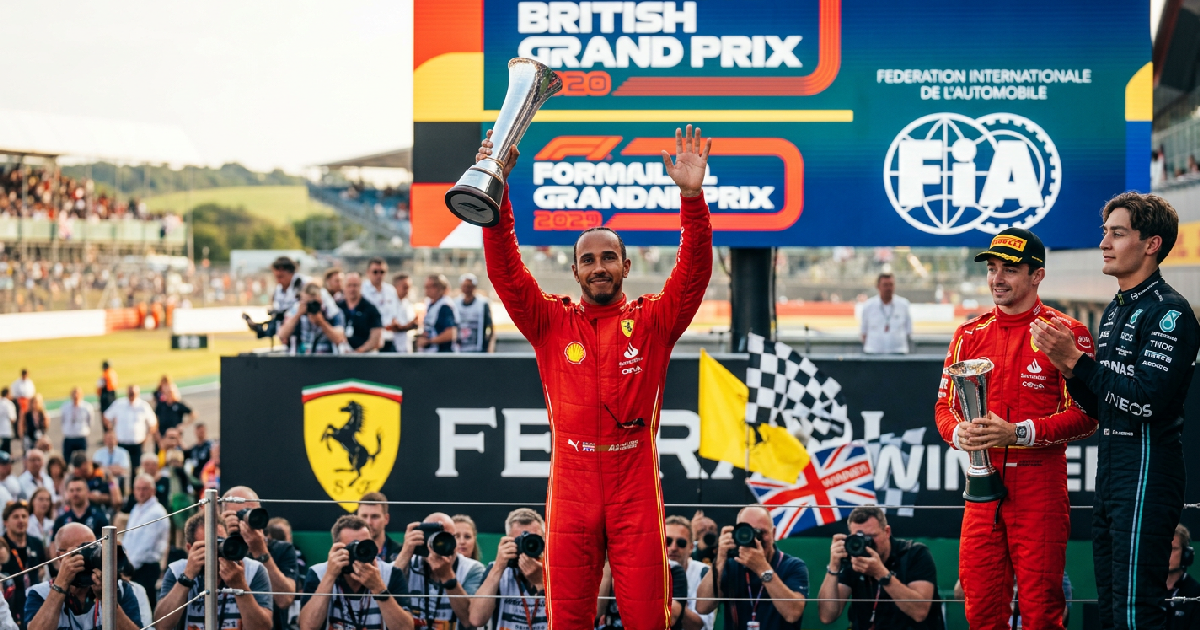
FIA confirms Sir Lewis Carl Davidson Hamilton
FIA Confirms Sir is at the centre of this story. Sir Lewis Carl Davidson Hamilton, the Ferrari Formula 1 driver, will keep his third-place finish at the British Grand Prix, held on Sunday, July 5, 2026, at the Silverstone circuit in Northampton, England. FIA race stewards issued a reprimand to Hamilton, opting against a more severe penalty after a yellow-flag infringement.
This decision means the seven-time world champion retains his podium spot, finishing behind his Ferrari teammate, race winner Charles Leclerc, and Mercedes driver George Russell, who secured second place. The outcome followed a tense post-race investigation by the FIA into the incident.
FIA Confirms Sir: Hamilton Cleared After Silverstone Yellow Flag Incident
The FIA race stewards convened at 5:00 PM BST, immediately following the podium ceremony, to review the alleged yellow-flag violation involving Car 44, driven by Lewis Hamilton. The infringement occurred at 4:03:34 BST when Hamilton passed the stranded Audi of Nico Hulkenberg in Turn 9.
Hamilton himself had anticipated a harsher outcome. He told Sky Sports F1 after seeing the stewards, “I’m probably going to get a penalty right now as well, so I’ll probably lose [it]. I went through a yellow flag and I didn’t see it.” He also added, “Jumped the start, yellow flag – when it rains, it pours,” underscoring his challenging race.
Stewards’ Detailed Rationale for Reprimand
The stewards’ panel, comprising Gerd Ennser, Tanja Geilhausen, Mathieu Remmerie, Pedro Lamy, and Richard Norbury, delved into the specifics of the incident. Their investigation found Hamilton entered the relevant sector in Turn 9 before any yellow flag or yellow light panel was displayed.
Key details
Crucially, the yellow indication on his steering wheel display only appeared once he was already on the straight towards Turn 10, close to the end of the yellow-flag zone. This meant Hamilton had “very limited” time to react to the changing conditions.
The stewards also acknowledged Hamilton’s distraction during the incident. He had been involved in a wheel-to-wheel battle with Red Bull driver Max Verstappen immediately prior to entering the sector. His attention remained directed to his mirrors for most of the straight towards Turn 10, anticipating a counter-attack.
Despite these mitigating factors, the stewards determined Hamilton “did not make a discernible reduction of speed” after the yellow was displayed on his steering wheel. This failure meant he did not fully comply with the requirements applicable under a single yellow flag, which mandates drivers to reduce speed.
However, considering the extenuating circumstances—the late yellow display, limited reaction time, and his battle with Verstappen—the stewards concluded a reprimand was the appropriate penalty. This is Hamilton’s first reprimand of the season.
Race Incidents and Hamilton’s Earlier Penalty
This yellow-flag reprieve was just one of several dramatic moments in the British Grand Prix for Lewis Hamilton. Earlier in the race, he received a five-second time penalty for a false start. Car 44 had moved after the third red light and before the official start signal, a clear violation of the rules.
That penalty was served during Hamilton’s first pit stop, extending it to a lengthy 8.8 seconds. This in-race sanction compounded the challenges he faced on track throughout the afternoon at Silverstone.
The race itself was eventful, featuring a late retirement from championship leader Kimi Antonelli. And a late accident for Red Bull driver Max Verstappen at Stowe triggered a Safety Car period. The race ultimately concluded under the Safety Car conditions.
The safety car period had a direct impact on Hamilton’s track position. He pitted for new tyres during this time, a strategic call that allowed Mercedes’ George Russell to gain track position by staying out. The safety car remained out until the finish, cementing Russell’s second place.
Ferrari’s Strong Showing and Championship Picture
Despite the drama, Ferrari secured a strong 1-3 finish at Silverstone, with Charles Leclerc taking the win and Lewis Hamilton holding onto third. This result provides a significant boost for Hamilton and the Scuderia. His confirmed podium finish reinforces Ferrari’s competitive standing.
The outcome also has considerable implications for the wider championship battle. Leclerc’s victory, coupled with Kimi Antonelli’s unfortunate retirement, means the points standings tighten. Every point, and every podium, proves crucial in what’s shaping up to be a tightly contested season, where controversial scorecards can decide outcomes in other sports too.
FIA Stewarding and Future Racing
The FIA’s detailed explanation for Hamilton’s reprimand highlights the complexities involved in F1 stewarding. They aim to balance strict adherence to regulations with the dynamic, split-second realities of competitive racing. Such decisions are constantly under scrutiny from teams, drivers, and fans.
The consistency and transparency of these rulings are paramount for the sport’s credibility. Stewards rotate to maintain impartiality, using multi-angle video, telemetry, and radio communications for their assessments. Their role in maintaining fairness is vital, especially when penalties are handed out, even minor ones like a reprimand.
Looking Ahead for Hamilton and Ferrari
With his British Grand Prix podium secured, Sir Lewis Hamilton now looks ahead to the remainder of the 2026 Formula 1 season. While a reprimand is a formal warning, it underscores the razor-thin margins and intense focus required at the pinnacle of motorsport.
The Ferrari team will be keen to convert strong qualifying performances and race pace into consistent podiums and victories. Hamilton’s extensive experience will be invaluable as Ferrari pushes to challenge for the Constructors’ Championship, as they navigate the season ahead. This constant pressure and focus are what define top-tier athletes, much like the struggles faced by injured baseball players striving to return to peak form.
The FIA, meanwhile, will continue its role in adjudicating incidents, often facing public and team pressure. Their detailed explanations are crucial in a sport where new rules and changes are always debated. Every race weekend brings new scenarios, testing the boundaries of both driver skill and regulatory enforcement.