

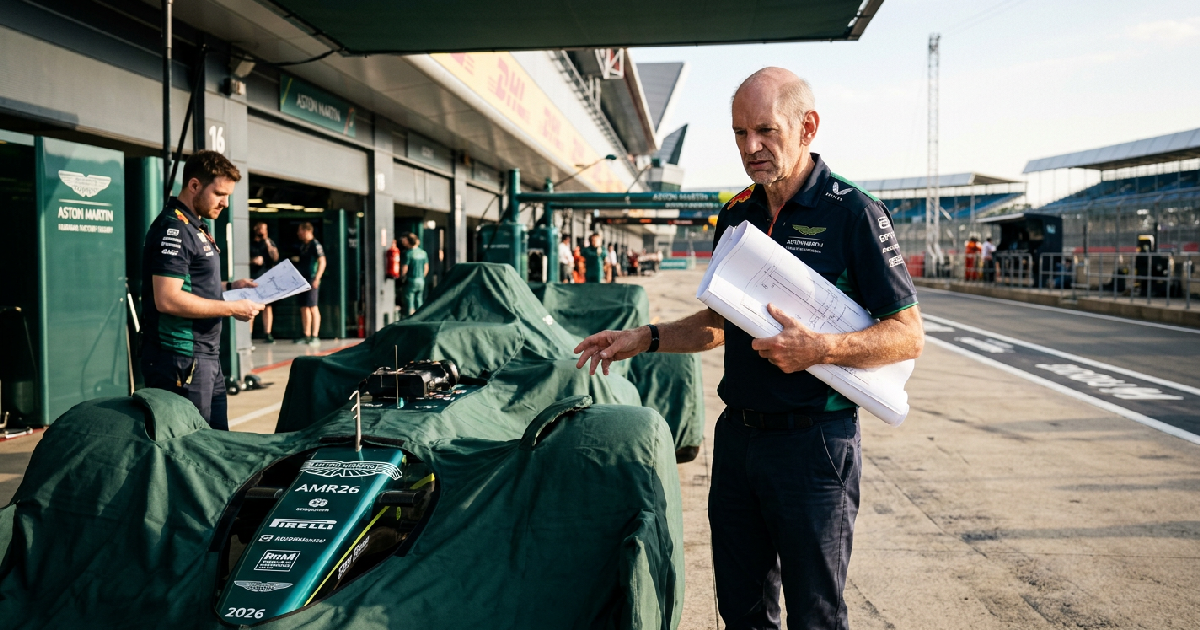
Adrian Newey reveals “not suitable” internal processes plagued Aston Martin’s F1 campaign
Managing Technical Partner Adrian Newey has identified a series of “not fit for purpose” internal processes as the primary reason for the Aston Martin Aramco Formula 1 Team’s disastrous 2026 campaign.
Speaking candidly about the squad’s decline into the slowest entry on the grid, Adrian Newey revealed that the AMR26 chassis is significantly overweight and aerodynamically compromised, exacerbated by reliability issues with the new Honda RA626H power unit.
Adrian Newey explains the 2026 technical disaster at Aston Martin
The admission marks a stark turning point for the Silverstone-based outfit, which now finds itself trailing the newcomer Cadillac team in performance.
The 2026 season was supposed to be the year Lawrence Stroll’s massive investment bore fruit, coinciding with the sport’s move to radical new technical regulations. Instead, a combination of late development starts and antiquated internal systems has left drivers Fernando Alonso and Lance Stroll languishing at the back of the pack.
Adrian Newey, who joined the project in 2025, admitted that the team’s growth in infrastructure had outpaced its organizational evolution, leaving talented engineers to work with tools that were effectively “patched and bodged for years.”
The root of the struggle lies in a misalignment between the team’s glossy public image and the reality of its engineering backend. While the team moved into a bespoke, state-of-the-art facility in Silverstone fairly recently, the software and procedural frameworks remained stuck in the past.
Adrian Newey noted that some of these legacy systems could be traced back to the original Jordan Grand Prix era. This technical debt manifested in a “frustrating” car build where parts were ordered late simply because the underlying management systems failed to notify the right people at the right time.
Aerodynamics and weight have become the twin pillars of the AMR26’s failure. Adrian Newey took personal responsibility for pushing a “bold” aerodynamic direction that backfired when the team lacked the time to explore alternative concepts.
Key details
Because the car did not enter the wind tunnel until April 2025—months after rivals had begun their simulations—the design was rushed. In the high-stakes world of Formula 1, rushing a design almost always results in a weight penalty, as engineers do not have the luxury of “optimizing” every bracket and carbon fiber layup for lightness.
The weight problem was further aggravated by the integration of the Honda power unit. While the partnership was heralded as a major coup, the first iteration of the RA626H has suffered from significant vibration issues.
Managing these vibrations required additional structural reinforcement on the chassis side, adding even more mass to a car that was already over the limit. Comparisons have been drawn to other teams finding their footing, much like how Toto Wolff handled recent Mercedes hurdles while integrating new driver talent into his technical program.
Outdated simulation tools hampered early AMR26 development
One of the most damning revelations from Adrian Newey concerns the team’s simulation capabilities. In modern Formula 1, track time is severely limited, meaning the quality of a car is determined almost entirely by the accuracy of its digital twin. Aston Martin reportedly lacked sufficient investment in core physics tools and engineering simulation software.
This led to a “correlation gap,” where the data seen on the factory computers did not match the physical behavior of the car on the asphalt.
The team is now racing to rewrite and validate these core tools, but Adrian Newey warned that this is not a task that can be completed in a few weeks. It requires months of data gathering from the current, albeit slow, car to calibrate the software for future iterations.
This lack of digital maturity has left the team essentially blind during the early rounds of the 2026 season, unable to predict how setup changes would affect performance.
Lawrence Stroll oversees massive internal production overhaul
In response to the current crisis, Team Owner Lawrence Stroll has sanctioned a total overhaul of the team’s production philosophy. For years, the Silverstone outfit relied heavily on subcontractors for high-end components. This model, while cost-effective for a midfield runner, has proven “not fit for purpose” for a team with championship aspirations.
Adrian Newey confirmed that the team is now aggressively bringing production in-house to gain “control over its own destiny.”
This shift is already visible on the factory floor. The team is now manufacturing its own gearbox casings and floor patterns, components that were previously outsourced. By producing these parts at the Silverstone campus, the technical department benefits from a much tighter feedback loop.
If a researcher identifies a potential aero gain, the design can be sent to the in-house manufacturing team and produced in a fraction of the time it would take to negotiate a contract and shipping schedule with an external supplier.
Greater quality control is the second major benefit of this insourcing strategy. With the AMR26’s reliability being a major talking point, having eyes on every stage of the manufacturing process allows for stricter tolerance checks.
The hope is that this flexibility will allow the team to react faster than their rivals during the European leg of the season.
This type of systemic change is as critical to long-term success as the players on the field, similar to how Gleyber Torres faces personal recovery hurdles to regain his top form in baseball.
The gamble on the Hungary B-spec car
All eyes are now on the Hungarian Grand Prix next month, where Aston Martin is slated to debut what is essentially a “B-spec” version of the AMR26. This update is designed to address the two primary complaints: excessive weight and lack of downforce.
Adrian Newey believes the overhaul will yield significant gains, though he stopped short of predicting a return to the podium. The goal for Hungary is primarily to surpass Cadillac and reclaim a spot in the competitive midfield.
This mid-season pivot is a high-risk strategy. In the budget cap era, spending such a large portion of the development budget on a fundamental redesign in July means the team will have almost no resources left for the final flyaway races in autumn.
If the Hungary package fails to deliver the expected “multiple tenths” of performance, the team may be forced to write off the 2026 season entirely to focus on 2027.
Honda partnership faces early reliability and vibration hurdles
The exclusive works relationship with Honda was meant to be the final piece of the puzzle for Aston Martin. However, the early stages of this marriage have been rocky. The Japanese manufacturer, returning to F1 in a full capacity under the 2026 engine rules, has struggled with the packaging and deployment of the hybrid elements.
Reliability failures during pre-season testing and early races prevented the team from gathering the mileage needed to understand the chassis.
Adrian Newey highlighted that the vibration issues stemming from the power unit forced the chassis team to make compromises they didn’t want to make. When an engine vibrates excessively, it can cause fatigue in local components and interfere with sensitive sensors.
Key details
Fixing this usually requires thickening the carbon fiber walls and adding dampening materials, both of which add dead weight to the car.
Honda is reportedly working on a major software and hardware fix, but like the chassis updates, these improvements are subject to strict “token” or upgrade limit rules depending on the FIA’s specific 2026 enforcement.
Despite these teething problems, Adrian Newey maintains that the Honda partnership is the only way to eventually win a world title. He argues that being a “customer” team—as they were with Mercedes—creates an inherent ceiling on performance because the chassis must always be designed around a pre-determined engine shape.
The current pain, he suggests, is a necessary part of the “integration” process required to become a true works powerhouse.
Future outlook for Fernando Alonso and the Silverstone squad
The person most affected by this technical slump is Fernando Alonso. The two-time world champion signed an extension with the team specifically to drive under the 2026 regulations, hoping for one last shot at a third title. Adrian Newey admitted that the current performance levels are a far cry from what the Spaniard was promised.
However, Newey remains hopeful that the upcoming upgrades will be enough to keep veteran competitors hungry for results, much like how Novak Djokovic continues to find motivation against younger rivals in tennis.
Looking ahead, the team’s success depends on whether they can truly move past the “Jordan era” mindset. Growing from 300 employees to over 800 requires more than just a new building; it requires a complete rethink of how data flows through the company.
Key details
Adrian Newey’s “not fit for purpose” comment serves as a wake-up call to the entire organization. The remaining months of 2026 will serve as a live laboratory for these new internal processes. If the team can correlate its wind tunnel data with the upcoming Hungary updates, it will prove that the structural repairs are working.
The road back to the front of the grid is long. With Red Bull, Ferrari, and McLaren currently operating at peak efficiency, there is no room for “patched and bodged” systems.
For Lawrence Stroll, the current disaster is a bruising experience, but as Adrian Newey points out, it has provided a unique opportunity to tear down failing systems and rebuild them correctly from the ground up. Whether this architectural shift happens fast enough to save the 2027 project remains the biggest question in the Silverstone paddock.