

US Senate committee approves bill that could ban
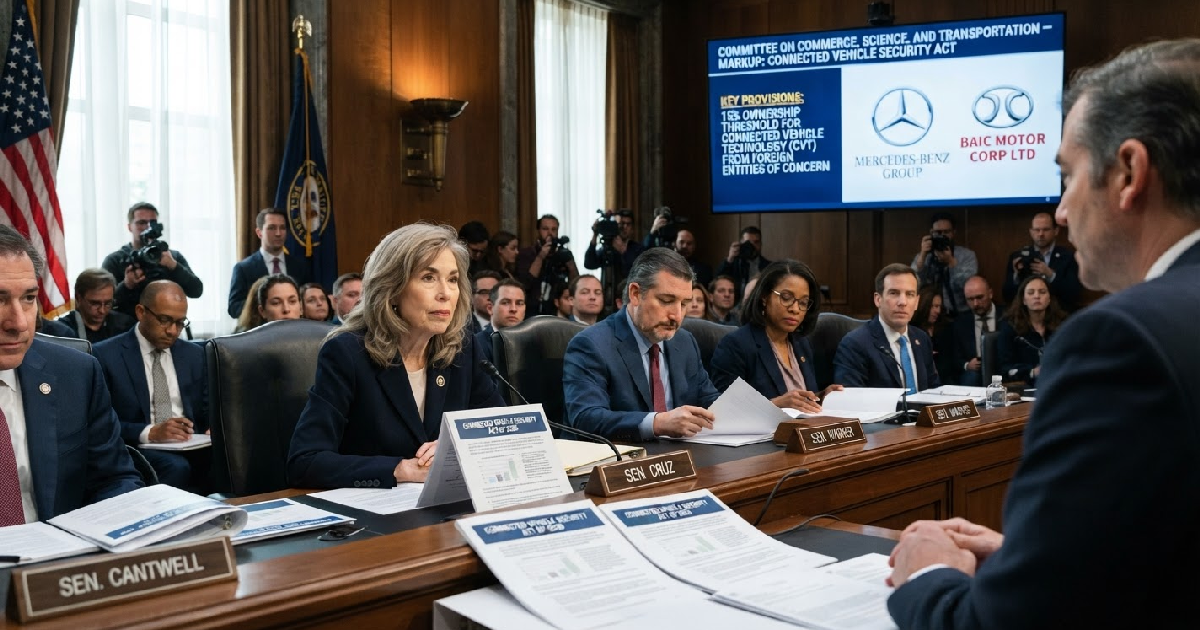
The U.S. Senate Commerce Committee approved bipartisan legislation on Wednesday, July 22, 2026, to stiffen a U.S. government ban on Chinese automakers. S. Senate Commerce Committee on Wednesday, July 22, 2026, approved bipartisan legislation designed to stiffen a U.S. government ban on Chinese automakers. This bill, known as the “Connected Vehicle Security Act of 2026,” could unexpectedly prohibit German automaker Mercedes-Benz from selling vehicles in the United States because of its existing Chinese ownership ties.
The legislation sets a 15% cap on Chinese ownership for companies selling connected vehicles in the U.S., a threshold Mercedes-Benz currently exceeds.
US Senate advances China auto bill amid security fears
Two Chinese investors, BAIC Motor Corp. and Geely founder Li Shufu, collectively own nearly 20% of Mercedes-Benz, placing the company squarely in the bill’s crosshairs. This move signals Washington’s deepening concerns over national security and economic protection, particularly regarding advanced vehicle technology. It marks a significant escalation in the ongoing economic tensions between the U.S. and China.
The “Connected Vehicle Security Act of 2026” received committee approval on July 22, 2026. This came after an initial hearing for the bill, introduced by Senators Elissa Slotkin (D-Mich.) and Bernie Moreno (R-Ohio), had faced a delay from July 15. The legislation aims to codify federal restrictions intended to keep Chinese-linked vehicle technology out of American markets.
Lawmakers have expressed growing apprehension that internet-connected vehicles could be vulnerable to exploitation. They worry these cars might collect sensitive data, facilitate espionage, or even disrupt critical infrastructure. This broad set of national security concerns is a primary driver behind the new regulations, as policymakers consider connected vehicle technology vital infrastructure.
National security concerns drive vehicle policy
The U.S. government fears advanced vehicle technology, especially from entities with ties to the Chinese government, poses significant risks to American interests. These anxieties span potential data harvesting and intellectual property theft, to the remote control or disruption of vehicle systems. The focus is on preventing vulnerabilities in critical transportation networks.
Beyond national security, the bill also intends to protect the U.S. auto industry. It aims to shield domestic manufacturers from the economic impact of potentially low-priced Chinese electric vehicle exports. This dual objective highlights the complex interplay of security and economic policy in Washington, seeking to safeguard both strategic assets and market share.
Mercedes-Benz confronts Chinese ownership threshold
The newly approved legislation presents a substantial challenge for Mercedes-Benz Group AG due to its current ownership structure. Senator Ted Cruz (R-Texas), the committee chair, highlighted that the bill’s 15% Chinese ownership threshold would directly affect the German automotive giant. He explicitly warned that the bill would need changes before becoming law, stating, “We would never consider” banning Mercedes-Benz.
This unexpected consequence puts a prominent European brand in a difficult position. It underscores the far-reaching implications of U.S. legislative actions targeting Chinese economic influence. The company will need to navigate this complex regulatory environment carefully, potentially requiring a significant strategic shift for its American operations.
Key Chinese shareholders in the German automaker
Mercedes-Benz’s significant Chinese ownership stems from two major investors. China’s state-owned automaker BAIC Motor Corp., formerly Beijing Automotive Industrial Corp., holds a 9.98% stake in the company. Geely founder Li Shufu also owns 9.69% of Mercedes-Benz. Combined, these stakes push total Chinese ownership to nearly 20%, far exceeding the proposed 15% cap and creating a complex legislative dilemma.
This complex web of international investment is now at the heart of a major U.S. legislative debate. It forces a conversation about the global nature of automotive production and ownership, and how national security interests intersect with free market principles. The situation illustrates the deep integration of global capital, making disentanglement a challenging prospect.
Industry lobbying and political accusations
The prospect of Mercedes-Benz potentially facing restrictions in the U.S. market has prompted lobbying efforts from the automaker. Mercedes-Benz Group AG is reportedly asking lawmakers to raise the ownership cap, seeking looser restrictions to avoid exclusion. However, this advocacy has met with opposition from the House Select Committee on China. They’ve maintained a firm stance.
The committee publicly opposed Mercedes-Benz’s request, characterizing the company as a “German-based, Chinese-owned company.” This firm stance from a key congressional body underscores a bipartisan resolve to counter perceived economic and security threats emanating from China. This resolve is also visible in discussions around China trading curbs in other financial sectors, reflecting a broader geopolitical strategy.
General Motors accused of competitive maneuvering
Senator Ted Cruz also brought another element into the debate during the committee markup. He accused General Motors of supporting the controversial provision in an effort to weaken Mercedes-Benz and bolster the competitiveness of its Cadillac brand. Cruz stated, “GM is pushing for this provision to get Mercedes-Benz out of the market.”
This allegation illustrates the intense competitive landscape within the automotive sector, further complicating the legislative process. It suggests that underlying economic rivalries are also influencing the policy debate, making the stakes even higher. The bill’s outcome could significantly reshape the competitive balance among luxury automakers in the U.S.
Compliance deadlines and market shifts
Should the “Connected Vehicle Security Act of 2026” proceed into law in its current form, Mercedes-Benz wouldn’t face an immediate prohibition. Senator Bernie Moreno, a co-introducer of the bill, clarified that Mercedes-Benz would have until 2030 to comply with the new ownership requirements. The possibility of seeking a waiver also exists, although the specific criteria for such exemptions remain undefined.
This timeline offers a critical window for Mercedes-Benz to potentially reconfigure its ownership structure or for congressional amendments to the bill. The situation introduces considerable uncertainty for a brand that has long been a fixture in the U.S. luxury vehicle market.
It forces the company to assess its long-term strategy for one of its most important global markets, much like how the Senate legislative process impacts other industries.
Evolving automotive partnerships and precedents
Other recent developments offer some precedent for navigating these new regulations. In May, Volvo Cars received approval to continue importing vehicles with connected-car technology into the U.S., potentially through a grandfathering clause. This suggests that established manufacturers might find avenues for compliance, though each case will likely be unique and depend on specific circumstances.
It points to a nuanced approach rather than a blanket ban, showing some flexibility.
Furthermore, major tech players are already adjusting their strategies. Google’s Waymo, for example, has committed to exploring a Detroit-based manufacturer for its autonomous vehicle platforms, after previously considering options from Chinese automaker Geely. These strategic shifts reflect a growing trend of re-evaluating international technology collaborations, as firms look to diversify their supply chains and partnerships.
Similar trends are emerging in corporate financial results in other international markets, driven by geopolitical and economic considerations and the desire for greater supply chain resilience.
Broader implications for global auto trade
The “Connected Vehicle Security Act of 2026” extends its impact far beyond Mercedes-Benz, signaling a significant shift in U.S. policy towards foreign investment in critical sectors. This legislation could set a precedent for other industries deemed vital for national security. It forces global automakers to re-evaluate their ownership structures and supply chains, particularly those with significant ties to China.
The bill underscores a hardening of U.S. stance against Beijing, especially in technology and manufacturing. This move will likely prompt other nations to consider similar protections for their domestic industries, potentially leading to a fragmentation of global automotive markets. Automakers might face pressure to localize production or divest certain ownership stakes to ensure market access.
Future of U.S.-China economic relations
The legislative effort targeting Chinese ownership in the auto sector reflects a broader U.S. strategy to de-risk its economy from potential dependencies on China. While the immediate focus is on connected vehicles, this precedent could influence future legislation across other industries heavily reliant on international supply chains and foreign investment. It highlights the growing ideological and economic divide between the two global powers.
The coming months will be crucial to see whether the bill undergoes significant amendments to address concerns raised by Senator Cruz and industry stakeholders. Its eventual form will send a clear message from Washington about the increasing scrutiny on Chinese influence in critical U.S. markets. This ongoing dynamic will undoubtedly shape international trade and investment for years to come.