

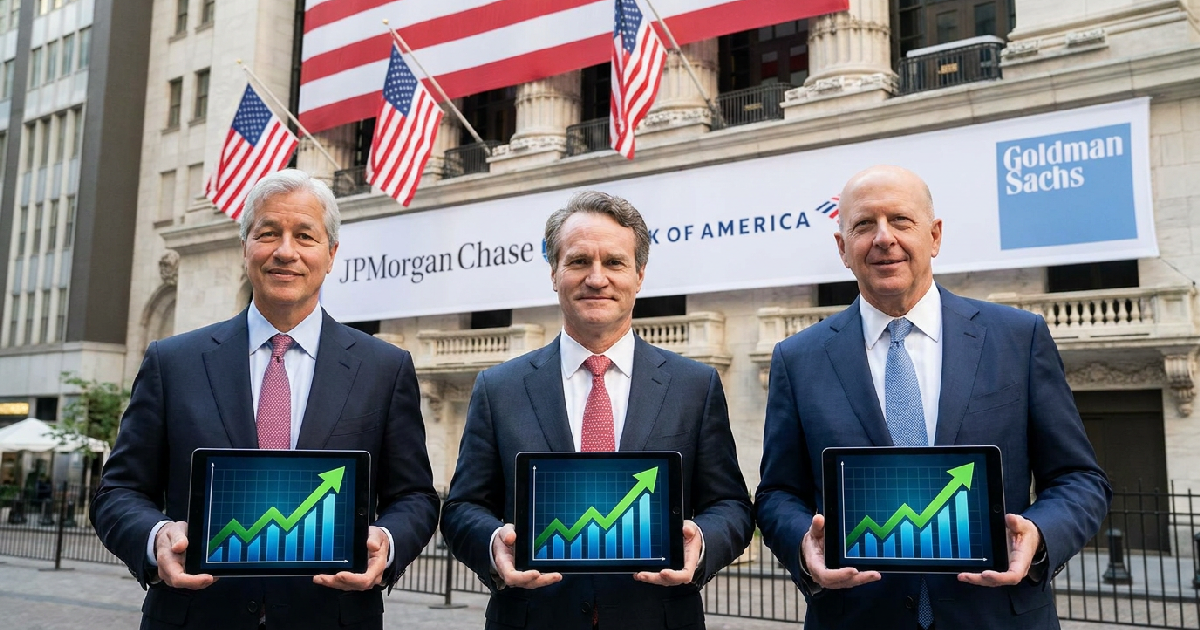
US bank profits soar in Q2 2026 as equities trading revenue booms
Wall Street’s biggest financial institutions, including JPMorgan Chase, Bank of America, and Goldman Sachs, announced unexpectedly strong second-quarter 2026 earnings on Tuesday, July 14, 2026. These impressive US bank profits largely exceeded analysts’ expectations, primarily fueled by a significant surge in equities trading revenue and a notable rebound in investment banking activity as firms capitalized on market volatility.
The stellar financial results reflect a robust period for the banking sector, marking a strong performance after prior quarters. Executives across these institutions pointed to healthy capital markets and consistent strategic investments as key drivers behind these elevated earnings.
JPMorgan Chase delivers strong Q2 2026 performance
JPMorgan Chase, the nation’s largest bank, reported an adjusted net income of $16.9 billion for the second quarter. This figure excludes $5.6 billion in pretax gains from one-time items, which included a $4.6 billion gain related to Visa shares and $1.0 billion from equity investment gains.
The bank’s adjusted earnings per share (EPS) hit $6.14, substantially beating analyst estimates of $5.55 by 38.7 percent. Total revenue for JPMorgan Chase climbed 15 percent year-over-year to $57.8 billion, outpacing the $51.3 billion consensus for managed revenue, which reached $58.0 billion.
Equities trading revenue skyrockets 86 percent
Crucially, JPMorgan’s equities trading revenue skyrocketed an impressive 86 percent, reaching $6.0 billion. The broader markets division saw its revenue grow 35 percent over the same period last year, demonstrating strong client engagement.
Investment banking fees also saw a significant jump of 30 percent year-over-year, marking the highest level recorded since 2021. Jamie Dimon, Chairman and CEO of JPMorgan Chase, attributed this success to “a particularly favorable environment with an elevated level of market activity, as well as rigorous execution, years of consistent investment, and thoughtful capital deployment.”
Mr. Dimon specifically highlighted the “booming environment” in equities, noting “a ton of activity, big IPOs, the AI theme, a very active environment.” Despite this robust showing, CFO Jeremy Barnum cautioned that some of the exceptional markets performance, particularly in equities, might not repeat in future quarters.
Bank of America reports record equities trading revenue
Bank of America also delivered robust figures for Q2 2026, reporting net income of $9.1 billion, a 27 percent increase from a year earlier. Its diluted EPS rose 34 percent to $1.21, surpassing analyst predictions of $1.13 per share.
Total revenue for Bank of America reached $31.6 billion, up 15 percent year-over-year. The bank’s equities trading revenue surged 70 percent to a record $3.6 billion, reflecting strong activity in capital markets and marking one of the strongest quarters to date for the institution.
Broad-based growth across business segments
Investment banking fees climbed 50 percent from a year earlier to over $2.1 billion. Brian Moynihan, Chief Executive of Bank of America, emphasized that “Every business segment reported double digit net income growth and strong returns on equity,” indicating broad-based strength across the bank’s operations.
CFO Alastair Borthwick echoed this sentiment during the bank’s media call, stating, “We’ve had really terrific global markets performance and investment banking performances. Business continues to feel good.” The bank also returned $8.0 billion to shareholders in Q2 2026, comprising $2.0 billion in dividends and $6.0 billion in buybacks.
Goldman Sachs crushes estimates with 84 percent net income increase
Goldman Sachs posted outstanding second-quarter results, with net income attributable to common shareholders soaring 84 percent year-over-year to $6.40 billion. This brought its total net income to $6.63 billion for the quarter.
The firm’s diluted EPS reached $20.98, crushing the consensus estimate of $14.46 by 45.1 percent. This also represents a 92.3 percent increase from the $10.91 reported in the year-ago period. Net revenues for Goldman Sachs stood at $20.34 billion, a 39.0 percent increase from Q2 2025, and well above the $16.13 billion forecast.
The Equities Net Revenues segment alone achieved a record $7, highlighting the firm’s continued strength in trading and market-making activities. This strong performance signals a successful period for Goldman Sachs amidst elevated market activity.
Factors driving Wall Street’s strong performance
The exceptional performance across these major banks wasn’t coincidental; it reflects a confluence of powerful economic and market forces. An elevated level of market activity, partly driven by the rapid buildout of artificial intelligence, has spurred significant capital flows and transactional volumes.
The relentless spending on AI through 2025 has been a major story, contributing to corporate profits and buttressing rising stock prices. The AI buildout is estimated to drive roughly 60% of GDP growth, creating opportunities for financial intermediaries.
Geopolitical tensions, including the Iran war which began in late February, also boosted trading revenue for banks by creating market volatility, prompting clients to adjust portfolios and seek hedging strategies. The US naval forces have also redirected commercial vessels during a maritime blockade against Iran, underscoring the ongoing tensions.
Resurgent retail investors and significant IPOs
The period also saw a significant surge in retail investing, with flows rising approximately 50 percent from 2023 to early 2025. This increased retail participation, partly fueled by commission-free trading and increased downtime during the pandemic, meant more daily transactions for banks to process.
By mid-October 2025, retail traders were responsible for a record 16 percent of single-stock trading volume. A crucial driver for investment banking revenue was the rebound in Initial Public Offerings (IPOs). The June 2026 SpaceX IPO, for example, became the largest public listing on record, bringing in $75 billion. Goldman Sachs, Morgan Stanley, and Bank of America were all involved in this monumental offering.
Outlook: can the momentum be sustained?
While the second quarter delivered exceptional results, the forward outlook remains a key topic of discussion. JPMorgan’s CFO Jeremy Barnum has already hinted that the outstanding markets performance might not be sustainable at the same pace. The question for investors and analysts now is whether this current favorable environment can persist through the latter half of 2026.
The banks themselves have offered cautious optimism. JPMorgan Chase, for instance, raised its full-year 2026 net interest income guidance to $105.5 billion, alongside adjusted expenses of $107.5 billion. This suggests continued strong core banking performance, even if the trading intensity moderates.
Navigating the regulatory landscape
The regulatory landscape also continues to shape bank operations and profitability. Debates surrounding regulations like the Volcker Rule, which prohibits proprietary trading by banks, have significant implications for their ability to engage in speculative investments. While the scope of financial instruments subject to the Volcker Rule was narrowed in 2019, ongoing discussions about capital requirements and risk management could influence future trading activities.
For now, major US banks have demonstrated remarkable resilience and profitability. Their Q2 2026 earnings reports paint a picture of strong market engagement and successful navigation of a dynamic global financial environment. The focus will undoubtedly shift to how they sustain this momentum amid evolving market conditions and regulatory pressures, particularly as the “AI theme” continues to drive market activity.