

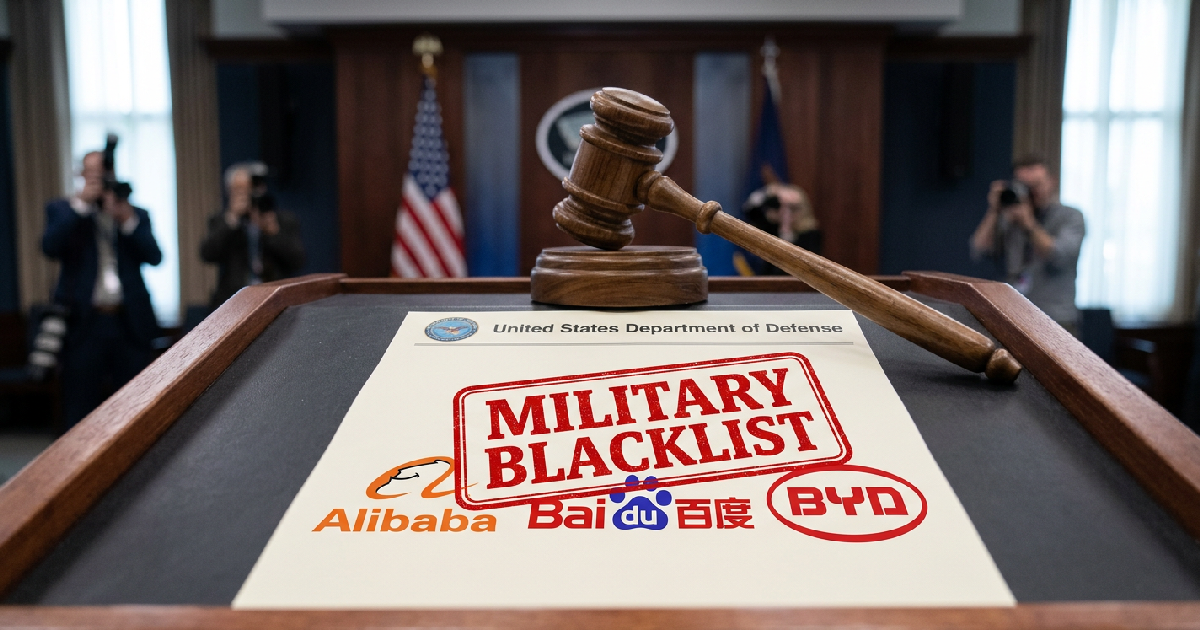
United States Department of Defense restores Alibaba, Baidu, BYD to military blacklist
The United States Department of Defense (DoD) has officially restored several of China’s largest corporations, including Alibaba Group Holding, Baidu Inc., and BYD Co., to its blacklist of Chinese military companies. The decision, announced on June 8, 2026, marks a significant intensification of Washington’s efforts to restrict American capital from supporting entities believed to be aiding the modernization of the People’s Liberation Army (PLA).
This move places these tech and automotive giants back under the scrutiny of Section 1260H of the National Defense Authorization Act (NDAA). By designating these firms as “Chinese military companies,” the Pentagon is signaling to investors and contractors that these organizations are deeply integrated with China’s military-industrial complex.
The decision follows a period of rigorous internal review and mounting pressure from lawmakers to close perceived loopholes in national security oversight.
The implications for the global tech sector are immediate. Alibaba and Baidu are central to China’s artificial intelligence and cloud computing ambitions, while BYD has overtaken global rivals in the electric vehicle market. By re-listing them, the U.S. government is effectively complicating their ability to access American technology and certain financial markets, further decoupling the world’s two largest economies.
National security risks and the military-civil fusion doctrine
The Pentagon’s justification for the re-listing centers on Beijing’s “Military-Civil Fusion” (MCF) strategy. This policy mandates that Chinese private-sector innovations in AI, semiconductors, and green energy must be shared with the military. Pentagon officials argue that allowing American investment in Alibaba or Baidu indirectly funds the development of surveillance tools and autonomous weapons systems used by the PLA.
And it is not just about software. The inclusion of BYD highlights growing concerns over the role of electric vehicles and battery technology in future logistics and military transport. While these companies often operate as commercial entities globally, the DoD maintains that their domestic obligations to the Chinese Communist Party make them inherent security risks to the United States and its allies.
This hawkish stance reflects a broader shift in how Washington views trade with China. Recent policy changes suggest that supply chain resiliency is increasingly prioritised over cost-efficiency. By blacklisting these firms, the U.S. is encouraging domestic and allied companies to seek alternative partners for critical infrastructure and emerging technologies.
Market reactions and the impact on global institutional investors
Wall Street has reacted with caution to the news. The restoration of these firms to the 1260H list does not trigger an immediate or total investment ban like the Treasury Department’s Specially Designated Nationals (SDN) list, but it creates a massive compliance headache for institutional funds. Many large-scale investors are likely to divest to avoid the reputational and legal risks associated with holding “military-linked” assets.
Compliance hurdles for international banking
For global financial institutions, the move requires a total overhaul of risk assessment models for Chinese assets. Experts suggest that the integration of automation will be necessary to manage these shifts. Recently, leaders like Iqbal Khan viewed AI as the biggest transformation for managing the complexities of banking jobs, especially when navigating volatile geopolitical landscapes.
The blacklisting also complicates the “China plus one” strategy adopted by many multinationals. With BYD on the list, any American firm involving BYD in their supply chain for energy storage or fleet management may face future federal contract restrictions. This creates a chilling effect on the commercial partnerships that have historically bridged the gap between the two nations.
Diplomatic fallout and the response from Beijing
The Chinese Ministry of Commerce has historically denounced such listings as “discriminatory” and “unfounded.” Beijing is expected to respond through its own “Unreliable Entities List,” potentially targeting U.S. firms that comply with the Pentagon’s directives. This retaliatory cycle has become a staple of the 2026 geopolitical climate, leaving little room for de-escalation.
The timing of the announcement is particularly sensitive. It comes during a period of fragile negotiations regarding trade imbalances and intellectual property rights. Some analysts suggest that the Pentagon’s move provides the U.S. with additional leverage, while others fear it may push Beijing toward even more aggressive self-sufficiency and economic isolationism.
The long-term strategic shift in the Pacific
Restoring these companies to the blacklist is a clear sign that the U.S. government no longer distinguishes between China’s commercial champions and its defense sector. This “all-of-government” approach to national security means that any Chinese company reaching a certain scale in a dual-use technology field—be it cloud computing or battery storage—is a candidate for future restrictions.
The decision also serves as a warning to other nations. Washington is actively lobbying its partners in Europe and Asia to adopt similar vetting processes for Chinese tech investments. As the U.S.
focuses on maintaining a “small yard and high fence” around critical technologies, the restoration of Alibaba, Baidu, and BYD to the military blacklist suggests that the yard is staying small, but the fence is getting much higher.
Looking ahead, the market will likely see increased volatility in shares of Chinese tech firms listed on U.S. exchanges. Investors may seek safety in alternative assets as the risks of holding Chinese equities continue to climb. For the companies themselves, the challenge will be attempting to maintain global growth while being formally branded as an arm of the world’s largest rival military.