

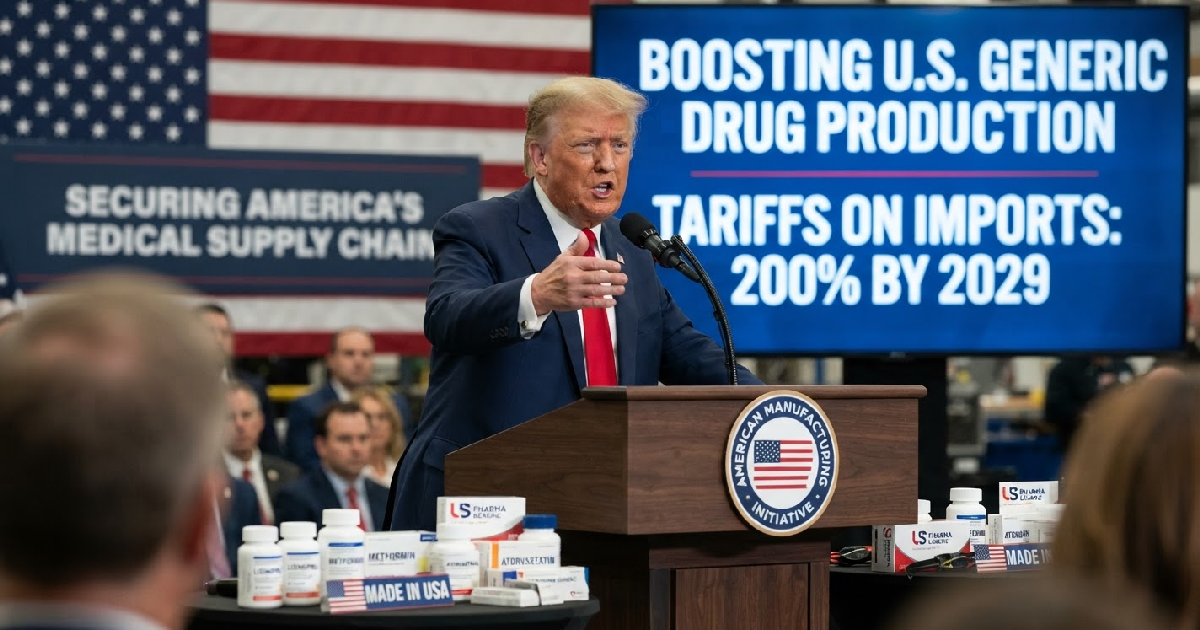
Trump announces escalating generic drug tariffs to boost US production by 2029
US President Donald Trump has unveiled an aggressive new policy targeting imported unpatented and unbranded generic drugs, announcing steep tariffs set to escalate dramatically by August 2029. The move, communicated via social media on Tuesday, July 21, 2026, aims squarely at compelling pharmaceutical manufacturers to reshore their production to the United States.
It’s a strategy designed to protect the American populace and bolster domestic manufacturing capabilities.
Phased tariffs to reshape pharmaceutical supply chain
Beginning August 1, 2026, imported generic drugs will initially face zero tariffs for two years. However, this grace period will end abruptly, with a 100% levy taking effect in August 2028, further climbing to a punishing 200% tariff by August 2029.
President Trump described this phased escalation as “a penalty” for companies that don’t establish manufacturing plants and facilities within the US during the two-year window.
This tiered approach to generic drug tariffs marks a significant shift in US trade policy for pharmaceuticals. With 90% of all prescriptions in the US filled by generic drugs, and roughly 70% of those currently sourced from abroad, the administration clearly wants to reverse this reliance.
Only about 10% of generics are presently manufactured domestically, highlighting the scale of the challenge President Trump’s policy intends to address.
The tariffs will be imposed under Section 232 of the Trade Expansion Act, which allows the President to adjust duties on imports deemed a threat to national security. A White House spokesperson confirmed this to Endpoints News, underscoring the administration’s view that foreign reliance for essential medicines poses a strategic vulnerability.
This follows an April 2025 probe into the pharmaceutical industry under the same national security grounds.
Global drugmakers face strategic crossroads
The impending tariffs will send shockwaves through the international pharmaceutical sector, particularly in countries heavily reliant on the US market. India, for example, stands as the largest exporter of generic drugs to the US, having shipped $9.7 billion worth of pharmaceuticals in 2025. That figure represented 38% of India’s total global pharma exports of $25.8 billion, demonstrating the profound dependence on the American market.
Chinese firms also play a critical role, dominating the upstream supply of active pharmaceutical ingredients (APIs) for many common medications like amoxicillin and heparin. Their position in the global supply chain means they too will need to re-evaluate strategies. Companies exporting to the US now face an ultimatum: invest in US manufacturing or bear crippling costs.
Varied tariff rates for trade partners
Not all countries will feel the immediate brunt equally. Certain nations with existing trade deals with Washington, including Switzerland, Japan, the European Union, and South Korea, will benefit from 15% lower tariff rates. The United Kingdom has secured an even more generous deal, receiving zero tariffs for three years, a clear indication of strengthening bilateral ties.
Some major drugmakers, such as Pfizer, AstraZeneca, and Novo Nordisk, have already negotiated specific tariff relief. These agreements typically come in exchange for commitments to increase US investment and reduce drug prices, often under the President’s “most favored nation” policy. That policy ties US drug prices to cheaper ones found abroad, aiming to ensure Americans don’t pay more than patients in other high-income countries.
A pattern of using tariff threats for leverage
President Trump has consistently utilized delayed tariff implementation dates as a tool for leverage, pushing companies and countries toward favorable outcomes for the US. The initial zero-tariff period, followed by a steep increase, is a classic example of this strategy, providing a clear incentive for companies to act quickly.
This policy on generic drugs also builds upon previous actions. Just three months prior, President Trump issued a proclamation explicitly stating that generic pharmaceuticals were “not subject to tariffs at this time,” but warned this decision “will be reassessed in one year.” That statement laid the groundwork for today’s announcement.
Tariffs on patented and branded drugs, however, will remain unchanged, having already faced duties of up to 100% since April 2.
Expanding US manufacturing capacity
Pharmaceutical companies committed to expanding their manufacturing footprint in the US can apply to the Commerce Department for a significant concession. If approved, these firms could benefit from a lower 20% tariff for a period of four years.
This provision aims to soften the blow for those willing to invest, providing a more manageable pathway to compliance and allowing time for new facilities to become operational.
The administration has also been pushing initiatives like TrumpRX, a direct-to-consumer discount drug sales platform. These efforts underscore a broader strategy to make medicines more affordable for Americans while simultaneously boosting domestic drug production and reducing reliance on foreign supply chains, a key national security objective for the White House.
Economic and geopolitical ripple effects
The new generic drug tariffs will undoubtedly lead to complex economic and geopolitical ripple effects. For consumers, the ultimate impact on drug prices remains uncertain. While the policy aims to lower costs in the long run by spurring domestic competition, initial transitions could see price volatility. Manufacturers may pass on increased operational costs, even with incentives to build stateside.
Geopolitically, the tariffs could strain relationships with key pharmaceutical exporting nations like India and China, potentially forcing them to diversify their own export markets or reconsider their global manufacturing strategies. It also sets a precedent for how the US views critical supply chains through a national security lens, potentially influencing other sectors in the future.
The next few years will test the pharmaceutical industry’s adaptability and the US’s resolve in reshaping its drug supply.
The policy presents a dual challenge and opportunity for drugmakers. They’ll need to carefully weigh the costs of establishing new US-based manufacturing against the escalating tariff burden. Many might find it strategically advantageous to partner with existing US firms or invest directly in new domestic plants.
This could create a boom for construction and manufacturing jobs in specific regions of the United States, aligning with the administration’s broader economic goals.