

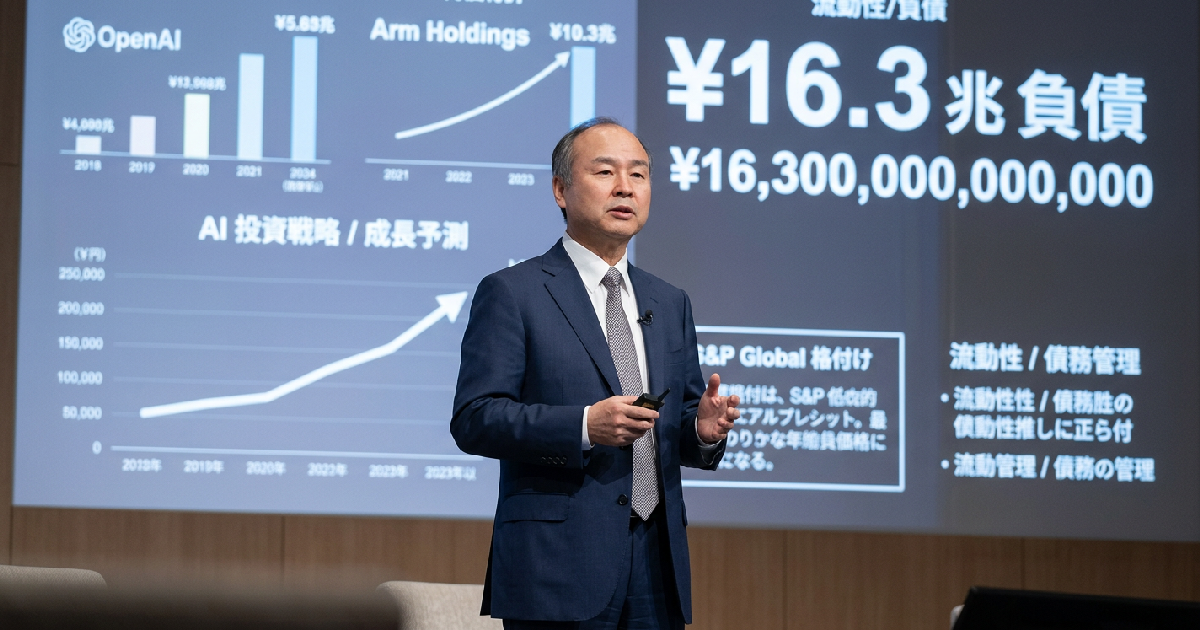
Masayoshi Son’s SoftBank faces warnings over 16.3 trillion yen liabilities
3 trillion yen debt pile and heavy concentration in OpenAI are fueling warnings of a potential liquidity crunch. Despite overtaking Toyota this week to become Japan’s most valuable company, the firm faces growing scrutiny from credit agencies and analysts. S&P Global Ratings revised SoftBank’s credit outlook to negative in March.
The agency cited concerns that the quality of the company’s portfolio and its financial capacity are likely to deteriorate following an additional $30 billion investment in the ChatGPT maker.
The tech giant’s shares have surged roughly 70% this year, riding a wave of investor enthusiasm for AI and the soaring valuation of its subsidiary Arm Holdings. However, this rally masks significant balance-sheet risks. SoftBank’s standalone interest-bearing debt reached approximately $104 billion (16.3 trillion yen) by the end of 2025. With a $40 billion bridge loan secured in March to fund further AI ventures, the company’s future is increasingly tethered to OpenAI’s ability to maintain its meteoric valuation and eventually go public.
Questions about the sustainability of this strategy arise as some investors consider the broader market impact of AI dominance. For example, capital has reportedly diverted away from Bitcoin toward AI and quantum tech, illustrating the massive scale of the trend SoftBank is leading. But for Masayoshi Son, the risk of concentration is secondary to the potential of the technology, which he recently described as being “50 times bigger” than the dot-com boom.
Mounting debt and the OpenAI concentration risk
SoftBank’s deepening involvement with OpenAI has turned the startup into a cornerstone of its investment strategy. S&P Global recently estimated that OpenAI accounts for roughly 30% of SoftBank’s total investment portfolio. This level of exposure is now on par with Arm Holdings. Analysts warn that such a concentrated position leaves the conglomerate vulnerable if the AI sector experiences a slowdown or if OpenAI fails to meet lofty expectations.
“SoftBank has made itself into a highly leveraged bet on AI which carries significant upside as well as risk,” said Gil Luria, head of technology research at Davidson equity capital markets. He noted that if OpenAI does not successfully launch an initial public offering (IPO) at its current valuation or higher, it could place immense pressure on SoftBank. The concern is that a cooling of enthusiasm surrounding AI valuations would leave SoftBank with a massive exposure it cannot easily liquidate.
Richard Windsor, founder of Radio Free Mobile, echoed these fears, stating that the risk profile is getting larger. He warned that a failure by OpenAI to deliver could easily trigger a liquidity crunch within the Japanese firm. This mirrors the volatility seen in other sectors, such as when Lincoln International valuations faced steep discounts after market shifts, proving how quickly sentiment can reverse for highly leveraged entities.
Evaluating OpenAI’s multi-billion dollar valuation
OpenAI’s valuation reportedly hit $852 billion following a record $122 billion funding round in March. This follows an earlier funding round last year where the company was valued at a reported $300 billion. While these numbers suggest massive paper gains for SoftBank, the actual liquidity of these holdings remains tied to future market events.
Professor Emeritus Jay R. Ritter of the Warrington College of Business pointed out that leverage functions as a double-edged sword. While it magnifies gains when investments perform, it amplifies the pain when they sour. Ritter highlighted that SoftBank’s reliance on OpenAI is particularly risky given other “weak spots” in the portfolio. These include underperforming holdings like the ride-hailing firm Didi and the South Korean e-commerce giant Coupang.
Lessons from the WeWork insolvency crisis
The current pivot toward AI comes only a few years after SoftBank was reeling from the collapse of the office-sharing startup WeWork. SoftBank’s cumulative investment losses in WeWork exceeded $14 billion after the startup, once valued at $47 billion, filed for bankruptcy protection in the United States in 2023. The WeWork disaster illustrated the dangers of pouring billions into a single, high-valuation startup with an unproven path to long-term profitability.
Critics argue that the current focus on OpenAI bears some resemblance to the WeWork era. SoftBank’s Vision Fund poured billions into the office-sharing firm before concerns over its business model and corporate governance caused its valuation to collapse. While OpenAI currently leads the generative AI field, any shift in corporate governance or market dominance could force SoftBank to absorb another round of massive losses, similar to the 2023 bankruptcy fallout.
However, some investors see the current debt levels as manageable. Richard Kaye, a portfolio manager at Comgest, argued that the company’s loan-to-value (LTV) ratio — which compares total borrowings to immediately fungible equity — remains below 25%. Kaye suggested that because SoftBank holds enough equity to offset potential losses, an OpenAI disappointment would likely result in a “one-off markdown” rather than a total solvency crisis.
Masayoshi Son defends aggressive AI strategy
Despite the negative credit outlook from S&P Global, Masayoshi Son remains undeterred in his vision. In a recent interview, he defended the company’s aggressive investments, arguing that any future correction in AI stocks should be viewed as a buying opportunity. He remains convinced that the AI revolution is a structural shift in the global economy rather than a temporary bubble.
His strategy involves using massive bridge loans to secure footprints in dominant companies before they go public. This approach depends on the continued willingness of lenders to extend financing against SoftBank’s equity holdings, such as its majority stake in Arm Holdings. As the most valuable company in Japan, SoftBank’s health is now a vital indicator for the broader Tokyo market.
Whether SoftBank can avoid a liquidity crunch will likely depend on OpenAI’s ability to maintain its valuation lead and the continued appetite for AI-linked debt. With 16.3 trillion yen in interest-bearing debt, the margin for error has rarely been thinner for the Japanese giant. For now, Masayoshi Son is betting that the “AI halo” will be enough to carry the firm through its next phase of growth.