

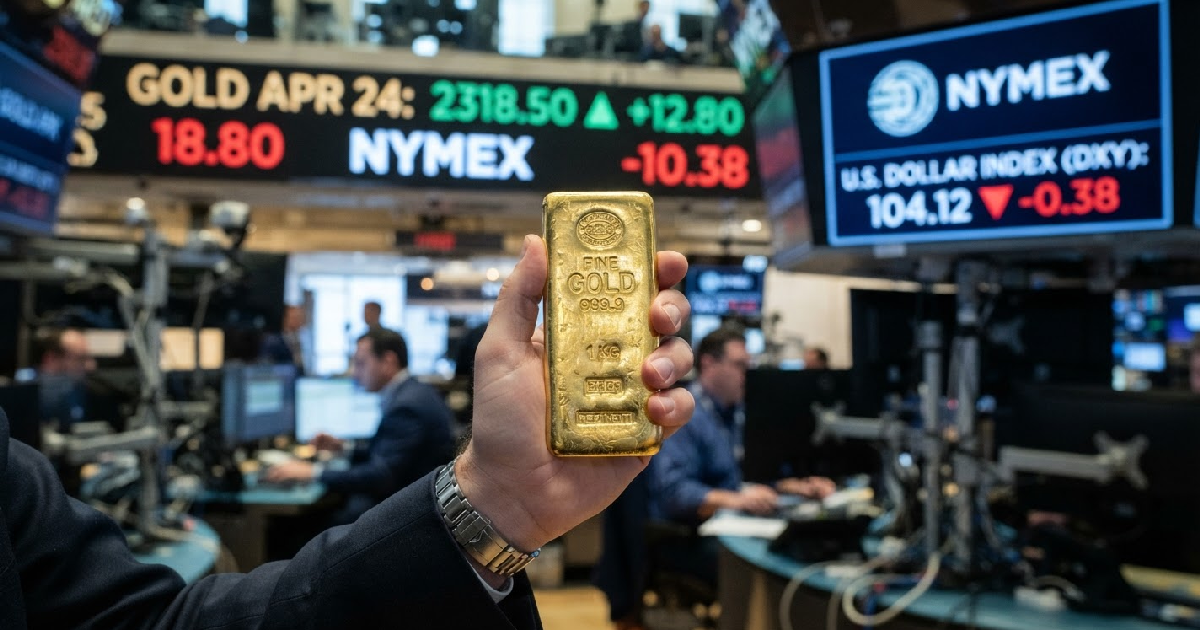
Smart ways to invest in gold as dollar slips
Investors are increasingly looking for smart ways to invest in gold as the U.S. dollar continues its recent downward slide, shifting market dynamics for the precious metal. This comes after an unusual joint intervention by the U.S. Treasury and the Federal Reserve, who stepped in alongside Japan to shore up the struggling yen earlier this week.
The move has intensified questions about the dollar’s long-held position as the world’s primary reserve currency. On Friday, August 7, 2026, front-month continuous contracts for gold on the New York Mercantile Exchange were trading for $4,402.60 an ounce, marking a 9% increase since the end of June.
Dollar’s recent decline fuels gold’s appeal
The U.S. Dollar Index (DXY) has declined 1.6% since the end of June 2026. This index measures the dollar against a basket of six major foreign currencies: the Euro (EUR), Japanese Yen (JPY), British Pound Sterling (GBP), Canadian Dollar (CAD), Swedish Krona (SEK), and Swiss Franc (CHF). A weaker dollar typically makes gold more affordable for international buyers, driving up demand and subsequently, prices.
The inverse relationship between gold and the dollar is a fundamental principle for those looking to invest in gold. A weaker dollar enhances gold’s purchasing power globally, cementing its role as a hedge against currency devaluation.
Yen intervention raises reserve currency concerns
The decision by Japan’s central bank to maintain its overnight borrowing interest rate at 1% sent the yen sliding early this week. This prompted Japan’s government to buy yen, an intervention notably joined by the U.S. Treasury and the Federal Reserve.
Joseph Adinolfi, a market analyst, highlighted that the mechanics of America’s participation specifically brought into question the dollar’s status as the international reserve currency. This unusual joint effort suggests a deeper concern about currency stability and global financial architecture.
Gold’s upward momentum and underlying drivers
Gold prices have shown upward momentum recently, attracting investors seeking stability. On August 7, 2026, gold prices surged over 1% to exceed $4,300 in the European session, with spot gold climbing above $4,280. This put spot gold on track for its strongest weekly gain since January.
U.S. gold futures were trading around $4,345 on August 7, 2026. The price is still nearly 22% down from an intraday high of $5,626.80 set in January 2026.
Key factors pushing gold prices higher
Several factors are converging to support higher gold prices beyond just the weakening dollar. Lower interest rates, or the expectation of them, tend to reduce the opportunity cost of holding non-yielding gold, making it a more attractive asset.
The Federal Reserve’s anticipated shift towards an easing bias in 2026, with expected rate cuts, points to a weaker U.S. dollar and potentially elevated gold prices. Sustained inflation also erodes the dollar’s purchasing power, positioning gold as a valuable hedge against rising living costs.
Geopolitical instability, such as wars, sanctions, and trade conflicts, routinely triggers safe-haven flows into gold. And central banks have become significant buyers, especially in emerging markets like China, India, and Turkey.
These central banks are diversifying their reserves and reducing their dependence on the U.S. dollar. They now collectively hold more gold than U.S. Treasuries, a notable shift in global financial strategy that underscores gold’s enduring appeal.
Strategic approaches to invest in gold
For investors aiming to capitalize on gold’s current trajectory, there are two main avenues: physical gold or “paper gold” products. Each offers distinct advantages and disadvantages depending on an investor’s goals and risk tolerance.
Understanding these options is crucial for anyone looking to invest in gold effectively. Both methods allow exposure to the yellow metal’s price movements, but they differ significantly in terms of ownership, liquidity, and cost.
Physical gold: direct ownership and tangible security
Direct ownership of gold involves acquiring tangible assets like coins, bars, and bullion. This method offers unparalleled security for those wary of financial institutions or counterparty risk.
Physical gold is a universally accepted asset for wealth preservation, providing a tangible store of value. It can even be traded in a crisis, offering a high level of security when stored safely.
However, physical gold requires a significant upfront investment. It also incurs ongoing costs for insurance, secure storage, and delivery, making it less suitable for short-term speculation. It’s more aligned with long-term wealth protection.
Paper gold: convenience and liquidity
Paper gold products offer exposure to gold prices without the need to own the physical metal directly. These financial instruments provide convenience and liquidity, often trading in smaller quantities than physical bullion.
They bypass the storage and insurance costs associated with physical gold, making them a popular choice for speculation. Their ease of trading allows investors to capitalize on short-term price fluctuations, as is often seen with rapid shifts in technology sector investments.
Gold-backed Exchange-Traded Funds (ETFs) are a prime example of paper gold. They offer efficient access to gold, with intraday tradability, low tracking error to bullion prices, and high liquidity. These ETFs hold physical gold in secure vaults, providing an indirect claim to the metal.
The SPDR Gold Shares (GLD), the world’s largest gold ETF, had over US$176 billion in assets under management in early 2026. Its exceptional liquidity, deep options chain, and tight bid/ask spreads make it a preferred instrument for frequent traders and large institutional investors.
Expert forecasts for gold prices in 2026 and beyond
Several prominent financial institutions have weighed in on gold’s future, though their predictions vary based on their outlook for the broader economy and interest rates. Investors should consider these diverse forecasts when planning their strategies to invest in gold.
These projections highlight the complexity of the gold market, influenced by global economic health, monetary policy, and geopolitical events. The current environment, marked by a slipping dollar, presents a nuanced picture for precious metal performance.
Diverging analyst predictions for gold’s trajectory
J.P. Morgan Global Research forecasts gold to average $6,000 per ounce by the final quarter of 2026, potentially rising to $6,300 per ounce by the end of 2027. Separately, J.P. Morgan also lowered its forecast in early July 2026, expecting gold to reach $4,500 in Q4 2026.
Goldman Sachs, however, lowered its year-end 2026 price target in June 2026 from $5,400 to $4,900 per troy ounce. This revision stemmed from expectations that the U.S. Federal Reserve might not lower interest rates in 2026.
HSBC similarly reduced its 2026 gold price forecast in July 2026, moving it from approximately $4,900 to $4,560 per troy ounce. ING’s commodity analyst, Ewa Manthey, also lowered their gold forecast for the second half of 2026, citing rising treasury yields, a stronger U.S. dollar, and weaker investor demand.
ING now expects gold to average $4,300 per ounce in Q3 2026 and $4,600 per ounce in Q4 2026, down from a previous forecast of $5,000. On the more conservative side, StoneX anticipates gold prices falling further to around $4,000 per troy ounce by the end of 2026.
Conversely, one unnamed commodity analyst predicts gold prices could nearly double, reaching $8,000 an ounce. This stark contrast in expert opinion underscores the inherent volatility and speculative nature of commodity markets.
Long-term outlook and broader implications
The World Gold Council (WGC), in its Gold Outlook 2026, presented three scenarios for gold price movements. A mild economic cooling with falling interest rates could see a 5% to 15% increase, while a global recession and geopolitical shocks might lead to a 15% to 30% rise.
However, strong growth driven by fiscal policy, coupled with a higher dollar and interest rates, could result in a 5% to 20% decline. Looking further ahead, long-term forecasts based on historical averages suggest gold could reach around $6,500 per troy ounce by 2030, assuming a 9% to 10% average annual return from $4,500 per troy ounce at the end of 2026.
By 2040, gold could potentially rise to about $11,600 per troy ounce, based on an average long-term return of approximately 7% per year from the same starting point. These long-term projections reflect gold’s enduring value as an investment and wealth preserver.
The U.S. dollar’s continued weakness, alongside global economic shifts, will keep gold in the spotlight. Investors looking to diversify their portfolios and mitigate currency risks are likely to continue exploring avenues to leverage new payment technologies and traditional assets like gold. The changing global financial landscape makes a well-considered approach to precious metal investment more critical than ever.