

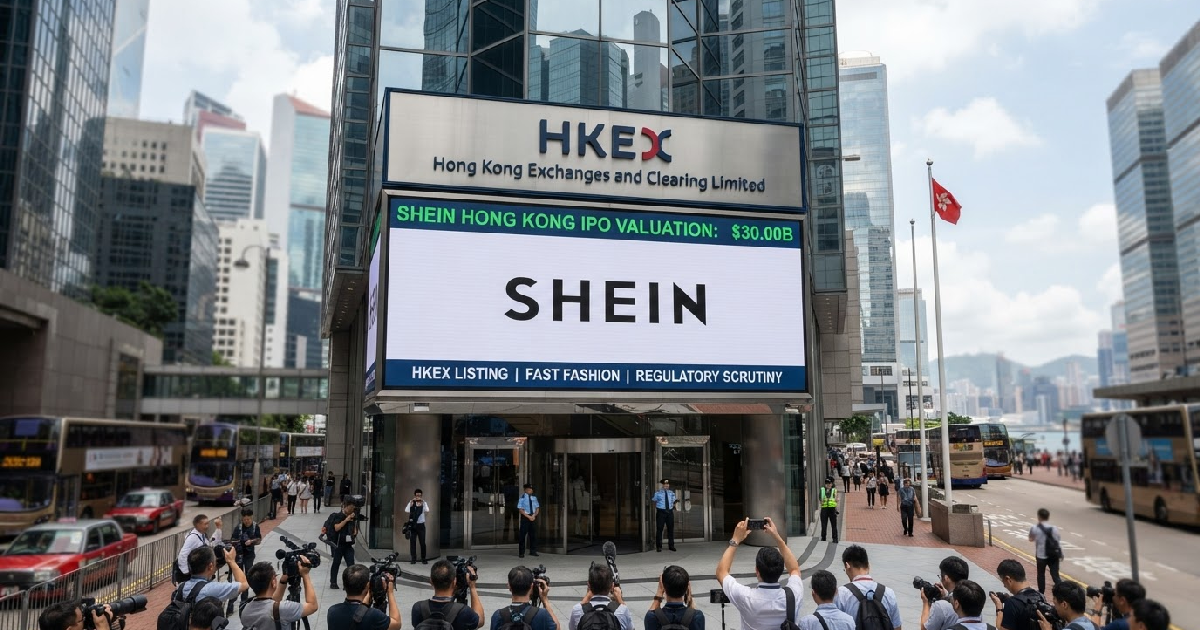
Shein secures Hong Kong IPO nod, faces $30 billion valuation amid stalled growth
Fast-fashion giant Shein has finally secured approval for its long-awaited initial public offering (IPO) on the Hong Kong Stock Exchange, ending a protracted three-year journey across multiple continents. This blessing from the China Securities Regulatory Commission (CSRC) arrived on July 10, 2026, marking a significant pivot after the company’s prior attempts to list in New York and London stalled.
But the road to a public market has come at a steep cost. Investors are now questioning whether the company, once valued at nearly $100 billion, can sustain even a $30 billion valuation in the face of slowing growth, mounting regulatory challenges, and a cooling market appetite for non-AI listings. Financial filings reveal significant pressures, suggesting Shein may have missed its opportune moment.
A protracted journey to market
Shein’s path to a public listing has been anything but straightforward, marked by shifting regulatory landscapes and strategic re-evaluations. The company, founded in Nanjing, initially set its sights on Western exchanges, a common tactic for Chinese tech firms seeking global capital.
It started in November 2023 with a confidential IPO filing to the U.S. Securities and Exchange Commission (SEC), coinciding with an approach to the China Securities Regulatory Commission. However, political headwinds and increasing scrutiny from U.S. lawmakers quickly redirected its ambitions.
The winding path from New York to London
By early 2024, Shein had shifted its focus to the London Stock Exchange (LSE), hoping for a more welcoming environment. The company confidentially filed papers with Britain’s Financial Conduct Authority (FCA) in June 2024 and secured approval to list by April 2025.
However, Beijing intervened, reportedly blocking the London prospectus due to concerns over risk disclosures related to its extensive supply chain in China. This move underscored the growing desire from Chinese regulators to see domestic champions list closer to home, shaping the China trading curbs on foreign listings.
Beijing’s pivot to a domestic listing
With Western options exhausted, Shein turned to Hong Kong, making a confidential filing in July 2025. This time, the company publicly embraced its Chinese roots, a notable change from its previous efforts to downplay them. This strategic shift seemingly paid off, with the CSRC granting approval on July 10, 2026.
The Hong Kong exchange’s listing committee cleared Shein around July 17, 2026, and the company subsequently published its post-hearing information pack, or draft prospectus, on July 26, 2026. Investment banking giants Goldman Sachs, Morgan Stanley, and JPMorgan are serving as joint sponsors for the highly anticipated Hong Kong IPO.
Valuation slides as growth engine cools
While gaining regulatory approval is a significant hurdle cleared, Shein now faces a far more challenging market reality than it did just a few years ago. The company’s valuation has shrunk considerably, reflecting a slowdown in its once-explosive growth trajectory and a less enthusiastic investor base.
From a peak of nearly $100 billion in a 2022 fundraising round, and $64 billion in 2024, Shein is reportedly under pressure to accept a valuation closer to $30 billion. William Ma, chief investment officer at GROW Investment Group, bluntly stated that the company “missed the golden time to list.”
Financial deceleration and Q1 2026 loss
Shein’s financial performance in recent years underscores this sentiment. Audited numbers from its Hong Kong prospectus show revenue growing 8% to $41.847 billion in 2025, a noticeable deceleration from the 20.7% growth recorded in 2024, when revenue hit $38.748 billion. Even with a compound annual growth rate (CAGR) of 14.2% from 2023 to 2025, the pace has cooled.
Profitability has also taken a hit. After posting net profits of $2.79 billion in 2023 and $3.37 billion in 2024, Shein saw its net profit decline 38.7% to $2.064 billion in 2025. The first quarter of 2026 brought further pain, with the company swinging to a $99 million loss.
This Q1 2026 loss was largely attributed to the U.S. removal of an import-duty exemption for small packages and a substantial one-time accounting charge. This marks a stark contrast to Q1 2025, when revenue grew 1.1% to $9.052 billion, indicating the impact of external factors on its bottom line.
Analyst perspectives on a maturing retailer
Analysts are adjusting their perceptions of Shein, viewing it less as a tech-driven disruptor and more as a traditional apparel retailer. Lenny Zephirin, principal and analyst at The Zephirin Group, believes the company is “transitioning from a high-growth, technology-enabled fast-fashion platform to a mature global apparel retailer facing structurally slower growth and sustained margin pressure.”
He anticipates Shein’s post-listing market capitalization could settle in the high-$20 billion to low-$30 billion range. This implies that even the current target valuation is considered demanding by some, especially when compared to peers like PDD, which trades at nine times fiscal 2025 earnings, or established Hong Kong consumer brands at around 11 times.
Mounting regulatory and reputational pressures
Beyond its financial performance, Shein is navigating a complex web of regulatory challenges and reputational risks that have undoubtedly contributed to its arduous IPO journey. These issues span multiple continents and touch upon critical areas like trade, labor, and consumer protection.
The U.S. Federal Trade Commission (FTC) recently launched an investigation into Shein’s U.S. business for unspecified reasons. Shein disclosed this inquiry on Tuesday, July 28, 2026, acknowledging that it could face significant fines as a result.
FTC investigation and EU import fees
This U.S. probe isn’t an isolated incident. The European Union, a significant market for Shein, imposed a 3-euro fee on low-value imports starting this month. This move has prompted both Shein and rival Temu to pause most advertising spending in Europe, effectively cutting off a key customer acquisition channel in a region that accounted for about a third of Shein’s revenue last year.
These tariff and fee changes directly impact Shein’s business model. Its strategy of shipping thousands of new designs daily, on demand, from China means it can’t easily localize inventory, unlike competitors that leverage bulk-imported goods to clear customs at standard tariffs.
Ethical concerns and supply chain scrutiny
Shein also continues to face persistent reputational and ethical risks. Allegations of poor working conditions at its suppliers, reports of “addictive features” in its shopping app, and concerns over the environmental toll of air-shipping enormous volumes globally have drawn criticism. These factors create a challenging environment for attracting long-term, ethically conscious investors.
The focus on its supply chain has become particularly intense. While Shein moved its headquarters to Singapore in 2022 to cultivate a global brand identity, its deep reliance on Chinese manufacturing remains.
Founder Sky Xu recently pledged to “continue to take root in Guangdong,” committing over 10 billion yuan ($1.4 billion) to a “smart supply chain system” in the province, perhaps an effort to demonstrate commitment and control amidst scrutiny regarding its supply chain resiliency.
Shifting market dynamics and fierce competition
The broader market for fast fashion is evolving, and Shein, once the undisputed king of ultra-low-cost, high-volume apparel, is finding itself in a more competitive and mature landscape. The investor appetite for companies like Shein has shifted, favoring sectors perceived as more innovative.
Shaun Rein, managing director at China Market Research Group, commented that “The Shein appetite has gone. It no longer exists.” He noted that the current IPO pipeline is dominated by AI and chip listings, areas where Shein simply doesn’t compete. This means a less receptive market for its offering.
Losing ground to rivals like Temu
Sales data from analysts confirm a deeper slowdown beyond just tariffs. Michael Gunther, an analyst at Consumer Edge, observed that Shein’s share of U.S. apparel, accessories, and footwear spending peaked at about 5% in the first quarter of 2025. It then turned negative year-over-year by the fourth quarter and continues to cede ground in 2026.
Even in the U.K., where Shein holds a strong 7.5% market share, its year-over-year share gain has slowed to nearly zero from roughly 1.8 percentage points in the first half of 2025. Gunther suggests this indicates Shein may be entering a “mature retailer phase” across key markets, struggling to maintain its rapid growth momentum.
Changing consumer demographics
Perhaps most tellingly, Shein’s customer base is showing signs of aging. In the U.S., the company is experiencing its steepest share losses among 18-to-34-year-olds, the demographic that initially fueled its meteoric rise. Conversely, shoppers over 55 are now adding share.
Juozas Kaziukenas, an e-commerce industry analyst, highlighted the significance of this trend, stating that “A fast fashion brand losing momentum with under-35s while growing with over-55s is a signal worth monitoring across geographies.” This demographic shift points to a potential long-term challenge in retaining its core, trend-driven audience.
The future of Chinese IPOs and Shein’s next chapter
Shein’s listing in Hong Kong could signal a broader trend for Chinese companies facing increasing scrutiny and obstacles in Western markets. The company’s strategic shift to embrace its Chinese origins and list closer to home aligns with Beijing’s apparent preference for domestic market activity.
Shaun Rein suggested that “the future for Chinese companies is to forgo western markets and seek listings close to home, or at home.” This move by Shein, therefore, might be seen as a pragmatic response to a geopolitical and regulatory reality, rather than a purely market-driven decision.
What the Hong Kong market expects
However, the Hong Kong market itself has evolved. While Shein offers a significant listing, the current investor appetite there heavily favors AI, semiconductors, memory chips, storage, and cloud infrastructure companies. Lenny Zephirin notes that “The Shein appetite has gone. It no longer exists.”
This means Shein enters a market less enthused by fast fashion, potentially impacting its post-listing performance and ability to attract the premium valuations it once sought. The coming weeks will show whether the long IPO odyssey will deliver the stability and capital Shein desperately needs, or if it simply confirmed that the “golden time” has indeed passed.