

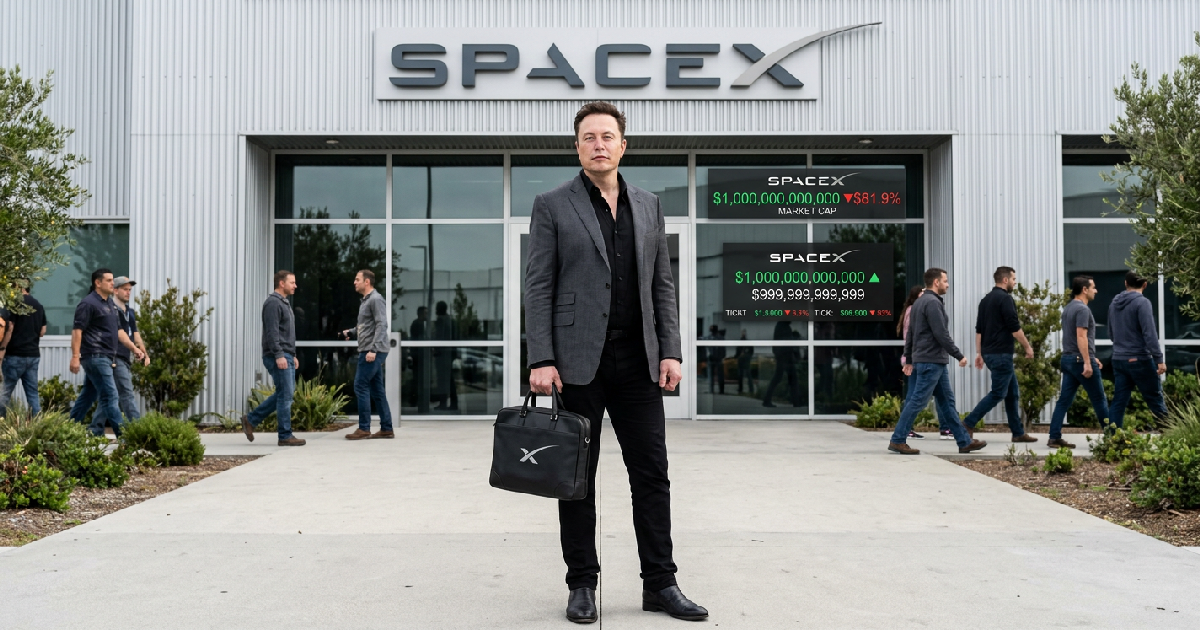
Reports of Elon Musk becoming world’s first trillionaire are false
A recent misinformation trend has surfaced online following fabricated reports claiming that Elon Musk has become the world’s first trillionaire. These claims, which circulated widely on June 13, 2026, falsely suggested that a public market debut for SpaceX propelled the entrepreneur’s net worth to a historic 13-figure sum.
However, there is no factual evidence to support the occurrence of a SpaceX Initial Public Offering (IPO) or such a valuation surge today.
The false reports alleged that SpaceX, headquartered in Hawthorne, California, listed on the New York Stock Exchange and achieved a valuation exceeding $600 billion within its first few hours of trading. Financial data from major exchanges shows no record of such a transaction.
While Musk remains one of the wealthiest individuals on the planet, his fortune is largely tied to equity in Tesla and the social media platform X, rather than a trillion-dollar public valuation of his aerospace venture.
SpaceX has historically remained a private entity, and despite frequent speculation about its public future, no official filing has been made with the Securities and Exchange Commission (SEC). The company continues to operate under private ownership, focusing on high-profile missions like the Starship development and the expansion of the Starlink satellite network.
These programmes are often subjects of intense market interest, but they have not triggered the milestone wealth event described in recent viral posts.
Verifying the status of Elon Musk and SpaceX market activity
Market observers note that the billionaire’s net worth fluctuates significantly based on the performance of his public holdings. While some analysts believe Musk could eventually achieve trillionaire status, current records do not indicate he has crossed that threshold. Institutional interest in private aerospace firms remains high, but the “record-breaking market debut” cited in social media reports simply did not take place on the dates mentioned.
This surge in misinformation comes as the tech sector experiences a massive shift in how information is shared and verified. In other financial contexts, leaders like UBS Asia President Iqbal Khan have noted that AI represents the biggest transformation for the industry, potentially impacting how market data is processed.
For now, the “trillionaire” tag remains a theoretical projection rather than a financial reality for the SpaceX founder.
Actual news regarding Musk’s holdings typically comes through formal regulatory channels or official company announcements. For example, when major shifts occur in global finance or politics, such as when Donald J. Trump reportedly requested edits to a proposed Iran deal, the information is tracked by reputable news agencies.
In contrast, the SpaceX IPO narrative lacks the verified documentation required for such a significant economic event.
Discrepancies in Starlink subscriber data and revenue claims
The corrected record also seeks to address specific numbers used in the false reports regarding Starlink’s performance. Claims that the satellite service reached over 10 million active subscribers to fuel a trillion-dollar IPO are not substantiated by verified company disclosures. While Starlink is expanding rapidly, the leap to 10 million subs exists without official confirmation from the company’s leadership team or financial auditors.
Public interest in SpaceX remains driven by its near-monopoly on commercial orbital launches and its strategic importance to western infrastructure. These factors have indeed led to high private valuations, but they remain distinct from the liquidity of a public listing. Economists warn that conflating private valuation rounds with public market capitalization can lead to exaggerated net worth figures that do not reflect actual liquid assets.
Broader context of wealth concentration and market speculation
The viral nature of the trillionaire claim highlights a growing fascination with extreme wealth concentration in the mid-2020s. As the world watches figures like Musk, the line between speculative projections and hard financial data often blurs in public discourse. This is particularly true in sectors where supply chain resiliency is prioritised over cost, making companies like SpaceX look increasingly valuable on paper.
For a wealth milestone of this magnitude to be official, it would require a massive transparent audit and sustained stock performance from his various companies. To date, no credible financial news organization has confirmed that Musk has reached the $1 trillion mark.
Investors are advised to rely on official SEC filings and exchange reports rather than narrative-driven social media posts regarding the financial status of public or private figures.
As the “trillionaire” story is debunked, the focus in the aerospace industry remains on actual mission milestones. SpaceX has several upcoming launches scheduled for its Falcon 9 and Starship platforms. These operations, while technically complex, are separate from the fictitious financial records that flooded the internet today.
The company’s path toward a potential future IPO remains a matter of speculation among Wall Street firms rather than a completed transaction.