

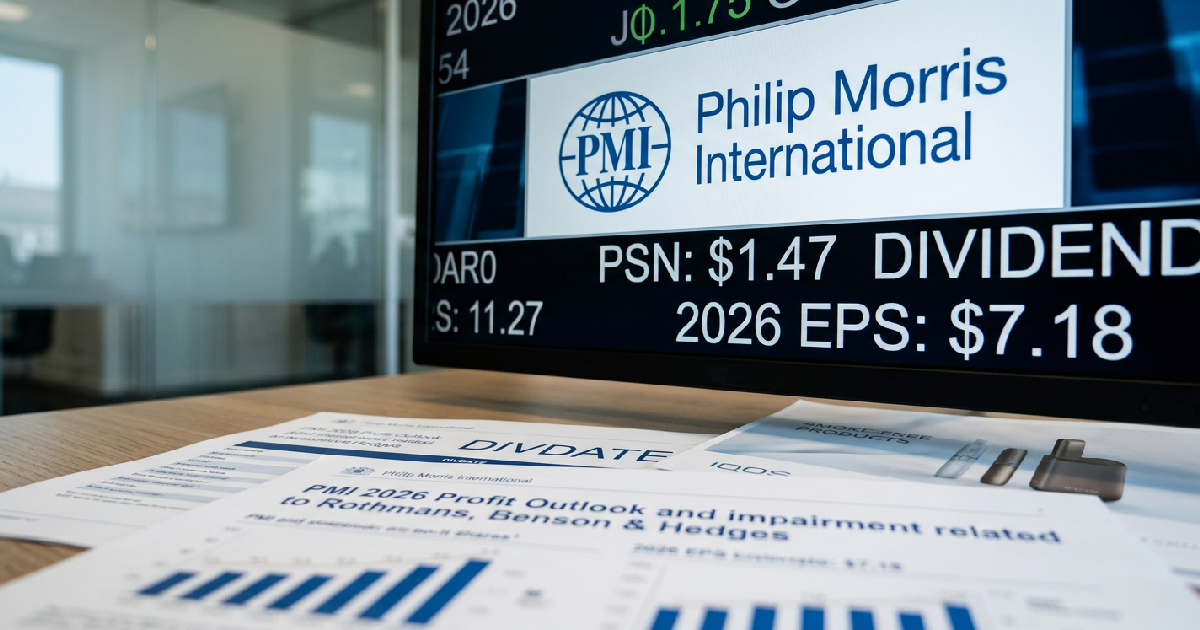
Philip Morris International confirms $1.47 dividend, lowers 2026 profit outlook to $7.18
Philip Morris International Inc. announced a regular quarterly dividend of US$1.47 per share on June 14, 2026, alongside an updated earnings outlook for the 2026 fiscal year. The company confirmed that shareholders of record on June 25, 2026, will receive the payment on July 20, 2026.
This financial update also includes a revised guidance for 2026 full-year reported diluted earnings per share (EPS), now projected in the range of US$7.18 to US$7.33.
The adjustment to the EPS guidance primarily reflects currency effects and a substantial non-cash impairment. Philip Morris International Inc. expects a US$500 million charge related to its Canadian affiliate, Rothmans, Benson & Hedges (RBH). Despite these accounting adjustments, the company indicates that the core risk-reward balance remains largely unchanged for investors focused on its evolving product base.
This transition is centered on an aggressive expansion into the smoke-free market. Recent data shows that smoke-free products now contribute over 40% of the company’s net revenues. In the first quarter of 2026, these products, led by brands such as IQOS and ZYN, accounted for 43% of total net revenues. These offerings are currently available in more than 105 markets globally.
Dividend metrics and long-term earnings growth
The US$1.47 per share dividend maintains the same level as the payout distributed on April 13, 2026. Over the last decade, Philip Morris International Inc. has increased its dividend by an average of 3.9% annually. With a current dividend yield of 3.19%, the firm continues to frame itself as an income-generating stock.
The consistency of these payments is a key factor for shareholders monitoring the company’s transforming product base.
Analysis of dividend sustainability shows that the payout is covered by both earnings and cash flows. The current earnings payout ratio stands at 78%, while the cash payout ratio is 86%. These figures reflect how the company manages its capital distribution while continuing to fund its strategic shift. Unlike the com/crypto-news/bitcoin-price-drops-over-5-to-67-692-76-liquidating-445-mill/”>high volatility often seen in digital assets, the company’s dividend history provides a specific metric for long-term equity holders.
Looking ahead, Philip Morris International Inc. expects its EPS to grow by 28% over the next three years. This projection comes despite the immediate impact of the US$500 million non-cash impairment in Canada. While the 2026 reported figures are trimmed, the broader narrative for the company remains tied to its ability to scale high-growth segments in international markets.
Operational impact of the RBH non-cash impairment
The US$500 million impairment regarding Rothmans, Benson & Hedges represents a significant paper adjustment for the 2026 fiscal year. Because the charge is non-cash, it does not involve an immediate outflow of capital, which allows the company to maintain its dividend schedule. This adjustment is a specific regional development within the Canadian market rather than a global operational failure.
Currency fluctuations also played a role in narrowing the 2026 EPS range to US$7.18–US$7.33. International corporations often face these headwinds, requiring resiliency in corporate strategy to manage shifting exchange rates. For Philip Morris International Inc., the impairment and currency effects are the primary drivers for the guidance update, rather than a decline in product demand.
Smoke-free revenue reaches 43 percent in first quarter
The growth of the smoke-free segment remains the most active part of the company’s financial profile. Reaching a 43% contribution to net revenue in Q1 2026 marks a significant point in the company’s history. The expansion of IQOS and ZYN has allowed the firm to diversify its revenue streams across various regulatory environments.
This transformation is occurring as financial institutions increasingly look at technological shifts to redefine traditional business sectors.
Investors are now looking toward the upcoming Q2 2026 results for further confirmation of these trends. Philip Morris International Inc. is scheduled to report these results on July 22, 2026. The market will be watching to see if the smoke-free segment’s momentum can offset the currency and impairment pressures noted in today’s guidance update.
Future outlook for Philip Morris International shareholders
The decision to reaffirm the dividend while adjusting EPS guidance suggests a focus on shareholder returns during a period of structural change. The company’s ability to generate 43% of its revenue from smoke-free alternatives in early 2026 provides a different context for its US$500 million impairment in Canada. For long-term holders, the 28% projected EPS growth over three years remains the benchmark for success.
The dividend payment on July 20, 2026, will be the next major milestone for those on the share register by the June 25 record date. As the company continues its expansion into 105 markets with its new product lines, the focus remains on the sustainability of its 78% earnings payout ratio.
The upcoming July earnings call will likely provide more granular detail on how the Canadian impairment affects the year-end balance sheet.