

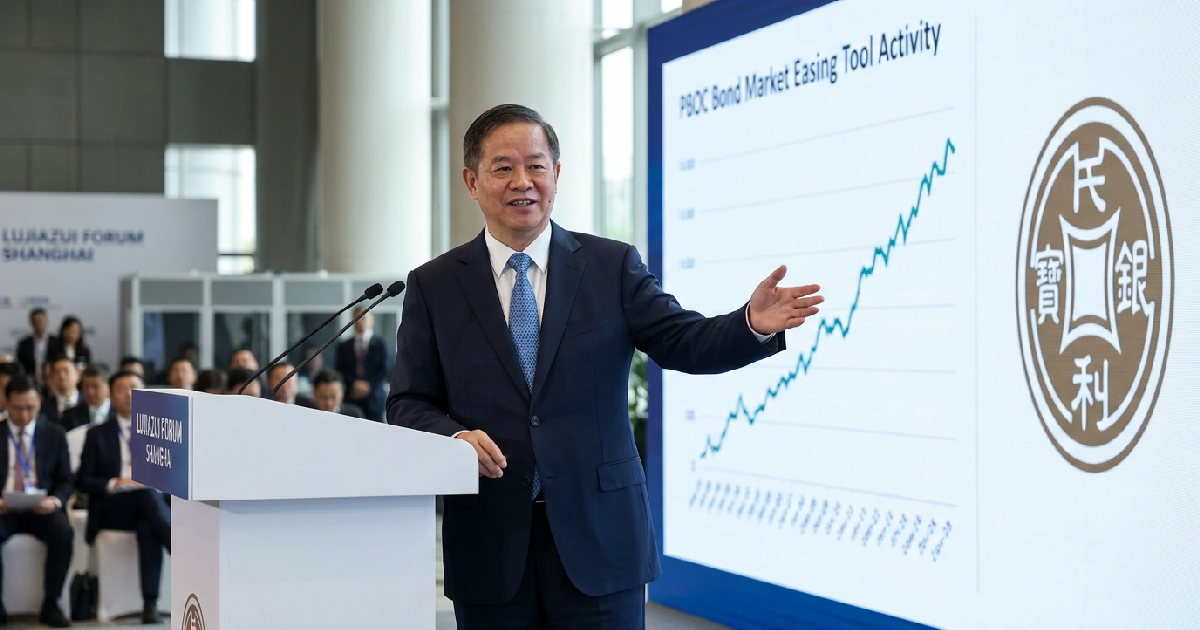
Pan Gongsheng announces PBOC will trade government bonds to manage economy
Governor Pan Gongsheng of the People’s Bank of China (PBOC) announced a fundamental shift in the nation’s monetary policy on Wednesday, June 17, 2026, revealing that the central bank will increasingly rely on government bond trading rather than traditional lending to manage the economy.
Speaking at the Lujiazui Forum in Shanghai, Pan Gongsheng outlined a transition toward a price-based model designed to enhance the precision of short-term interest rate adjustments. This reform marks a departure from decades of reliance on direct bank loans as the primary tool for liquidity injection.
The move signalises a maturation of the Chinese financial system as it attempts to align more closely with the operational frameworks used by the Federal Reserve and the European Central Bank. By trading sovereign debt on the open market, the PBOC gains a more flexible lever to control funding costs within the banking sector.
This evolution occurs as the central bank seeks more “room to maneuver” in an environment where traditional credit growth has faced structural headwinds. The central bank’s focus is now firmly on the “transmission” of policy rates to the real economy.
The pivot follows a series of incremental steps taken over the last two years. On August 30, 2024, the PBOC conducted its first treasury bond trade in nearly two decades, a move that set the stage for the current systemic overhaul.
Following that, the central bank introduced outright reverse repo operations on October 28, 2024, to manage banking system liquidity with greater granularity. These tools allow the bank to fine-tune the amount of cash circulating among lenders without the blunt impact of across-the-board reserve requirement changes.
UBS Asia President Iqbal Khan views AI as ‘biggest transformation’ for banking jobs
Expanding the central bank bond market toolkit
The central bank is not just buying bonds; it is creating a sophisticated ecosystem of repurchase agreements and swap facilities. PBOC Governor Pan Gongsheng confirmed that the bank will improve the use of temporary overnight reverse repo and repo operations.
These facilities will run daily from 3:00 PM to 3:30 PM, with interest rate corridors set at 25 basis points above and below the seven-day reverse repo rate. This narrow window allows for surgical adjustments to liquidity during the final trading hour.
To support this shift, the PBOC has also broadened its engagement with the private sector. In October 2024, it established swap facilities specifically for securities firms, mutual funds, and insurance companies. This ensured that non-bank financial institutions remained liquid even during periods of market volatility.
Such measures are increasingly relevant as global financiers, including those at supply chain firms prioritising resiliency, keep a close eye on China’s domestic stability.
The central bank has shown a willingness to be active on both sides of the ledger. While it resumed purchasing sovereign bonds in October 2025, it had previously suspended such purchases on January 10, 2025, citing “persistent excess demand.”
This high-frequency involvement indicates that the PBOC is moving away from the “set and forget” mentality of long-term lending toward a more active, market-making role that responds to daily shifts in bond yields.
Managing yuan liquidity for international institutions
A significant component of the reform involves the internationalisation of the yuan. The PBOC is establishing new repo facilities specifically for foreign central banks, sovereign wealth funds, and international financial organisations. These entities often face hurdles in managing their on-shore yuan holdings. The new facility allows them to use high-quality yuan-denominated bonds—such as Chinese government bonds and policy bank bonds—as collateral for short-term liquidity.
The tenors for these international repos include seven-day, one-month, and three-month options. By providing these windows, the PBOC aims to make the yuan a more attractive reserve currency. As of the end of May 2026, overseas institutions held approximately RMB 3.21 trillion of bonds in the interbank market.
Providing these holders with a reliable way to access cash through repos reduces the risk of sudden, large-scale sell-offs that could destabilise the exchange rate.
Authorised lenders and offshore trading
Six major state-owned lenders have been authorised to lead the charge in offshore foreign exchange trading under these new guidelines.
These institutions include:
- Industrial and Commercial Bank of China
- Agricultural Bank of China
- Bank of China
- China Construction Bank
- Bank of Communications
- Citic Bank
On June 12, 2026, the central bank specifically instructed these big lenders to reduce interbank lending, forcing a shift toward the bond market for funding needs.
The impact of shifting from loans to bond operations
The broader easing tool offered by bond trading gives the PBOC a way to influence the “yield curve” rather than just the “base rate.” When the bank buys short-term bills and sells long-term bonds, it can effectively flatten or steepen the curve to suit economic goals.
This is a far more nuanced approach than the targeted monetary policy tools discussed by Vice-governor Zou Lan back in January 2026, which focused more on specific sector support.
This transition also addresses the problem of “excessive” liquidity in some parts of the system and “scarcity” in others. In May 2025, the PBOC cut its seven-day policy rate to 1.4%, but the effects were unevenly felt. Using open market operations (OMO) allows the bank to target specific primary dealers.
On June 2, 2026, the bank demonstrated this control by reducing its daily OMO to a record low of 200 million yuan, proving it can tighten as easily as it can ease.
The use of CNY 700 billion in three-month outright reverse repos in November 2025 further illustrated the scale at which the bank is now comfortable operating. By moving these massive sums through the bond market, the PBOC avoids the “stigma” sometimes associated with banks borrowing directly from the central bank during times of stress.
Instead, the liquidity appears as a natural market transaction, which helps maintain confidence in the broader financial system.
Monetary policy outlook following the Lujiazui Forum
The reforms announced in Shanghai suggest that investors should prepare for a more volatile but more transparent interest rate environment. As the PBOC moves toward a price-based model, the seven-day reverse repo rate will likely become the “North Star” for all other market rates.
Analysts have noted that the bond market began pricing in these easing measures as early as January 9, 2026, signaling that the market was ahead of the official policy shift.
However, challenges remain. The central bank must balance its desire for lower rates with the need to prevent the yuan from weakening too rapidly against the dollar.
Furthermore, the “persistent excess demand” for government bonds seen in early 2025 suggests that if the PBOC isn’t careful, its own buying could drive yields so low that they no longer reflect economic reality. Pan Gongsheng’s team will need to remain nimble as they navigate this new, bond-centric landscape.
Looking ahead, the success of this transition will depend on the depth of the secondary bond market. For the PBOC to use bonds as its primary tool, there must be enough volume for the bank to trade without causing massive price distortions.
The efforts to bring in sovereign wealth funds and international organisations are a clear attempt to deepen this pool. As the PBOC continues to refine these facilities, the era of “loan-first” Chinese monetary policy appears to be drawing to a close.