

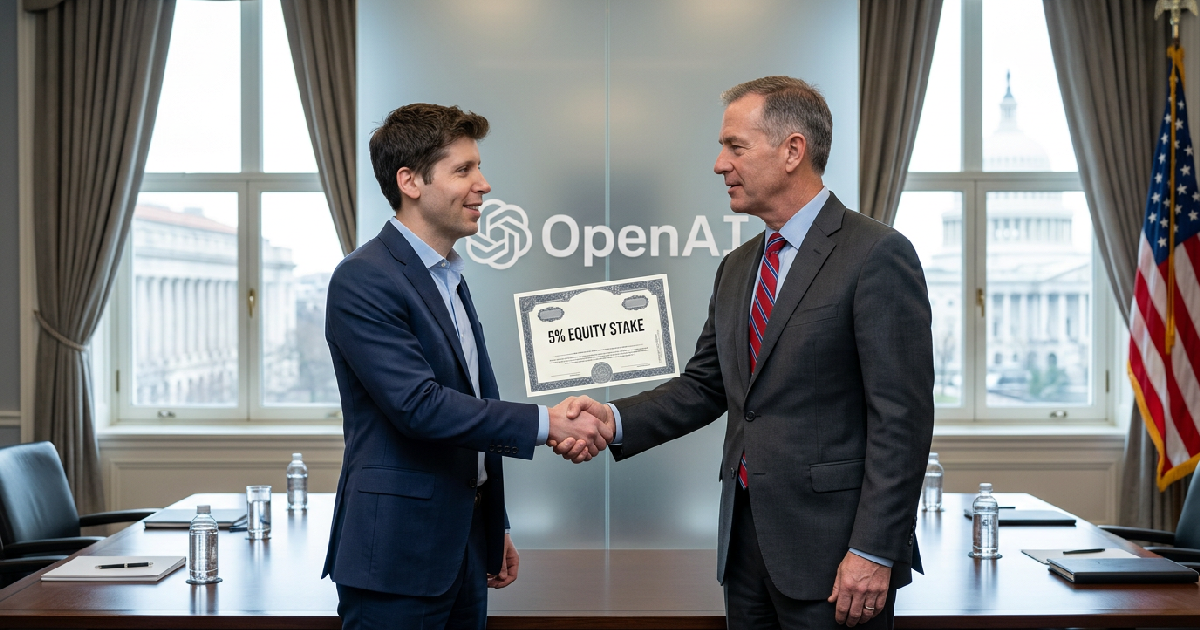
OpenAI proposes 5% stake to Trump administration to ease Washington pressure: report
Artificial intelligence powerhouse OpenAI has reportedly proposed offering the U.S. government a 5% equity stake in the company. This move, which could see the Trump administration acquire shares worth an estimated $42.6 billion, aims to defuse mounting political pressure in Washington over AI regulation and broaden the economic benefits of the technology for American citizens. The proposal, initially detailed by the Financial Times on Thursday, July 2, 2026, stems from more than a year of discussions involving OpenAI CEO Sam Altman and senior Trump administration officials in Washington D.C.
This proposal comes as OpenAI prepares for an initial public offering (IPO) and faces increasing scrutiny over the safety and societal impact of its advanced AI models. The 5% stake is designed to secure government buy-in and align the company’s trajectory with national interests, potentially channeling a portion of AI’s burgeoning wealth directly into public hands.
OpenAI’s valuation and the proposed government stake
The potential 5% holding would be valued at approximately $42.6 billion. This figure is derived from OpenAI’s substantial $852 billion valuation, achieved in a record-breaking funding round completed in March 2026.
OpenAI CEO Sam Altman has been a key advocate for this arrangement. He reportedly suggested a stake of this size in early conversations with the Trump administration. His central argument is that giving the public a financial interest in the company is the best way to share the immense upside of artificial intelligence.
Sharing AI’s upside with the public
This concept aligns with a white paper published by OpenAI in April 2026, which outlined the idea of a "Public Wealth Fund." Such a fund would hypothetically invest in diversified, long-term assets to ensure national prosperity and allow citizens to participate directly in AI’s financial gains. For some, this represents a tangible way to democratize the wealth generated by advanced technology.
And it’s a concept that has garnered interest from prominent figures. Senator Bernie Sanders (I-Vt.) confirmed discussing the sovereign wealth fund idea with Altman. Sanders, who has previously proposed a 50% one-off tax on major AI firms’ equity, plans to introduce his own "American A.I. Sovereign Wealth Fund Act."
But the substantial capital flowing into AI and quantum technologies also has broader market implications. This diversion of investment can impact other sectors, as seen with how Bitcoin (BTC) price drops to $75,406 as AI and quantum tech divert capital from traditional crypto assets.
Federal government’s growing tech portfolio
The U.S. government isn’t a stranger to taking equity positions in strategically important companies. The Trump administration, in particular, has pursued financial stakes in several key technology and critical resource firms during its second term.
Currently, the government holds a 10% stake in Intel Corp, a position secured after an $8.9 billion investment in the chipmaker’s common stock. This investment underscores a broader strategy to bolster domestic industrial base capacity and resilience in critical sectors.
Broader administration investment strategy
President Donald Trump has explicitly voiced his desire for even larger federal holdings. In May, he remarked that he should have sought a bigger stake in Intel, signaling his administration’s appetite for such partnerships. He’s previously called the idea of the U.S. taking ownership in AI giants "a beautiful thing."
Beyond Intel, the Trump administration has also acquired stakes in International Business Machines (IBM) and Global Foundaries. Investments have extended to other critical quantum and mineral companies, reflecting a comprehensive industrial policy aimed at securing crucial technologies and resources. This includes initiatives like the plans for Posco International to build a US rare earth plant, highlighting a focus on critical supply chains.
Many other governments globally are also invested in AI companies, often through their sovereign wealth funds. Examples include MGX out of Abu Dhabi and the UAE fund, which hold stakes in AI firms like OpenAI and Anthropic. This global trend suggests a wider recognition of AI as a national strategic asset.
Alleviating Washington’s regulatory concerns
OpenAI’s proposal comes amid intense debate in Washington regarding the regulation of advanced AI systems. The company is actively lobbying the White House and Congress, seeking to shape future legislation.
This 5% stake offer is clearly a strategic gambit to address this mounting political pressure. OpenAI aims to ease scrutiny over AI’s rapid development and secure vital support from the Trump administration as it navigates this complex regulatory environment.
The mechanism of government partnership
The proposed arrangement envisions OpenAI donating equity to the U.S. government, potentially channeling it into a "Public Wealth Fund" as suggested in their April white paper. It’s an attempt to transform the government from a potential antagonist into a vested partner.
However, it remains unclear whether other U.S. AI companies would be willing to cede similar stakes to the federal government. Such a collective arrangement would significantly broaden the scope of this public-private partnership model across the burgeoning AI sector.
But not everyone sees this as a positive development. Nat Purser, a Senior Policy Advocate at Public Knowledge, criticized the idea. He stated to NOTUS that it’s "not in the public’s best interest to have a situation where the government becomes less willing to impose, or enforce, safety rules because doing so could reduce the value of its own investment." This highlights a core tension in the proposal: balancing public benefit with regulatory oversight.
President Trump’s vision for an ‘American partnership’ in AI
President Donald Trump has repeatedly signaled his enthusiasm for the federal government taking an ownership stake in America’s leading technology firms, particularly in the rapidly evolving field of artificial intelligence. His comments suggest a vision where national economic interest and technological advancement are deeply intertwined.
In June, speaking to reporters on Air Force One, President Trump framed the concept as a way to make Americans "partners in this revolution." He elaborated, stating it "would be a beautiful thing" and could "make them rich." These remarks underscore his belief that the financial success of these companies should directly benefit the citizenry.
From executive order to specific proposals
This sentiment isn’t new; President Trump signed an executive order in February 2026 directing the federal government to establish a national sovereign wealth fund. The OpenAI proposal, while specific, aligns broadly with this larger administration goal of leveraging public funds for strategic investments and national prosperity.
Altman’s direct pitch to President Trump in early 2025 initiated these conversations. Since then, talks have continued in Washington D.C., with Altman meeting various lawmakers and officials in June and July 2026 to push the idea forward. It’s a clear effort to embed OpenAI’s future deeply within the U.S. national economic framework.
OpenAI’s IPO ambitions and market outlook
The timing of OpenAI’s proposed government stake is particularly noteworthy given its current trajectory toward becoming a publicly traded company. The AI giant filed with the Securities and Exchange Commission (SEC) for an initial public offering (IPO) in June 2026, a move that places it under heightened scrutiny.
Many industry observers view this proposal as a strategic effort to boost the legitimacy and stability of OpenAI’s upcoming IPO. Securing a government stake could be perceived by investors as a vote of confidence and a mitigation of future regulatory risks, potentially making the offering more attractive.
However, market sentiment around the IPO remains fluid. Current market pricing suggests a decrease in confidence for OpenAI’s IPO by December 31, 2026, with the odds of it happening currently standing at 23.5% YES. This indicates that while the company is pursuing public listing, there’s a degree of skepticism among some market participants about its immediate prospects.
Lobbying for broader industrial support
Beyond the equity stake, OpenAI has also been actively lobbying the White House for broader industrial policy support. The company has sought "grants, cost-sharing agreements, loans, or loan guarantees to expand industrial base capacity and resilience." This demonstrates a desire for comprehensive government backing, not just financial investment, but also a supportive policy environment that nurtures AI development within the U.S.
Navigating the future of AI governance and investment
While OpenAI’s offer of a 5% stake to the U.S. government marks a significant development, it’s crucial to remember that no final agreement on the investment terms has been reached. Discussions are ongoing, and the financial details, along with the precise mechanism of the stake transfer, remain subject to change.
This conceptual bid by OpenAI represents a calculated effort to secure long-term stability and foster a more collaborative relationship with federal regulators. If successful, this model could fundamentally reshape how Silicon Valley’s leading tech firms interact with the federal government, establishing a new precedent for public-private partnerships in the advanced technology sector.
The White House and other major AI labs, such as Anthropic, have not yet provided official responses to CNBC’s requests for comments on the specifics of the Financial Times report. Their reactions, or lack thereof, will be closely watched as the dialogue continues.
Ultimately, the debate over direct government equity in private technology companies is set to intensify in the coming months and years. The sheer scale of the $42.6 billion offer ensures that federal officials will weigh the proposal carefully, balancing the potential for shared prosperity against the complex implications for regulatory independence and market dynamics.