

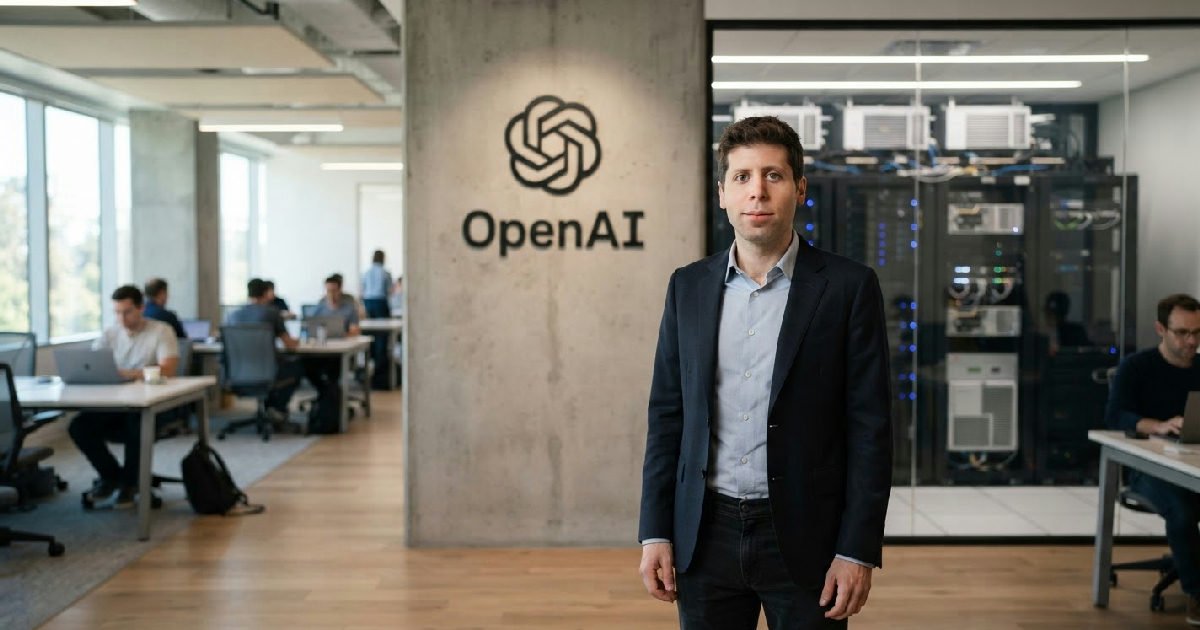
OpenAI lowers funding goal to $20 billion
OpenAI, a leading artificial intelligence research company, has significantly reduced its funding target for its latest investment round by an assertive $10 billion. The company, initially aiming to raise $30 billion at a $1.4 trillion valuation, is now seeking approximately $20 billion at a revised valuation of $1.25 trillion.
This substantial adjustment, reported by The Financial Times, comes amidst a brutal tech market sell-off and increasing investor caution regarding the rapid pace and scale of AI spending.
OpenAI lowers funding targets amid market pressures
The decision underscores a broader shift in investor sentiment, as the initial exuberance for artificial intelligence ventures faces a reality check. While OpenAI had previously cited a rapid increase in revenue since July to justify a near doubling of its price tag from an $852 billion valuation in March 2026, market conditions have clearly cooled.
OpenAI’s decision to lower its ambitions reflects a challenging fundraising environment. The company had set a recent Friday deadline for investors to commit to the funding round. Despite the revised $20 billion target, the “first close” of the funding round is anticipated to bring in less, as some investors have opted to reduce their original allocations.
This adjustment represents a notable recalibration from OpenAI’s earlier, more aggressive projections. The company’s valuation target also dropped from $1.4 trillion to $1.25 trillion, indicating a more conservative outlook on its immediate market worth.
Tech market turbulence and AI spending anxieties
Several significant factors are driving this reduction in OpenAI’s fundraising goals. A primary concern is the ongoing sell-off in technology stocks, which has created a more cautious investment climate. This broader market contraction has made investors more hesitant to commit to large, high-valuation private deals, especially in nascent sectors.
Just recently, the tech-heavy Nasdaq 100 experienced a sharp decline, falling 3.5% on a recent Friday. This performance mirrors a growing anxiety among investors about the sustainability and extent of current AI spending. Many are questioning the massive capital outlays required for AI development and whether returns will justify such investments.
The current market environment suggests a shift from the speculative enthusiasm that characterized earlier AI funding rounds. Investors are now scrutinizing business models and pathways to profitability more closely. Tech markets remain volatile.
Anthropic IPO creates competitive pressure
Adding to OpenAI’s fundraising challenges is the imminent public listing of its key rival, Anthropic. Anthropic is preparing for its own initial public offering, expected in mid-November, at a reported valuation of over $1.5 trillion. This direct competition for investor capital is undoubtedly influencing the landscape for private AI deals.
Anthropic’s aggressive valuation and impending market debut are putting additional pressure on OpenAI to refine its own financial strategy. With another major AI player entering the public markets, investors have more options, potentially diluting the pool of available capital for private rounds. This dynamic forces companies like OpenAI to offer more attractive terms or adjust their expectations.
Key investors and OpenAI’s future plans
Despite the scaled-back target, several prominent investors are still participating in OpenAI’s funding round. A consortium of investment groups from the United Arab Emirates, including state-backed tech fund MGX, is expected to be the largest participant. As part of this strategic deal, OpenAI will gain an option to lease newly developed computing power in the region, an essential resource for AI development.
Other notable venture capital firms reportedly involved include Founders Fund, Coatue, Sequoia Capital, Andreessen Horowitz, and Masayoshi Son’s SoftBank. Their continued participation, even at a reduced target, signals confidence in OpenAI’s long-term potential.
Pathway to a future IPO
OpenAI also has a subsequent retail offering planned, which will allow wealthy individuals to invest in the company at the $1.25 trillion valuation. This move could potentially help expand the round to reach closer to the $20 billion target. Looking further ahead, OpenAI aims for its own initial public offering next year, mirroring the path of its competitor Anthropic.
The company’s ambition to go public underscores its long-term strategy to raise substantial capital and solidify its market position. The retail offering serves as an intermediary step, broadening the investor base before a full public debut.
The high cost of advanced AI development
Developing cutting-edge artificial intelligence models demands immense financial resources, primarily for computing power. OpenAI plans to spend multiples of its raised capital on precisely this: training and running its sophisticated models. This insatiable demand for computational infrastructure makes fundraising targets particularly sensitive to market shifts.
The sheer scale of investment needed highlights why large funding rounds are critical for AI companies. Any reduction in fundraising capacity can impact research timelines, model development, and the ability to scale operations effectively.
Broader implications for the AI investment landscape
OpenAI’s adjusted funding target serves as a bellwether for the wider artificial intelligence investment community. It suggests that the era of seemingly limitless capital for AI startups, fueled by hype, may be giving way to a more pragmatic and scrutinizing environment. Investors are becoming increasingly selective, demanding clearer paths to profitability and more tangible returns on their significant investments.
This evolving landscape could lead to a consolidation within the AI sector, favoring companies with robust business models and proven technologies. Startups that relied heavily on inflated valuations and speculative growth might find it harder to secure funding moving forward.
This change forces a more disciplined approach to capital allocation and operational efficiency across the industry. The conversation around artificial intelligence capabilities, even with terms like super intelligence, now includes financial prudence.
A maturing market for AI
The current market conditions, characterized by high interest rates and a general slowdown in venture capital, are prompting a re-evaluation of growth-at-all-costs strategies. For AI companies, this means a greater emphasis on generating revenue and demonstrating a clear return on investment rather than solely focusing on technological breakthroughs. The market is maturing, and with that comes a demand for greater financial accountability.
This shift could ultimately benefit the AI ecosystem by weeding out less viable ventures and focusing resources on those with the most promising commercial applications. It’s a natural progression for any rapidly expanding technological frontier, moving from early-stage speculative investment to more grounded, performance-driven funding. It’s a stark contrast to earlier crypto market exuberance, where concerns about crypto fraud schemes were often secondary to growth.