

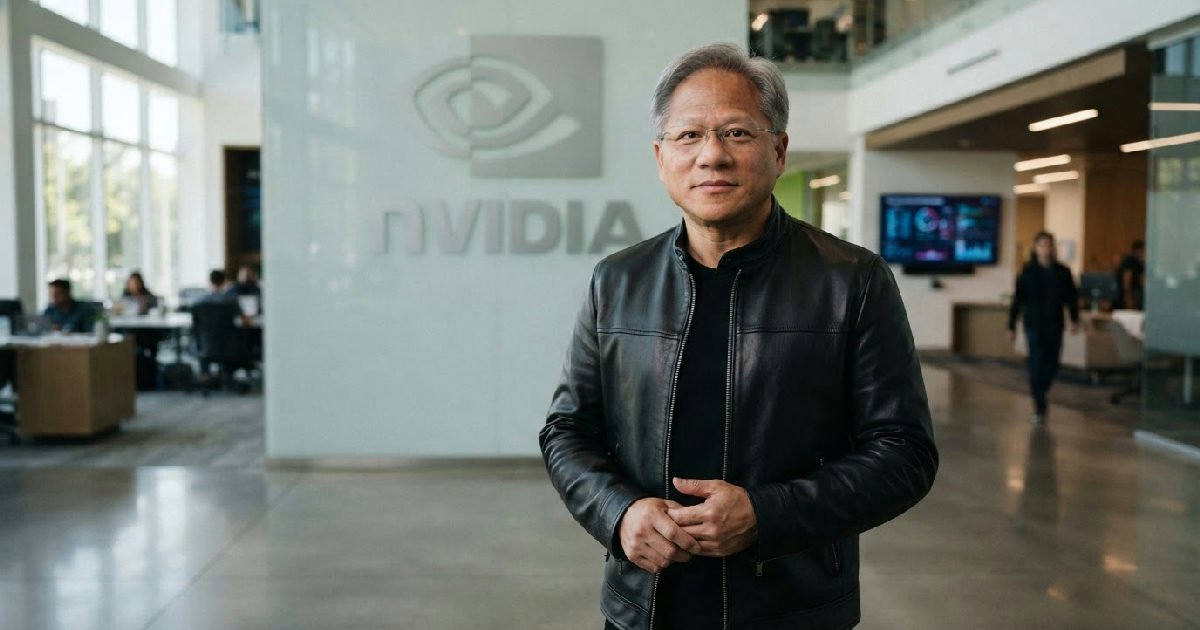
Nvidia board investigates CEO Jensen Huang
Nvidia’s board of directors has launched an independent investigation into its co-founder and Chief Executive Officer, Jensen Huang, following reports he was targeted by a foreign intelligence operation.
The probe was triggered by US intelligence officials’ suspicions that Alice Huang, an executive at an Nvidia customer and a Chinese citizen, is a Chinese spy who maintained a close relationship with Jensen Huang.
Nvidia board launches probe into CEO’s conduct
The investigation also follows Jensen Huang’s public admission in an email to company staff on Sunday, November 8, 2024, that he had been “unfaithful” to his wife.
This development casts a spotlight on Nvidia, the artificial intelligence industry’s dominant force, amidst escalating geopolitical tensions over advanced technology. While the board has stated it has no reason to believe national security or Nvidia secrets were compromised, the inquiry will examine all available information.
Jensen Huang, who has built Nvidia into a global tech titan, will remain CEO during the review and has pledged his full cooperation. This incident draws attention to various market and technological shifts, including new game announcements.
The Nvidia Board of Directors confirmed the independent investigation, stating a committee of independent directors, supported by outside counsel, would oversee the process. Their focus is to ascertain whether Jensen Huang was indeed the “target of a foreign intelligence effort.” This formal inquiry comes at a critical time for the company, valued at over $4.5 trillion.
Jensen Huang addressed his staff directly in an email on November 8, 2024, acknowledging his infidelity. “I was unfaithful to my wife. My actions hurt her and our children. There is no excuse for what I did,” Huang wrote, expressing deep regret. He accepted full responsibility for his actions and the resulting criticism.
Jensen Huang’s personal admission
Huang’s candid admission directly links his personal conduct to the broader investigation. He explicitly stated, “I am deeply sorry,” and committed to protecting Nvidia while supporting America’s national security. This public disclosure highlights the extraordinary pressures leaders in critical technology sectors face, particularly when personal lives intersect with matters of national security.
The board’s statement emphasized its confidence in Jensen Huang and his leadership team, confirming he would continue in his role throughout the investigation. Nvidia spokesperson John Rizzo reiterated this position, asserting, “Today’s news will not slow Nvidia. Jensen is committed to continuing to lead Nvidia as CEO without interruption.”
Allegations of foreign intelligence efforts
The investigation stems from reports that surfaced in The New York Times in October 2024, detailing US intelligence officials’ suspicions about Alice Huang. She is identified as a Chinese citizen and former executive at Megaspeed, a Singapore-based data center company.
Intelligence agencies reportedly concluded she was an asset of China’s Ministry of State Security (MSS), tasked with gathering information on Jensen Huang and Nvidia’s cutting-edge AI chips.
Alice Huang and Jensen Huang were photographed together in Taiwan earlier in 2024, fueling speculation about their relationship. US officials reportedly believe their connection extended beyond professional interactions to include a romantic relationship. The core concern revolves around the potential for sensitive US technology and information to have been compromised and passed to Beijing.
This situation underscores the intense economic warfare between the US and China, particularly concerning advanced semiconductors. The US government has imposed stringent export controls on AI chips to China, aiming to curb Beijing’s technological advancements. This includes restrictions on sales of top-tier processors to Chinese customers, a policy Nvidia has navigated.
Megaspeed’s role and chip sales
Megaspeed, a significant Nvidia customer, has purchased billions of dollars worth of chips, with one report citing $4.8 billion in equipment. The company rents data center capacity, including to Chinese technology firms like Alibaba. US authorities have been investigating Megaspeed since late 2024 for allegedly helping Chinese businesses bypass export restrictions on advanced AI chips.
Jensen Huang had previously defended his business dealings with Megaspeed as “normal and not unusual,” asserting that Nvidia had verified the company did not unlawfully ship AI processors to China. The Chinese Embassy in Washington, D.C., has denied all allegations of spying, dismissing them as “groundless speculation.”
Industry reaction and market implications
The news of the investigation and Huang’s admission coincided with a turbulent period for tech stocks. Nvidia’s shares, traded under Nasdaq: NVDA, fell 9 percent for the week as of Friday’s close, reflecting a broader sell-off across the sector.
This downturn, attributed to election-related uncertainty and concerns about data center demand, erased approximately $450 billion in market value for the company. Analysts suggested these market shifts are part of a broader industry trend, impacting sectors such as console platform exclusivity.
Despite the immediate market reaction, analysts offered mixed views on the long-term impact. Phillip Wool of Rayliant Global Advisors suggested that while the investigation is newsworthy, it might not significantly affect Nvidia’s shares. He noted that investors often prioritize company fundamentals and demand for hardware, often overlooking other issues when companies are performing well.
Increased scrutiny on chip sales to China
However, not all analysts shared Wool’s optimism. Dan Ives, Partner and Senior Managing Director at Yorkville & Ives Co., called the situation a “black eye moment” for Jensen Huang. Ives predicted heightened scrutiny on Nvidia’s chip sales to China and suggested the investigation would cast a shadow over the company’s share price.
He further warned that there’s a clear risk Jensen Huang could be removed as CEO, depending on the board’s findings.
The timing of these revelations is particularly sensitive for Nvidia, which is scheduled to report its third-quarter earnings on November 17, 2024. Investors will closely watch this report for any indications that data center construction slowdowns or other pressures are affecting the company’s outlook, alongside the implications of the ongoing probe.
Broader concerns over AI dominance and governance
Nvidia has cemented its position as a “kingmaker” in the global AI race, largely due to its Graphics Processing Units (GPUs) being essential for high-end AI technology. The company holds a dominant market share in AI chips, estimated at over 80% to 95% in various reports. This near-monopoly raises concerns about centralization risks and potential stifling of diverse AI development approaches.
The current situation also brings Nvidia’s corporate governance into sharper focus. The company has previously faced criticism, even receiving a “High Risk” rating from 1792 Exchange due to its perceived yielding to political activism and identity-based policies. This investigation adds another layer to those governance questions, particularly concerning the unique structure Jensen Huang implemented that allows him significant control over business aspects.
Congressional pressure on Nvidia
The US Congress has also weighed in, with several prominent lawmakers expressing serious concerns. Senator Chris Coons (D-Del.) voiced strong criticism, linking the situation to perceived corruption within previous administrations and vowing congressional investigation.
He stated, “The more I learn about the insane relationship between the Trump Administration, Chinese spies, and AI billionaires, the more I’m convinced there is nothing this administration does that isn’t corrupt.
Congress will investigate and get answers.” President Donald Trump had reportedly been briefed on intelligence regarding Alice Huang a year prior but chose not to act.
Senator Elizabeth Warren (D.) echoed these sentiments, demanding answers from Jensen Huang and Nvidia’s board regarding the flow of advanced AI chips to China.
Adding to the pressure, three House Republican committee chairs—House Foreign Affairs Committee Chairman Brian Mast, Select Committee on China Chairman John Moolenaar, and House Permanent Select Committee on Intelligence Chairman Rick Crawford—jointly wrote to Jensen Huang.
They requested his appearance for a private session with lawmakers on November 18, 2024, to address the “significant national security concerns” regarding China’s access to sensitive US technology.
Geopolitical landscape of AI chips
This incident is a stark reminder of how personal relationships can become critical points of vulnerability in an era of intense geopolitical competition. Intelligence services have historically used such avenues to gain access to key executives. The FBI has repeatedly warned about foreign intelligence agencies, particularly China’s, targeting US companies to steal trade secrets, often leveraging platforms like LinkedIn.
The US government’s stance against China’s technological ambitions means companies like Nvidia are on the front lines of what amounts to economic and technological warfare. The CIA has reportedly expanded its espionage efforts against China, specifically targeting firms in sensitive sectors such as AI, biotechnology, and semiconductors.
The Pentagon also established the Economic Defense Unit to counter adversaries through economic means, highlighting the severity of this ongoing struggle.
The path forward for Jensen Huang and Nvidia
Jensen Huang’s future at the helm of Nvidia hinges on the outcome of the independent investigation. The committee, assisted by outside counsel, will meticulously review communications and evidence to determine if any sensitive information was compromised. While the board has publicly backed Huang, analysts like Dan Ives point to the potential for his removal as CEO, depending on the findings.
The immediate challenge for Nvidia lies in managing investor and public perception ahead of its upcoming earnings report on November 17, 2024. The company’s continued financial performance will be crucial in reassuring stakeholders, even as the probe continues. The long-term implications could include stricter internal security protocols, a re-evaluation of board oversight, and potentially recalibrated strategies for engaging with international markets, especially China.
Ultimately, the investigation into Jensen Huang transcends a typical corporate governance issue; it touches on national security, global technological leadership, and the ethical responsibilities of executives steering companies at the forefront of innovation. Such high-profile incidents invariably push major technology firms to reinforce their defenses against both corporate and geopolitical threats.