

Nvidia’s AI Boom Escalates Demands for Global Data Centers
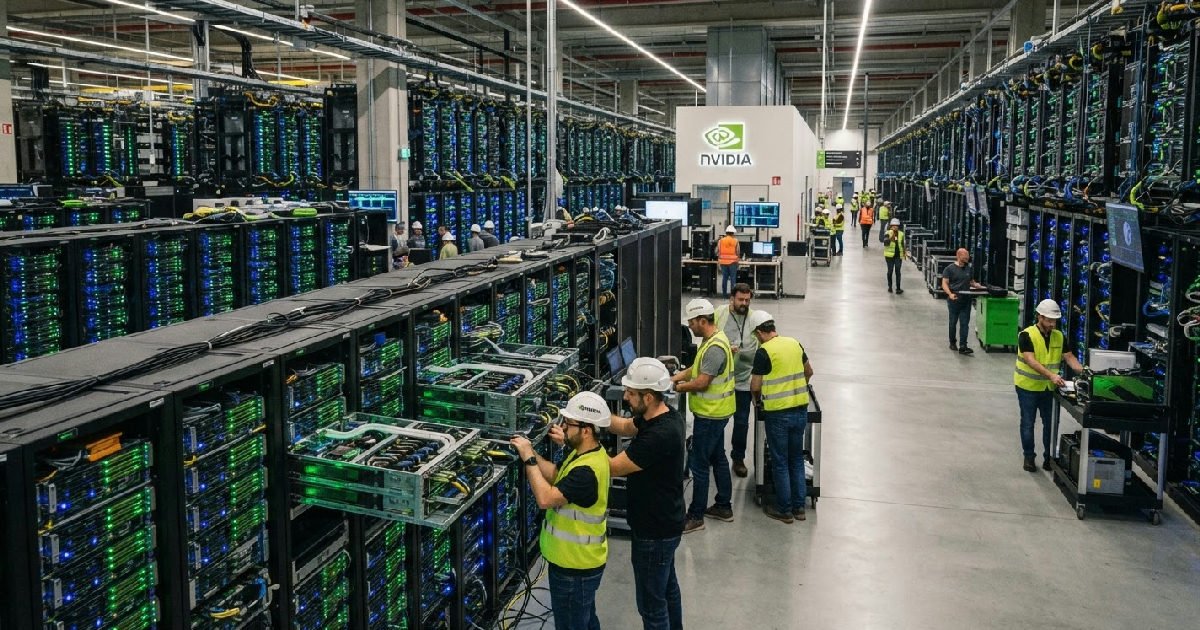
Nvidia’s explosive growth, particularly within its Data Center segment, is dramatically increasing pressure on global Nvidia data centers. The surging demand for artificial intelligence (AI) processing power, powered by Nvidia’s dominant Graphics Processing Unit (GPU) technology, is creating both unparalleled opportunities and significant challenges for the digital economy.
This market dynamic has prompted industry leaders to reassess investment priorities. Ardian’s Executive President Vlad Colas recently emphasized Europe’s digital infrastructure and secondary markets as crucial areas for investment, even as the pace of new data center construction slows globally.
Nvidia data centers and soaring revenue
Nvidia’s financial performance underscores the intense demand for AI capabilities. The company reported a total revenue of $81.6 billion for Q1 fiscal year 2027, ending April 26, 2026. This marked an impressive 85% year-over-year increase, with its Data Center revenue reaching $75.2 billion during the same period.
The momentum continued into Q2 fiscal year 2027, which ended July 26, 2026. Nvidia announced total revenue of $96.2 billion, representing a 106% year-over-year surge and an 18% increase from the prior quarter. Data Center revenue alone hit $89.0 billion, growing 117% year-over-year and 18% sequentially.
Nvidia’s Founder and CEO, Jensen Huang, has articulated this shift clearly. He noted that “Computing demand is growing exponentially – the agentic AI inflection point has arrived.” Huang also highlighted that “technology chips have become an investable asset class,” reflecting their strategic importance in the global economy.
The company’s next-generation platform, Vera Rubin, began its production ramp in August 2026. This signals Nvidia’s ongoing commitment to meeting the escalating needs for high-performance computing required by AI workloads. Amazon Web Services (AWS) plans to deploy an additional 2 million Nvidia GPUs, including Blackwell Ultra, Rubin, and Rubin Ultra models, across its global infrastructure in 2027 and 2028.
This move by AWS follows customer demand that significantly exceeded earlier expectations. AWS had already planned to add over 1 million Nvidia GPUs starting in 2026, demonstrating the relentless appetite for advanced processing power. These deployments illustrate how deeply integrated Nvidia’s technology has become in the foundation of modern AI.
Data center capacity strained as construction slows
Despite the surging demand for AI, the data center industry faces a significant paradox: a slowdown in new construction. This decelerated pace is largely due to a confluence of factors that are now making existing facilities far more valuable.
Rising interest rates have increased the cost of financing new data center projects, deterring some developers. Furthermore, material costs have seen a substantial overall increase of 55.5% since February 2020, impacted by global events and tariffs, making construction more expensive. Neil Osnato, Founder of Persistence Analytics Group, recently discussed the complexities of matching physical infrastructure buildout with rapid technology deployment.
But the biggest bottlenecks often relate to power availability and permitting challenges. Major data center hubs, such as Northern Virginia, are experiencing multiyear delays for new grid connections. Local communities frequently resist new developments, further complicating the expansion of critical digital infrastructure.
Steven Dickens, CEO and principal analyst at HyperFrame Research, has emphasized the profound implications of these supply-side constraints. He points out that the scarcity of new facilities means that existing data centers, especially those with robust power and cooling capabilities, are becoming increasingly valuable assets in the current market.
AI data centers consume significantly more energy than their traditional counterparts. A single Nvidia DGX H100 system, for instance, draws 10.2 kilowatts. Projections suggest that power demand from AI data centers in the U.S. could reach 123 gigawatts by 2035, a thirtyfold increase from 4 gigawatts in 2024. This dramatic increase puts considerable strain on energy grids and raises critical environmental concerns.
Strategic financing and sustainability initiatives
To address the burgeoning demand and infrastructure gaps, Nvidia is not just focusing on chip production. The company is actively pursuing strategic partnerships and making key investments in the broader digital infrastructure ecosystem. These efforts are crucial for sustaining its rapid growth trajectory and supporting the AI industry.
In August 2026, Nvidia announced a groundbreaking deal with six prominent Wall Street firms: Apollo Global Management, Blackstone, BlackRock, Brookfield Asset Management, Goldman Sachs, and KKR. This partnership aims to mobilize over $500 billion in third-party capital specifically for AI infrastructure financing. Mobilizing capital on this scale highlights the enormous financial commitment required to build out the AI economy.
Larry Fink, CEO of BlackRock, characterized AI infrastructure expansion as “an enormous economic opportunity.” He also warned that the U.S. alone would require an additional 70 gigawatts of power to support this growth. These figures underscore the vast scale of investment and resource allocation needed.
Nvidia also made a minority investment in data center power company Cloverleaf Infrastructure in August 2026. This move demonstrates a direct effort to shore up the power supply chain for its energy-intensive products. Furthermore, in October 2026, Nvidia significantly increased its supplier and capacity commitments, boosting them from $119 billion to $279 billion to ensure future demand can be met.
Sustainability is also becoming a core consideration. Josh Parker, Nvidia’s head of sustainability, spoke at COP31 about the importance of making data centers an asset to communities. He stressed prioritizing energy efficiency and water conservation, acknowledging the significant environmental footprint of these powerful new facilities.
Europe emerges as a key digital infrastructure hub
Amidst the global challenges and opportunities, Europe