

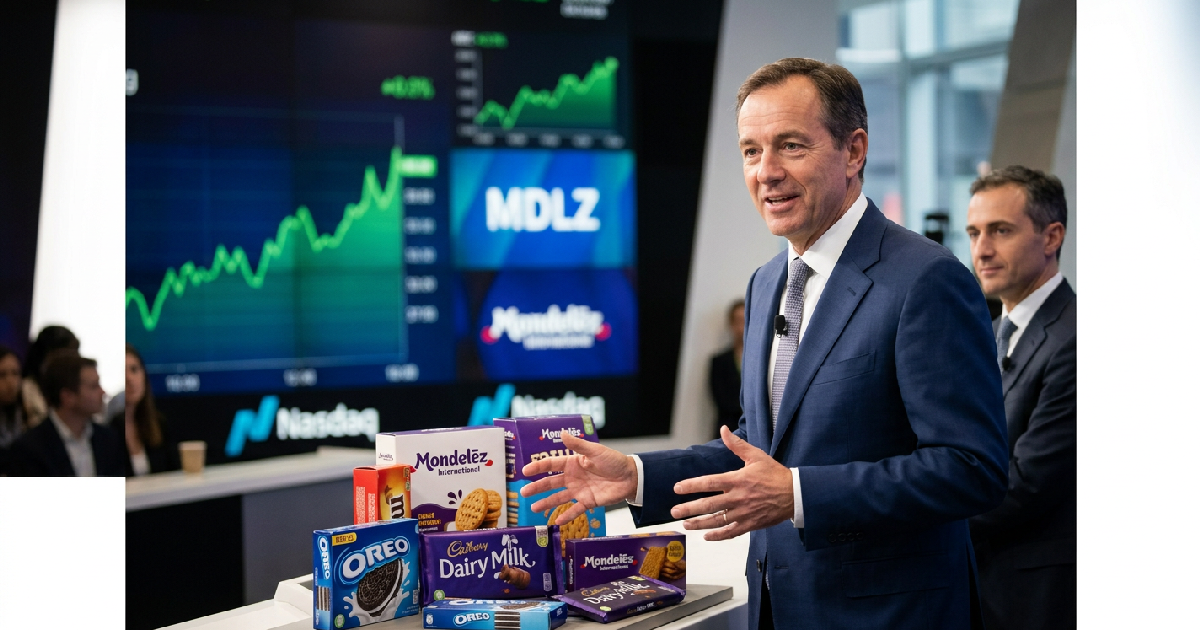
Dirk Van de Put accelerates Mondelēz snack focus, targets 90% revenue from core categories
Mondelēz International Chairman and CEO Dirk Van de Put is accelerating the company’s long-term strategy to focus its global portfolio on core categories including chocolate, biscuits, and baked snacks.
The plan, which seeks to generate 90% of revenue from these segments over time, involves a disciplined reshaping of the business through major divestitures and targeted acquisitions. On June 18, 2026, the company’s stock closed at $60.10 on Nasdaq, reflecting investor attention on the firm’s ability to maintain growth amidst shifting economic cycles.
The strategic roadmap was first unveiled on May 10, 2022, and has been a central theme of recent updates, including those provided at the February 2026 Consumer Analyst Group of New York (CAGNY) Conference. Management is prioritising high-margin power brands like Oreo, Milka, and Cadbury while moving away from non-core assets.
Mondelez International targets expansion in emerging markets
As part of this shift, the company completed the divestiture of its developed market gum business by 2023 and announced plans to sell its global Halls business, redeploying that capital into faster-growing snack adjacencies.
This organizational transformation includes a $1.2 billion investment in a global supply chain and systems overhaul. This initiative, categorised under “Operational Excellence,” aims to improve productivity and efficiency to support margins over the long cycle. These efforts are particularly relevant as global manufacturers find that com/international-news/supply-chain-resiliency-perma-crisis-era-logistics-shift/”>supply chain resiliency is increasingly prioritised to ensure consistent delivery in a volatile market. For Mondelēz International, these improvements underpin a long-term goal of sustaining 3% to 5% organic net revenue growth.
A significant portion of the company’s growth trajectory is tied to its performance in emerging markets such as China, India, Brazil, and Mexico. As of March 20, 2026, these regions accounted for approximately 39% of the company’s total revenue. These markets have proven to be a reliable engine for the business, delivering a 13.
4% compound annual growth rate (CAGR) over the last five years. CFO Luca Zaramella has highlighted these areas as vital for meeting the company’s “high single-digit” adjusted earnings per share (EPS) growth targets.
The company utilizes a local-first operating model, allowing regional teams to tailor global powerhouse brands to local consumer tastes. This approach is supported by a deeper distribution network and a focus on premiumizing product offerings. While these markets offer immense potential, the company remains exposed to currency swings and local economic cycles, necessitating a disciplined approach to capital allocation and operational innovation.
Portfolio reshaping through acquisitions and digital shifts
Mondelēz has been active on the M&A front to bolster its position in the $65 billion baked snacks market. Recent acquisitions include Evirth, which strengthened the company’s presence in China, as well as Clif Bar, Tate’s Bake Shop, and Ricolino.
These “bolt-on” deals allow the company to capture new consumer segments quickly while leveraging its existing global scale. This aggressive expansion strategy is backed by projections of free cash flow exceeding $3.5 billion for 2025.
The company is also investing over $1 billion to become a leader in digital commerce, with an ambitious target of generating 20% of its revenues through digital channels by 2030. This represents a significant increase from the 6% recorded in 2021.
This digital pivot is a broader trend across international business, similar to how AI and digital transformation are reshaping the landscape for high-level banking and services. For Mondelēz, the digital push is about meeting the consumer where they snack, whether in-store or online.
Financial performance and the snacking made right agenda
The company’s Q1 2024 results, reported on April 30, 2024, showed net revenues of $9.29 billion, a 1.4% increase year-over-year. Organic net revenue growth for the period was 4.2%, with an adjusted gross profit margin of 39.2%. During that same quarter, the company returned $1.
1 billion to shareholders through a combination of dividends and share repurchases. At the close of trade on June 18, 2026, the company’s market capitalization stood at $77.17 billion.
Sustainability has been elevated as the fourth pillar of the growth strategy under the “Snacking Made Right” agenda. A key public target was to source 100% of the cocoa volume for its chocolate brands through the Cocoa Life program by 2025.
This focus on ethical sourcing is increasingly important as international trade bodies, such as the Office of the U.S. Trade Representative, continue to scrutinise global supply chains and labor practices. For Mondelēz, sustainability is viewed as a prerequisite for long-term category leadership.
Looking ahead, the company continues to navigate headwinds such as input cost inflation and price sensitivity in North America. Executive Vice President Gustavo Valle is focused on restoring consumption growth in developed markets by addressing consumer desires for more affordability.
Despite these challenges, the company’s 2024 outlook remains steady, with organic net revenue growth expected to land between 3% and 5%, even as currency translation is projected to reduce net revenue growth by roughly 1.5%.