

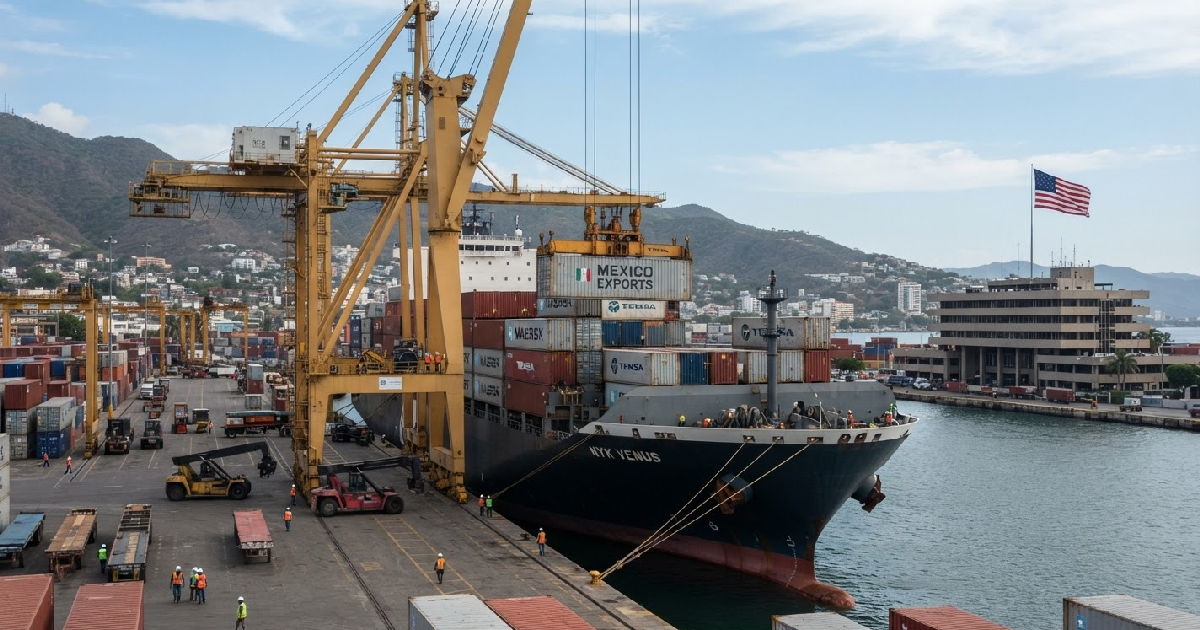
Mexico-U.S. cross-border trade hits $87.23 billion in May, Mexican exports set record
Mexico solidified its position as the United States’ largest trading partner in May 2026, with cross-border commerce reaching $87.23 billion. This robust trade was underscored by a historic record in Mexican exports to the U.S., which hit $54.18 billion for the month. These figures highlight the deepening economic integration between the two nations, driven by resilient supply chains and nearshoring trends.
The significant bilateral exchange, compiled from U.S. Census Bureau and U.S. Bureau of Economic Analysis data, confirms Mexico’s vital role in the North American economy. T21 Business Intelligence and WorldCity further analyzed this data, revealing critical shifts in global trade patterns and their implications.
Mexico’s record-setting trade performance in May
Mexico’s overall two-way trade with the U.S. in May 2026 saw a 17.4% increase compared to May 2015. This substantial growth demonstrates the increasing interdependence of the two economies, a trend gaining momentum for over a decade.
Exports from Mexico to the United States soared to $54.18 billion, marking a 17.5% growth over May 2025 figures. The Mexican Economy Ministry confirmed this export volume represents a historic record for Mexican goods shipped to the United States in any single month since data collection began.
In the same period, Mexico purchased $33.05 billion worth of U.S. goods, reflecting a 17.4% increase over May 2025. This strong exchange led to Mexico recording a trade surplus of $2.26 billion. That’s an impressive 83.4% higher than the surplus reported in May 2025, demonstrating Mexico’s increasing export prowess and competitive manufacturing base. The U.S.
deficit with Mexico subsequently grew by $5.3 billion, reaching $20.1 billion in May 2026. This widening gap signals a structural shift in trade flows.
Cumulative trade highlights strong ties
Looking at the first five months of 2026, bilateral trade between Mexico and the U.S. reached an unprecedented $404.6 billion. This cumulative figure stands 13% higher than the $359.184 billion recorded in the same period last year, indicating consistent momentum.
Mexico’s exports to the U.S. for this period totaled $242.9 billion, an 11% increase over last year. This reflects robust demand for Mexican-made products. Imports from the U.S. also rose, reaching $161.66 billion, a 15.4% year-over-year increase, showing Mexico’s strong appetite for U.S. inputs and finished goods.
Mexico maintained a substantial trade surplus of $81.23 billion with the U.S. during these five months, further strengthening its economic position.
North America leads global commerce
Mexico continues to be the United States’ largest trading partner, representing 16.5% of total U.S. trade in the first five months of 2026. Total U.S. trade for this period amounted to $1.8232 trillion. This makes Mexico a pivotal player in the overall American trade landscape.
Mexico was also the top exporter of goods to the United States and the world’s leading buyer of U.S. exported goods for both May and the year-to-date. This dual role solidifies its critical position in international commerce, demonstrating its capacity both as a producer and a consumer.
Canada secured its spot as the U.S.’s second-largest trading partner in May, with total trade reaching $66.128 billion, an increase of 13.5%. Exports from Canada to the U.S. were $36.3372 billion, a 21.2% year-on-year rise. These figures underscore the robust economic ties across the entire North American continent.
China, by contrast, ranked third with $32.6252 billion in total trade with the U.S., despite a 21.2% year-on-year increase. Its exports to the U.S. were $23.5078 billion, 15% more than May 2025. These contrasting figures underscore the ongoing reorientation of global supply chains. Concerns over potential China trading curbs continue to influence international trade discussions and corporate strategies.
Nearshoring and USMCA drive integration
The remarkable trade growth stems from several key factors, including Mexico’s preferential access to the U.S. market and deeper North American supply chain integration. The sustained trend of nearshoring has also played a crucial role, as companies seek to reduce geopolitical risks and logistics costs.
Record foreign direct investment (FDI) inflows are expanding Mexico’s manufacturing and export capabilities across various sectors. This investment often targets industries with high demand in the U.S. market.
The United States-Mexico-Canada Agreement (USMCA) remains a critical framework, allowing the vast majority of Mexico’s exports to enter the U.S. tariff-free. This trade pact is instrumental in maintaining North America’s competitive edge, ensuring predictability for businesses.
Key goods flowing across the border
A wide array of goods flows from Mexico to the U.S., including computers, televisions, vehicles, and auto parts. Electrical equipment, machinery, medical devices, and fresh food products such as beer and tequila also form a significant portion of these exports, showcasing Mexico’s diverse manufacturing and agricultural strengths.
Conversely, the U.S. supplies Mexico with essential products like natural gas, petroleum products, yellow corn, and a variety of auto parts and other intermediate manufacturing inputs. This demonstrates a highly integrated industrial ecosystem, where both nations rely on each other for vital components and finished goods to sustain their respective production cycles.
Laredo remains a pivotal trade hub
The port of entry in Laredo, Texas, continued its role as the nation’s busiest international trade gateway, handling $36.33 billion in imports and exports during May. This reinforces its central position in the U.S.-Mexico supply chain, serving as a critical artery for North American commerce.
Trade through Mexico’s top border crossings also continued to surge. Port Laredo handled $35.29 billion of Mexico-related trade during May. The Ysleta-Zaragoza International Bridge in El Paso processed $12.09 billion, with Otay Mesa in California seeing $4.99 billion. Eagle Pass recorded $4.15 billion, and the Pharr International Bridge handled $3.83 billion, all contributing to the fluid movement of goods across the border.
The sale of a 31,488-square-foot industrial property at 7577 Airway Road in San Diego’s Otay Mesa submarket for $8.824 million, completed by Avison Young, highlights strong demand for strategic locations.
Associate Tanner Johnson from Avison Young noted that properties offering functional loading and immediate access to cross-border routes are highly sought after by owner-users and investors alike. This transaction underlines the strategic value of real estate near the border, vital for facilitating logistics and manufacturing.
USMCA’s future and ongoing dialogue
The United States-Mexico-Canada Agreement continues to be the backbone of North American competitiveness. On July 1, 2026, the U.S. government opted not to automatically renew the USMCA for another 16 years, choosing instead to maintain the current term until 2036 through annual reviews. This approach allows for greater flexibility.
This decision, as explained by Mexico’s Secretary of Economy Marcelo Ebrard, doesn’t signify a withdrawal from the treaty or immediate changes to its terms. The agreement remains fully in effect, allowing for ongoing adjustments and discussions to keep pace with economic realities.
A third round of bilateral negotiations between Mexico and the United States is scheduled for the week of July 20, 2026, in Mexico City. These talks will aim to further integrate economies and address any emerging trade challenges, ensuring the continued smooth flow of goods and services. The stability provided by such agreements encourages sustained investment and growth across the continent.
Outlook for North American trade integration
The trajectory of Mexico-U.S. cross-border trade points towards sustained integration and growth, driven by fundamental economic factors. Geographical proximity, combined with established supply chains and policy support like USMCA, makes the partnership resilient in a volatile global landscape.
As global markets continue to evolve and face various challenges, the stability and efficiency of the North American trade corridor become even more pronounced. Companies are increasingly prioritizing supply chain resilience, and Mexico offers a compelling solution through its nearshoring capabilities and skilled workforce.
The record trade figures suggest that this trend is not merely a temporary shift but a long-term re-alignment of manufacturing and sourcing strategies. This has profound implications for regional development, job creation, and overall economic stability in both countries. The symbiotic relationship between the U.S. and Mexico is deepening, transforming the economic landscape of North America for the foreseeable future.