

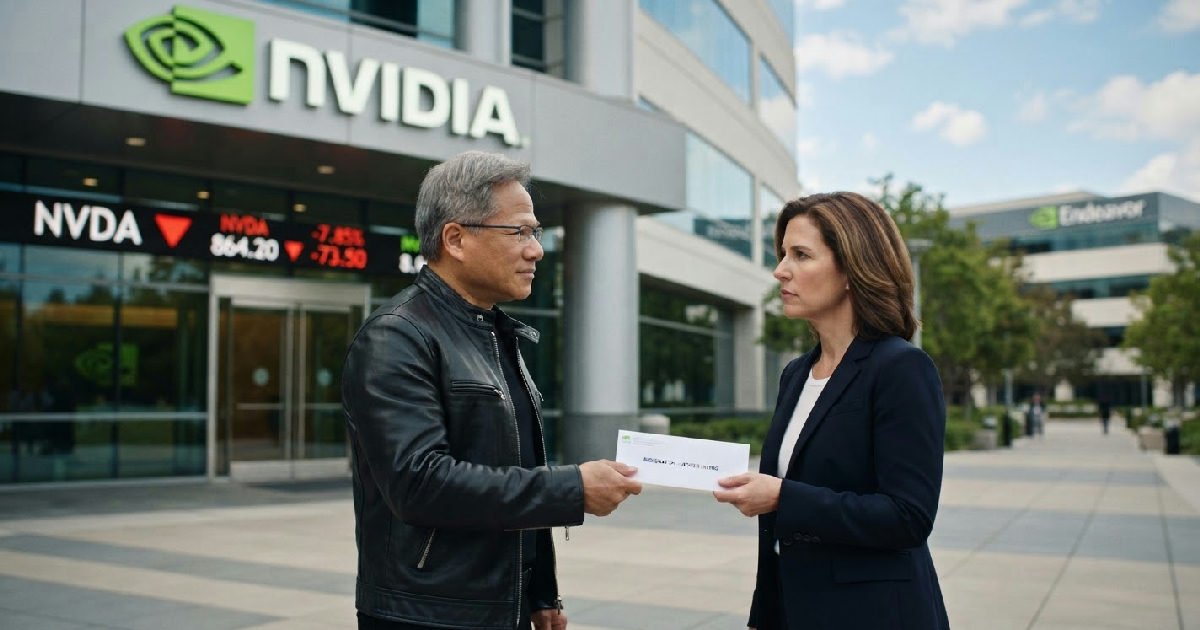
Jensen Huang resigns from Nvidia effective immediately
Jensen Huang, the co-founder and chief executive who built Nvidia into a dominant force in artificial intelligence, has resigned from the company effective immediately. The stunning departure on November 11, 2026, follows a board of directors investigation into alleged extramarital affairs, including one with a senior executive at a data center firm that U.S. officials reportedly suspect of spying for China.
Nvidia’s board moved quickly to install a new leader, appointing Executive Vice President and Chief Financial Officer Colette Kress as Interim CEO.
Jensen Huang resigns amid board probe
The leadership crisis has sent shockwaves through Wall Street, erasing over $1 trillion in market capitalization from the chip giant in recent weeks and raising profound questions about the future of the entire AI sector, which has been powered by the booming demand for data centers running Nvidia’s chips.
The catalyst for Huang’s departure was an internal investigation launched by Nvidia’s board. The inquiry, assisted by outside counsel, is examining reports of multiple affairs. According to The New York Times, one alleged relationship was with Kimberly Powell, Nvidia’s Vice President of Healthcare. Another reported affair involves Alice Huang, a senior executive at the Singapore-based data center company Megaspeed.
The connection to Alice Huang carries significant weight, as reports indicate U.S. officials believe she was working for Chinese intelligence. While Nvidia has stated it has no reason to believe national security or company secrets were compromised, the allegations created a crisis of confidence that the board could not ignore.
The situation escalated quickly, moving from a board statement of confidence in Huang on Sunday to the acceptance of his resignation on Wednesday, November 11.
Analysts noted the severity of the situation and the board’s decisive action. The inquiry is expected to continue to examine all available information, creating a period of uncertainty for the company even as it moves to stabilize its leadership structure.
Market meltdown and industry fallout
The market reaction to the leadership crisis was swift and brutal. Nvidia’s shares, already struggling in 2026, plummeted in the wake of the news. The stock lost nearly 13% of its value last week alone and fell another 2.2% on Friday, marking its sixth consecutive weekly decline.
This slide has wiped out over $1 trillion in market capitalization in just five weeks, with the company’s value on course to drop below $4 trillion for the first time since July 2025.
The sell-off was so intense that on November 12, the stock was on track to lose around $590 billion in market value in a single day. The contagion spread across the technology sector. The Philadelphia Semiconductor Index dropped 3.7% on November 13, while the broader Nasdaq Composite fell nearly a full percentage point.
This turmoil comes at a time when other tech giants have seen their own successes, with some companies managing to exceed revenue expectations through their AI initiatives.
But where there is crisis, some see opportunity. Rival chipmakers AMD and Broadcom saw their stocks gain following the news. Chinese semiconductor stocks like Moore Threads and MetaX also rose nearly 10% on November 12, with investors betting they could gain market share from a distracted Nvidia. The crisis has forced investors to re-evaluate the governance risks in the high-flying AI sector.
Colette Kress takes the helm as interim CEO
Stepping into one of the most visible and challenging roles in technology is Colette Kress, Nvidia’s longtime Chief Financial Officer. Appointed Interim CEO, Kress will also continue in her role as CFO, a dual mandate that signals the board’s confidence in her financial stewardship during a volatile period.
Kress joined Nvidia in September 2013 after a nearly 25-year career in senior finance roles at major technology companies, including Cisco and Microsoft.
In a statement, Kress sought to reassure employees, investors, and customers. “NVIDIA’s strength has always come from its people, and together with our leadership team, I am committed to building on the extraordinary foundation Jensen created over the last 33 years,” she said. “Our focus remains on serving our customers, partners, developers and shareholders.”
To further bolster governance, the board also appointed Harvey C. Jones as its first-ever Chair. Jones brings over 30 years of experience as a technology executive and investor. The board has initiated a formal search for a permanent CEO, stating it will consider both internal and external candidates. This move is critical as the company previously had no formal succession plan.
An irreplaceable founder leaves a vacuum
Jensen Huang, 63, was not just a CEO; he was the visionary founder who was synonymous with Nvidia itself. His departure leaves a massive vacuum at the top of the company he led for over three decades.
Analysts have drawn parallels to other iconic founders, with David Rosenberg of Rosenberg Research noting, “Jensen is much more than just a CEO — like Elon Musk, he is the face of the firm.”
This sentiment was echoed across Wall Street. “Jensen is not replaceable,” stated Dan Ives, a senior managing director at Yorkville Ives & Co. The market appears to agree. “The market is starting to price Nvidia without its founder as the likely outcome, not a tail risk,” said Armina Rosenberg, a portfolio manager at Minotaur Capital.
“Losing Jensen would be a real blow.” The crisis is compounded by the fact that Nvidia had no formal succession plan, a risk highlighted by Huang’s unconventional flat leadership structure with as many as 60 direct reports.
This lack of a clear heir apparent has been criticized by corporate governance experts, who argue that companies without documented succession plans risk self-inflicted crises. With Huang owning about 3.6% of Nvidia’s stock, his influence will linger, but his absence from day-to-day leadership creates the deepest crisis the chip giant has faced in its history.
What this means for the future of AI
The shockwaves from Huang’s exit extend far beyond Nvidia. The company is at the heart of the AI supply chain, and its strategy of investing billions in data-center infrastructure has fueled the entire industry. Analysts now question whether a new leader will maintain this aggressive spending or pivot, potentially disrupting the broader AI ecosystem and even areas like AI client development in other sectors.
Rob Arnott, founder of Syzygy Asset Management, warned there’s a “real possibility that this has an impact on future business.” The scandal could also invite greater regulatory scrutiny. Ben McMillan, CIO at IDX Advisors, suggested the saga could lead to tighter export rules for advanced chips, stricter “know your customer” checks for buyers, and even potential geotracking requirements within GPUs to prevent misuse.
The immediate test for the new leadership will be Nvidia’s quarterly earnings report, scheduled for November 18. Investors will be desperately listening for guidance on the company’s strategy and whether its blockbuster $1 trillion revenue forecast remains intact.
For a market built on Nvidia’s seemingly unstoppable growth, the departure of its iconic leader is a cautionary tale about the risks that lie beneath the surface of the AI boom.