

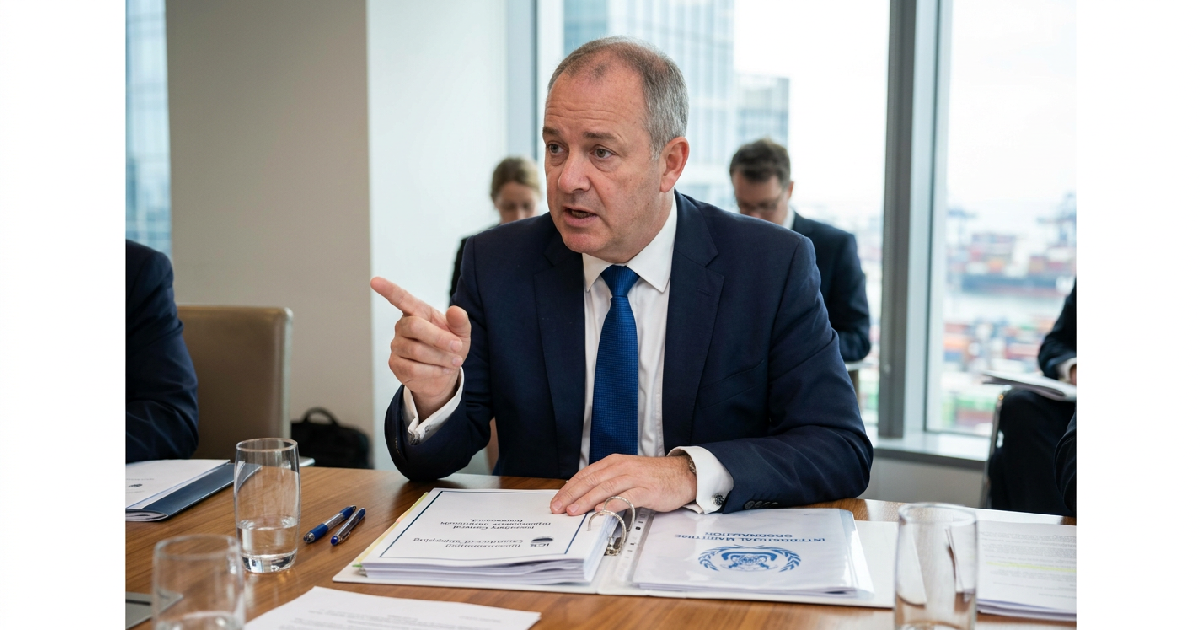
Guy Platten warns fragmented regulations threaten global shipping trade
Guy Platten, the Secretary General of the International Chamber of Shipping (ICS), warned that the global maritime industry faces a fragmenting regulatory environment as nations increasingly bypass international standards.
During a recent interview with S&P Global, Guy Platten expressed deep concern over the “erosion” of the global regulatory framework that has historically governed the high seas. He cautioned that a patchwork of regional laws could disrupt global trade flows and undermine the safety and environmental benchmarks set by the International Maritime Organization (IMO).
The shipping sector has traditionally relied on a single set of rules to ensure that a vessel can move seamlessly between jurisdictions without conflicting legal requirements. But Guy Platten noted that this consensus is fraying as powerful regional blocs, such as the European Union, implement their own maritime policies to accelerate decarbonization.
Fragmented rules threaten global maritime stability
This shift threatens the “level playing field” that the International Chamber of Shipping (ICS) has advocated for over decades, potentially leaving smaller shipping nations at a disadvantage.
This regulatory drift comes at a time when the industry is already grappling with extreme volatility. As supply chain resiliency increasingly prioritised over cost in this era of constant disruption, the added layer of regulatory complexity could drive up operational expenses. Shipowners are now forced to navigate varying standards for fuel emissions, crew welfare, and reporting requirements depending on which ports their vessels visit.
Guy Platten highlighted that the strength of the maritime industry originates from its international nature, which requires universal cooperation. When individual nations or regions act unilaterally, it creates a “Swiss cheese” effect of regulations that are difficult for global operators to follow. He specifically pointed to the inclusion of shipping in regional emissions trading schemes as a prime example of this growing trend toward localism.
The International Chamber of Shipping (ICS) remains a staunch defender of the IMO as the sole regulator for the global fleet. According to Guy Platten, the erosion of this central authority leads to legal uncertainty and could stall the massive investments needed for the green transition.
Investors are often hesitant to commit capital to new propulsion technologies if the regulatory goalposts change from one continent to the next.
The risks of regional decarbonization mandates
While the ICS supports the goal of net-zero emissions, the organization fears that regional mandates will lead to “carbon leakage” rather than actual environmental progress. Ships may simply alter their routes to avoid strictly regulated zones, which does nothing to lower the industry’s total carbon footprint.
This lack of coordination makes it harder for the industry to adopt a unified strategy for alternative fuels like ammonia or hydrogen.
And the pressure isn’t just coming from Europe; other major trading powers are considering similar moves to protect their domestic interests or meet localized climate targets. Guy Platten argued that this piecemeal approach ignores the reality that shipping is the most international business on earth.
A vessel built in Japan, owned in Greece, and crewed by Filipinos may carry cargo from Brazil to China, making local laws inherently ill-suited for the task.
Impact on global trade and shipping costs
The financial implications of this regulatory erosion are significant for both carriers and consumers. When regulations are inconsistent, compliance costs skyrocket, and these expenses eventually trickle down to the cost of goods on the shelf. In an environment where the United States Department of Justice appeals judicial directive outcomes regarding trade duties, the shipping industry finds itself squeezed by both legal and political pressures.
Guy Platten also touched upon the “seafarer crisis,” noting that inconsistent regulations affect the people on board the ships as much as the companies that own them. During the pandemic, the world saw the disastrous effects of varying national rules on crew changes and shore leave.
He fears that without a return to strong international norms, seafarers will continue to bear the brunt of geopolitical and regulatory disagreements.
Security remains another major concern for the ICS leadership. As geopolitical tensions rise, the safe passage of merchant vessels is no longer guaranteed in several key maritime corridors. Guy Platten emphasized that the erosion of international norms extends beyond environmental policy into the basic right of “freedom of navigation” that has sustained global commerce for centuries.
The role of technology in navigating new hurdles
Technology is often pitched as the solution to these complex compliance issues, but Guy Platten remains cautious. While digital systems can help track emissions and manage documentation, they cannot replace the need for a stable legal environment. Even in the banking sector, where Iqbal Khan views AI as the biggest transformation for future operations, human-led policy remains the foundation of trust.
The Secretary General suggested that “digital bureaucracy” could actually become a new barrier to entry for smaller shipping firms. If every nation requires a different digital interface or specific data reporting standard, only the largest companies with the most resources will be able to comply. This could lead to further consolidation in the shipping industry, reducing competition and potentially raising prices further.
What lies ahead for the International Chamber of Shipping
Looking forward, the International Chamber of Shipping (ICS) plans to double down on its engagement with the IMO to push for faster, more comprehensive global agreements. Guy Platten believes that the only way to stop the erosion of standards is to prove that international bodies can move quickly enough to address modern challenges.
He called on member states to prioritize global unity over short-term domestic political wins.
The industry is now watching the next round of IMO meetings closely, where fuel standards and carbon pricing will be at the top of the agenda. For Guy Platten and the ICS, the goal is simple: ensure that the rules of the sea remain truly international.
If they fail, the golden age of seamless global trade may be replaced by a far more expensive and complicated era of maritime regionalism.