

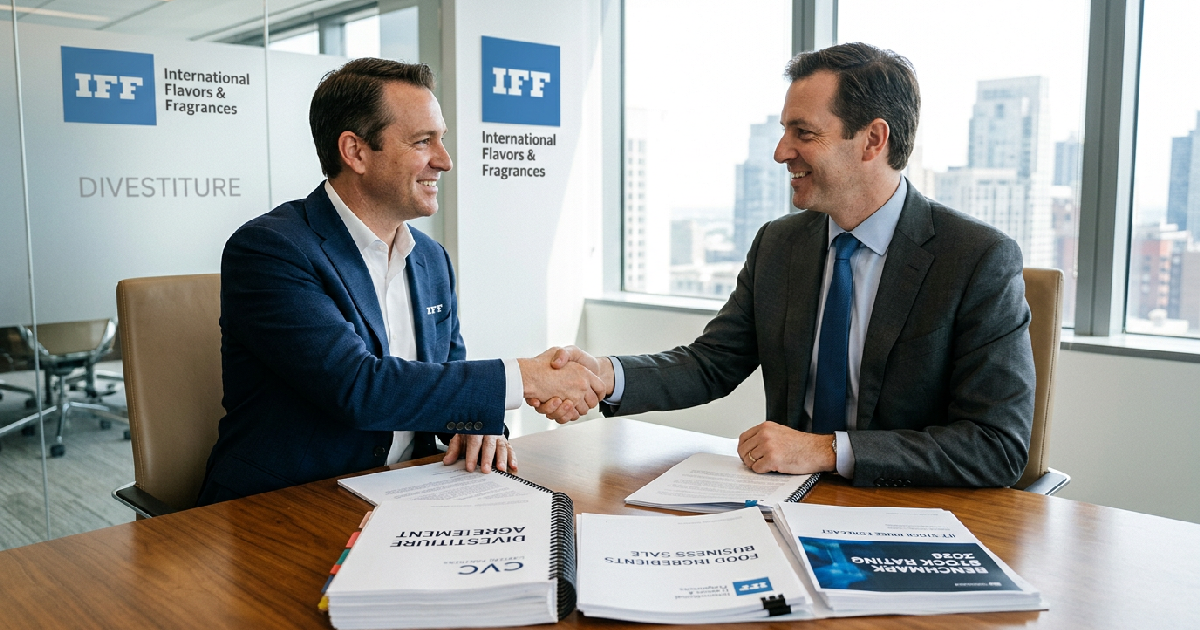
International Flavors & Fragrances jumps 7.2% after Benchmark marks divestiture plan
International Flavors & Fragrances (IFF) shares rose 7.2% as of June 13, 2026, following a bullish initiation from Benchmark that focused on the company’s multi-billion dollar divestiture strategy.
The chemical giant recently entered a definitive agreement to sell 90% of its Food Ingredients business to private equity firm CVC Capital Partners for an enterprise value of $4.3 billion.
This transaction, expected to close by the end of the second quarter of 2027, marks a significant pivot for the organisation as it attempts to shed underperforming units and reduce a heavy debt load.
The deal values the Food Ingredients unit at approximately 10 times its 2025 EBITDA of $430 million, a figure widely seen as a solid exit for a division that has struggled recently. IFF will retain a 10% minority equity interest in the business, valued at roughly $200 million, alongside a seat on the board.
This specific business segment, which produces emulsifiers, sweeteners, and plant-based solutions, accounted for nearly 30% of IFF’s total revenue but has seen its financial performance lag compared to other divisions.
Investors responded enthusiastically to the Benchmark report, pushing the IFF share price to US$78.27 by mid-June. Despite a broader 38% decline in total shareholder return over the last five years, the stock has gained over 12% in the last 90 days.
This momentum suggests the market is finally rewarding the company’s aggressive portfolio pruning, which has now seen 13 non-core businesses sold off in recent years, generating approximately $10 billion in gross proceeds.
Strategic rationale for the International Flavors & Fragrances divestiture
The decision to offload the Food Ingredients arm is not merely a reactive measure but a central component of a long-term strategy to focus on higher-margin sectors. Post-divestiture, IFF will concentrate its resources on three core segments: Scent, Taste, and Health & Biosciences. These areas are currently outperforming the broader portfolio and align with growing global consumer demand for health-conscious and sustainable products.
Company leadership intends to use the expected $3.8 billion in net cash proceeds to prioritise debt reduction and targeted share repurchases. This financial cleanup is a much-needed step after the company reported a net loss of US$374 million in 2025. That loss was largely tied to a massive US$1.
15 billion write-down on the very Food Ingredients business it is now selling, reflecting the division’s 3% sales decline last year.
These internal shifts mirror a broader trend where supply chain resiliency is prioritised over simple volume as companies navigate a volatile global trade environment. By streamlining, IFF aims to insulate itself from the cost sensitivities that have plagued the bulk ingredients market in recent quarters.
Market reaction and Benchmark initiation
Benchmark’s coverage initiation provided the catalyst for the recent price surge, highlighting the “sum-of-the-parts” value that the CVC Capital Partners deal unlocks. Analysts noted that the current P/E ratio of 24.2x sits comfortably below the peer average of 63.9x, suggesting there is still room for valuation expansion as the company moves toward a “pure-play” model in the scent and taste industries.
The 7.2% jump reflects a growing consensus that the $4.3 billion price tag is a fair valuation for a unit with a 12.9% adjusted operating EBITDA margin. While this margin is lower than the rest of IFF’s business, it remains attractive for a private equity buyer like CVC Capital Partners, which can focus on operational efficiencies without public market pressure.
Furthermore, global investors are increasingly looking for stability in the chemicals and ingredients space. While some sectors face disruption from emerging technologies, similar to how AI is transforming banking jobs according to industry leaders, the fragrance and taste markets remain heavily dependent on tangible chemical innovation and intellectual property that IFF still dominates.
Financial performance and 2026 outlook
Despite the net loss reported in the previous fiscal year, IFF’s recent quarterly performance has shown signs of a turnaround. The first quarter of 2026 saw adjusted earnings of $1.25 per share, beating analyst estimates by more than 15%. This was supported by a 3% increase in comparable currency-neutral sales, with volume growth across all four of its primary business segments.
The company has reaffirmed its full-year 2026 guidance, forecasting total sales between $10.5 billion and $10.8 billion. Adjusted operating EBITDA is expected to land between $2.05 billion and $2.15 billion. These targets suggest that even as IFF shrinks in terms of revenue by offloading the Food Ingredients unit, it expects to become a significantly more profitable entity on a margin basis.
As the company moves toward the Q2 2027 closing date for the CVC deal, management will be under pressure to show that the $3.8 billion cash infusion is spent wisely. Investors are particularly keen on the debt reduction plan, as IFF seeks to regain the investment-grade confidence it arguably lost during its massive acquisition spree in 2018 and 2019.
Future implications for the chemicals industry
The IFF divestiture represents a manual for other diversified chemical manufacturers who find themselves over-leveraged and under-focused. By selling 90% of a lagging division while keeping a 10% “upside” stake, IFF is hedging its bets while securing the liquidity needed to survive a cost-sensitive market.
If the Scent and Taste segments can maintain their current growth trajectories, the company may finally break its five-year cycle of stock price underperformance.
What remains to be seen is how quickly the remaining debt can be cleared. IFF’s ability to hit its reaffirmed 2026 targets will be the primary indicator of whether this strategy is working or if the company is simply selling off its furniture to pay the rent. For now, the 7.
2% rally indicates that Benchmark and the wider market are willing to give the turnaround plan the benefit of the doubt.