

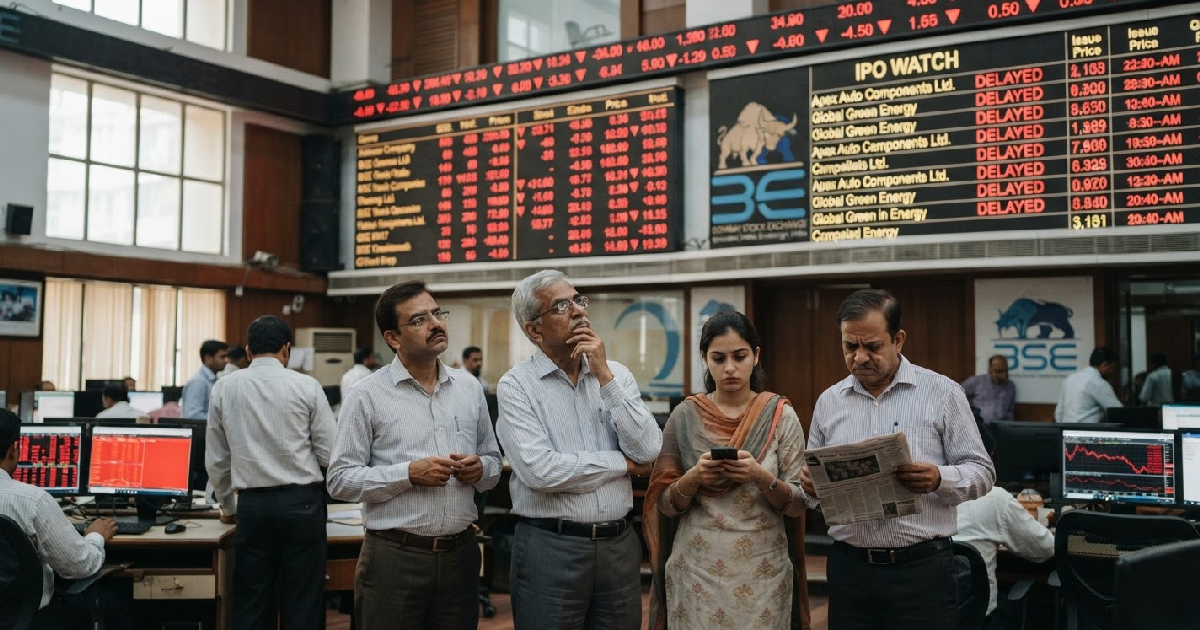
Indias IPO Boom cools as weak markets force issuers to cut back
India’s initial public offering (IPO) market, a major driver of capital formation for the past two years, is undergoing a significant cool-down in 2026. Companies are cutting deal sizes, accepting lower valuations, and delaying listings as proceeds from public offerings have fallen by a fifth compared to the previous year.
This shift raises questions about the sustainability of India’s IPO boom and its earlier momentum on the Bombay Stock Exchange (BSE) and National Stock Exchange (NSE).
India’s public offerings decline significantly in 2026
As of early August 2026, data compiled by Bloomberg indicates companies have collectively raised about $5.78 billion through public offerings. This marks a considerable drop from the $7.32 billion recorded in the year-earlier period. The current climate stands in stark contrast to the robust fundraising figures seen in 2024 and 2025.
The downturn in India’s IPO market has become increasingly evident throughout 2026. In the first half of fiscal year 2026 (H1 FY26), the number of IPO deals decreased by 23% compared to H1 FY25, totaling 73 deals. Despite this, proceeds remained healthy at approximately $2.48 billion USD, suggesting that while fewer companies are going public, some are securing larger capital injections.
However, the overall picture for 2026 points to a clear contraction in activity. By July 1, just 23 IPOs had raised around $2.58 billion USD. Companies are finding themselves in a position where they must often revise down their expected deal sizes or accept lower valuations to attract cautious investors in the current environment.
It’s not just about the volume of deals; it’s also about performance post-listing. As of July-end 2026, 66% of the 36 issues launched are trading above their issue prices, an improvement from 54% in 2025. This mixed post-listing performance has undoubtedly contributed to a more selective investor base, impacting the total funds raised.
Recalling the record-setting years of 2024 and 2025
To fully grasp the current slowdown, it helps to look back at the extraordinary boom that preceded it. Both 2024 and 2025 were record-breaking years for India’s equity capital markets, setting high benchmarks for fundraising and activity.
In 2024, 338 companies successfully went public on the NSE and BSE, collectively raising a record $21 billion USD. India’s IPO volume in that year notably matched the combined total of China and Hong Kong. This momentum continued into 2025, with more than 100 companies raising approximately $22 billion USD through mainboard IPOs, marking it as the highest annual mobilization on record.
The pace was intense; over 200 companies either received approval or lodged prospectuses for IPOs in 2025, which was the highest tally in 27 years. In September 2025 alone, 25 companies debuted on India’s main listing boards, the most active single month since 1997.
By the final three months of that year, at least 38 companies had gone public, with 70 of the 2025 listings achieving positive market returns on their debut days.
Why investor caution is hitting India’s IPO market
Several factors are converging to cool India’s robust IPO market. A significant shift in investor risk appetite is central to this trend, with investors becoming much more selective about where they place their capital. They’re shying away from offerings that might have been popular just a year or two ago.
Heightened volatility in secondary markets, where existing shares are traded, is also making investors wary of committing fresh capital to new listings. When new issues show mixed performance after listing, it naturally dampens overall enthusiasm. Companies are finding it harder to command the premium valuations they once did, leading to reduced deal sizes.
Global economic uncertainty also plays a pivotal role in this domestic trend, including geopolitical tensions, fluctuating oil prices, and evolving interest rate expectations worldwide. These factors create a climate of apprehension that reverberates across international financial markets, influencing investor confidence in India. An oil price jump, for instance, can quickly affect market stability.
Foreign investment outflows exacerbate liquidity crunch
A major contributing factor to the primary market’s current struggles is the substantial outflow of foreign institutional investment (FIIs). These significant international players have pulled out approximately ₹2.81 lakh crore (around $33.6 billion USD) from Indian equities since October 2024. This massive withdrawal of capital has directly impacted the liquidity available for new IPOs.
In 2025 alone, FIIs withdrew roughly $18 billion USD from Indian equities, becoming consistent net sellers. This exodus stems from several reasons, including concerns over elevated valuations in the Indian market, a strengthening US dollar, and general global uncertainties. The reduced presence of foreign capital means domestic institutional and retail investors bear a greater burden for new issues.
This liquidity crunch is compelling companies to rethink their listing strategies. Many are opting to delay their IPOs, hoping for a more favorable market environment. Others are revising their initial public offering terms, accepting smaller raises or lower share prices to ensure successful subscription.
SEBI’s regulatory adjustments reshape IPO landscape
Beyond market dynamics, the Securities and Exchange Board of India (SEBI) has introduced a series of regulatory amendments that are reshaping the IPO landscape. These tighter norms aim to enhance investor protection and ensure greater transparency, creating a more stringent environment for companies looking to go public. The regulator’s efforts to balance growth with oversight are directly impacting issuance activity.
One key change, implemented in September 2025, involved amendments to the Issue of Capital and Disclosure Requirements (ICDR) regulations. SEBI recalibrated minimum public offer (MPO) requirements for companies with post-issue market capitalization exceeding ₹50,000 crore. They also extended timelines for issuers to achieve the Minimum Public Shareholding (MPS) threshold of 25% after IPO completion.
Further amendments in October 2025 broadened anchor investor rules, expanding reserved anchor allocations to 40% and including pension and insurance funds. This was designed to strengthen institutional participation and stabilize pricing. SEBI also relaxed promoter Employee Stock Ownership Plan (ESOP) rules, intended to help Indian startups retain talent.
New rules for public offerings streamline process
April 2026 brought even more significant changes, as SEBI reduced IPO listing timelines from T+6 to T+3 working days. This aims for faster share allotment and quicker refunds for investors, increasing market efficiency. However, it also demands faster compliance from issuers and intermediaries, adding pressure to the already complex listing process.
Crucially, SEBI introduced a phased lock-in for anchor investors: 50% of shares are now locked for 30 days, with the remaining 50% locked for 90 days from the allotment date. This measure is intended to prevent immediate exits and reduce post-listing volatility, though it may make anchor investors more cautious about participating in new issues.
Additionally, the regulator tightened Offer for Sale (OFS) norms, aiming to restrict excessive promoter dilution and ensure a more balanced allocation of shares. Enhanced transparency requirements now mandate clearer disclosures and digital access to IPO documents. These measures, while beneficial for long-term market health, contribute to a more arduous and time-consuming IPO process in the short term.
The future of India’s capital markets
Despite the current cooling trend, India’s IPO pipeline remains substantial, with around 250 companies at various stages of the listing process. This represents approximately ₹2.5 lakh crore (roughly $30 billion USD) worth of potential fundraising. However, issuers are expected to be far more selective about when and at what valuation they choose to launch their public offerings.
The market is increasingly favoring industrial and manufacturing companies, moving away from the consumer-focused businesses that dominated during the post-pandemic boom. This indicates a broader shift in investor preference towards more traditional, asset-heavy sectors. Companies in other sectors might find a tougher reception.
SEBI is also considering further reforms for the Small and Medium Enterprises (SME) IPO ecosystem, aiming to align it more closely with the mainboard process. Proposed changes include potentially removing mandatory market making and reducing the minimum application lot size. These measures could increase retail participation and liquidity in the SME segment, potentially injecting new life into a crucial part of the primary market.
The overarching outlook for the latter half of 2026 suggests continued caution but also adaptation. Companies that can demonstrate robust fundamentals and realistic valuations will likely find success, albeit at a slower pace than the frenzied activity of recent years. The market is maturing, demanding greater discipline from both issuers and investors alike.
This period of moderation, while challenging for some companies, could ultimately lead to a healthier and more sustainable IPO market in India. It forces a stronger focus on intrinsic value and business viability rather than speculative fervor.
The days of easy listing gains seem to be behind us, at least for now, making way for a more discerning investment environment.