

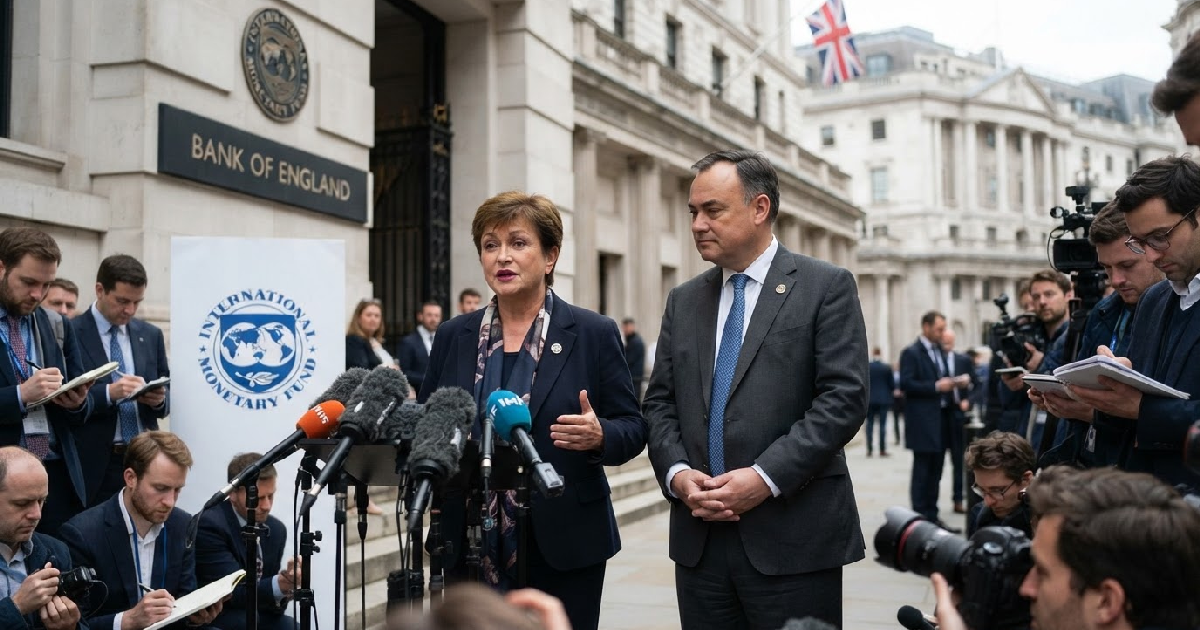
IMF chief warns Bank of England against premature rate cuts amid Iran war risks
The International Monetary Fund (IMF) has issued a stern warning to the Bank of England (BoE), advising against any premature cuts to its benchmark interest rate of 3.75%. The directive, which came as part of the IMF’s annual assessment of Britain’s economic health on July 16, 2026, emphasizes maintaining “sufficiently restrictive” monetary policy due to ongoing inflation risks, largely exacerbated by the persistent Iran war.
This caution from the global financial body highlights concerns that easing monetary conditions too soon could spark a painful new wave of inflation, difficult to bring under control. The IMF^{\prime}s stance underscores a growing tension between calls for interest rate reductions to stimulate a weak economy and the imperative to stabilize prices.
International Warning on UK Rates
The IMF^{\prime}s latest assessment, following its 2026 Article IV Consultation with the United Kingdom, made it clear: the Bank of England shouldn’t budge on interest rates as long as the economic fallout from the Iran war continues. Global oil prices have remained elevated, feeding into inflationary pressures across the UK economy and presenting a complex challenge for policymakers.
Pierre-Olivier Gourinchas, the IMF^{\prime}s chief economist, has been vocal in this regard. He warned that the path for the Bank of England should be “very cautious in its easing trajectory” and that it must ensure inflation is firmly “on the right track” before considering cuts. His comments reflect a broader concern about embedding higher energy costs into core inflation and wages.
Geopolitical Tensions Fueling Inflation Concerns
The shadow of the Iran war looms large over the UK’s economic outlook. Disruptions to energy transportation and supply have directly pushed up oil and gas prices, which economists fear could cascade throughout the economy. This isn’t just about higher petrol prices at the pump; it’s about the ripple effect on goods manufacturing, transportation, and ultimately, consumer spending power.
The IMF expects UK inflation to remain stubbornly high, projecting it to be the highest among G7 nations in both 2025 and 2026.
Official forecasts suggest CPI inflation, which stood at 2.8% in May 2026, will hover “a little under 3%” in Q3 2026 and rise to “a little over 3.25%” in Q4, potentially peaking above 3.5% towards the end of the year.
This makes any move to cut rates a gamble that the Bank of England seems unwilling to take, at least for now.
The Specter of Second-Round Effects
One of the primary fears driving the IMF’s caution is the potential for “second-round effects.” This economic phenomenon occurs when an initial price shock, like soaring energy costs, spreads through the broader economy. Workers then bargain for higher wages to offset their increased cost of living, which in turn gives companies more leeway to raise prices further, creating a self-reinforcing inflationary cycle.
So far, evidence of this wage-price spiral has been limited. The UK labour market has softened, giving workers less leverage to demand significant pay raises. Plus, businesses are facing tough trading conditions, making it harder for them to pass on all their increased costs to consumers. But the risk remains a significant consideration for the Bank’s Monetary Policy Committee (MPC).
Bank of England’s Tightrope Walk
The Bank of England finds itself in a precarious position, caught between external warnings and internal pressures. Its primary mandate is to achieve a 2% CPI inflation target, but it also has a secondary objective to support sustainable economic growth. Cutting rates could stimulate growth, but it risks reigniting inflation.
The current benchmark interest rate of 3.75% was set by February 2026, having been reduced by 1.5 percentage points in total between August 2024 and December 2025 from a peak of 5.25% in August 2023. This delicate balancing act demands careful consideration of every economic indicator.
Internal Disagreements within the MPC
Even within the Bank of England’s Monetary Policy Committee, opinions aren’t monolithic. At their most recent meeting in June 2026, seven members voted to hold borrowing costs at 3.75%, but two members advocated for a 0.25 percentage point increase. This split highlights the ongoing debate about the appropriate course of action.
Huw Pill, the Bank of England’s Chief Economist, has expressed concern that the economy might have been running “a little bit hotter than the supply side,” suggesting a need for tighter policy. However, external MPC member Alan Taylor offers a contrasting view.
He believes that maintaining a “too restrictive path of interest rates” could mean the Bank has “braked too hard,” hindering inflation’s smooth return to target while the economy struggles.
Balancing Inflation Control and Economic Growth
Sarah Breeden, a Bank of England Deputy Governor, has noted the current “softish economic outlook” and “slack in the labour market.” These factors, she argues, make it less likely that an external shock like elevated oil prices will become embedded in inflationary dynamics, suggesting less need for aggressive monetary tightening. This nuanced perspective reflects the real-world challenge of forecasting and reacting to complex economic forces.
The BoE also plans to continue its quantitative tightening (QT) program, aiming to reduce its asset holdings by a further £70 billion over the year to September 2026. This ongoing withdrawal of monetary stimulus runs in parallel with its interest rate decisions, adding another layer to its efforts to control inflation without stifling economic activity.
Fiscal Strategy and Future Outlook
Beyond monetary policy, the IMF also weighed in on the UK’s fiscal approach. The financial institution praised British lawmakers’ efforts to manage public finances, stating that the UK’s fiscal plans strike “a good balance between deficit reduction and growth-friendly spending.” This endorsement offers some reassurance amidst the broader economic uncertainties.
Chancellor Rachel Reeves welcomed the IMF’s backing, asserting that the government has “the right economic plan to build a stronger more secure Britain.” She emphasized that the choices made have placed the country in a “much stronger position than it was two years ago.”
Government’s Fiscal Path Praised
The IMF specifically highlighted the importance of “staying the course” on plans to cut the deficit, even delivering a subtle warning to potential future administrations, including one led by former Manchester mayor Andy Burnham. The fund remarked that the government’s handling of the Iran war’s energy shock has been “prudent,” calling it “tightly targeted, temporary and budget neutral.”
However, the IMF also pointed to medium- to long-term fiscal challenges. Rising spending pressures from an aging population, defence commitments, and the transition to green energy will necessitate “difficult choices and greater focus on containing spending and enhancing efficiency.” This suggests that while current fiscal management is sound, future governments will face significant hurdles.
Market Expectations and Upcoming Decisions
Financial markets and businesses are closely watching the Bank of England for any signals regarding future rate movements. Many had hoped for earlier cuts, but the IMF’s clear advice complicates that picture. The next major announcement from the Monetary Policy Committee is scheduled for Thursday, July 30, 2026, a date eagerly anticipated by investors and consumers alike.
The IMF’s repeated warnings against premature easing, coupled with the persistent inflationary pressures from global events like the Iran war, suggest that interest rates are likely to remain elevated for some time. This will undoubtedly continue to affect mortgage rates, borrowing costs for businesses, and the broader economic environment for households across the UK.
Broader Economic Implications for Britain
The decision to hold interest rates has widespread implications. For homeowners with variable mortgages, or those looking to remortgage, sustained higher rates mean continued financial strain. Businesses, particularly smaller ones, may find it harder to access affordable credit, potentially stifling investment and growth.
The IMF’s upgraded GDP growth forecast for the UK in 2026, now at 1.0% (up from 0.8%), offers a glimmer of positive news. It also revised its 2025 forecast upward to 1.2%. The UK is projected to be the third fastest-growing economy in the G7 in 2026.
But these figures must be balanced against the inflation outlook and the risks inherent in the global economic landscape, especially with the ongoing geopolitical instability.
Consumer Impact and Labour Market Dynamics
Consumers will continue to feel the pinch of elevated inflation if the Bank of England maintains its restrictive stance. While the labour market has shown signs of slack, preventing a rapid wage-price spiral, it also means less upward pressure on incomes for many workers. This creates a challenging environment where households face higher costs without necessarily seeing a proportional increase in their earnings.
The balance between protecting purchasing power through inflation control and supporting employment and wage growth is a constant struggle for central banks. The IMF’s intervention clearly prioritizes the former, stressing the long-term damage that entrenched inflation can inflict on an economy.
Long-Term Challenges Beyond Immediate Crises
While the immediate focus remains on navigating the effects of the Iran war and controlling inflation, the UK also faces structural economic challenges. The IMF’s report touched upon these, noting the rising spending pressures from demographic changes, defence needs, and the substantial investments required for the energy transition. These factors will demand sustained fiscal discipline and strategic planning from future governments.
The interplay of global geopolitical events, domestic economic conditions, and central bank policy will shape Britain’s economic trajectory over the coming years. The IMF’s latest warning serves as a stark reminder of the complexities involved and the need for vigilance in monetary management, especially when the threat of inflation remains potent.
The next MPC meeting on July 30 will provide further insight into the Bank’s immediate response.