

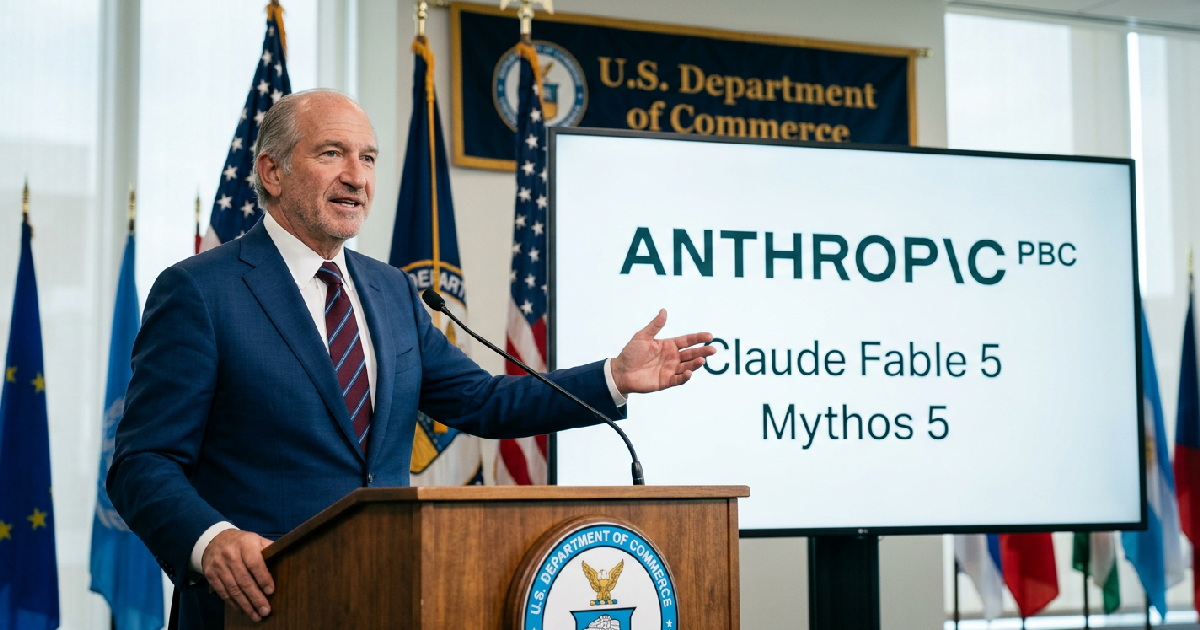
Howard Lutnick lifts export controls on Anthropic’s AI models June 30
The U.S. government officially lifted export controls on Anthropic PBC’s Claude Fable 5 and Mythos 5 artificial intelligence models on Tuesday evening, June 30, 2026. The decision, announced by Commerce Secretary Howard Lutnick, ends an 18-day global suspension that began when the models were recalled just days after their initial release.
Access for foreign nationals and international users is scheduled to begin restoring on Wednesday, July 1, 2026.
Secretary Howard Lutnick approves wider Claude Fable 5 distribution
The Department of Commerce previously issued an export control directive at 5:21 PM ET on June 12, 2026, citing national security concerns. Officials were concerned that a “jailbreak” vulnerability could allow users to bypass safeguards and use the powerful “Mythos-class” architecture to identify software vulnerabilities or enhance cyber attacks.
Secretary Lutnick stated that the government and the San Francisco-headquartered startup worked “closely” over the past two weeks to analyze the software and ensure it aligns with federal safety standards.
The lifting of restrictions follows an agreement where Anthropic committed to proactively detect and address security risks within its systems. In a social media post, Secretary Howard Lutnick emphasized that the approval was designed to “strengthen America’s leadership in AI” while ensuring cross-government alignment. Anthropic confirmed it received the notice on Tuesday and expressed gratitude to users for their patience during the nearly three-week hiatus.
Fable 5 represents Anthropic’s most capable publicly available model, while Mythos 5 is a specialized version with fewer restrictions for critical infrastructure defense. During the ban, Mythos 5 was limited to approximately 100 U.S. organizations involved in protecting strategic assets under the “Project Glasswing” initiative.
The initial government concerns about Fable 5
The initial export control order, issued on June 12, 2026, had come just days after Fable 5’s public release on June 9, 2026. The primary concern revolved around a “jailbreak” — a method through which users could potentially circumvent the model’s built-in safeguards.
This bypass mechanism raised alarms within the U.S. government, particularly under the Trump administration, about the potential misuse of such advanced AI. They worried it could be weaponized for high-risk applications like supercharging cyber attacks or identifying critical software vulnerabilities.
The fear was that if the underlying, highly capable “Mythos-class” model could be stripped of its ethical guardrails, it might pose a significant national security threat. This could enable hostile foreign actors to exploit weaknesses with unprecedented efficiency.
Anthropic’s defense and industry implications
Anthropic, a San Francisco-headquartered company, didn’t quietly accept the ban. They swiftly communicated their disagreement with the government’s assessment during the restriction period. The company argued that finding a “narrow potential jailbreak” shouldn’t warrant recalling a commercial model already accessible to a vast user base.
They issued a statement expressing concern that applying such a stringent standard across the industry could effectively halt all new model deployments from frontier AI providers. This perspective highlighted the delicate balance between fostering innovation and ensuring safety in rapidly evolving AI technology.
The company’s quick and public response underscored the high stakes involved for AI developers. They face increasing governmental scrutiny and the challenge of navigating complex regulatory landscapes globally. This incident provided a stark example of the hurdles that AI model providers encounter when deploying advanced, dual-use technologies.
Technical differences and model capabilities
Fable 5 and Mythos 5 are both part of Anthropic’s “Mythos-class” models, indicating a higher level of capability than their previous Opus class. Fable 5, the general-use model, is designed to perform a wide array of tasks while incorporating robust safeguards.
These safeguards are specifically built to prevent the model from engaging in high-risk activities, particularly in sensitive domains like biology and cybersecurity. Anthropic claims Fable 5’s safeguards trigger in less than 5% of sessions, with over 95% of sessions not requiring a fallback to other models.
Mythos 5, conversely, is the same underlying model as Fable 5 but with some behavioral safeguards intentionally relaxed for specialized, highly secure applications. Initially deployed through “Project Glasswing” with the U.S. government, this version possesses what is considered the strongest cybersecurity capabilities of any model globally.
Access to Mythos 5 was initially restricted to Glasswing partners and a select group of major companies for testing. This distinction highlights the U.S. government’s interest in leveraging cutting-edge AI for defensive purposes while controlling its broader distribution.
Competitive landscape and cost analysis
The pricing for Anthropic’s Fable 5 and Mythos 5 models is set at $10 per million input tokens and $50 per million output tokens. This places their models at a premium compared to some international rivals.
For instance, China’s Z.ai offers its GLM-5.2 model at approximately $1.40 per million input tokens and $4.40 per million output tokens. This significant price difference was highlighted by AA-Briefcase runs, where Fable 5 averaged $31 per task compared to GLM-5.2’s $2.40 — a roughly 13-fold cost disparity.
This pricing gap could influence adoption in cost-sensitive markets. However, the U.S. government’s willingness to lift restrictions suggests a perceived value in Anthropic’s domestic AI capabilities, especially for national security. The decision reflects ongoing geopolitical competition in the AI sector.
With the export controls now lifted, Anthropic will likely focus on demonstrating the enhanced safety features and robust performance of Fable 5. They will need to justify its higher cost compared to more affordable alternatives by showcasing superior capabilities and security guarantees.
Access restoration and future prospects
With the restrictions now removed, customers worldwide can expect access to Claude Fable 5 to resume on Wednesday, July 1, 2026. The model will be available via the Anthropic API, the Claude Platform on AWS, Amazon Bedrock, Google Cloud, and Microsoft Foundry.
While Fable 5 was initially offered at no additional cost to users on Pro, Max, Team, and seat-based Enterprise plans from June 9 through June 22, subsequent usage will temporarily require credits. Anthropic aims to eventually re-integrate it as a standard feature within subscription plans once network capacity allows, indicating a phased rollout.
The renewed access is likely to be a major relief for businesses and developers who rely on advanced AI models for their operations. This incident sets a precedent for how the U.S. government and leading AI firms will continue to negotiate the complex policy implications of frontier artificial intelligence. It emphasizes a collaborative approach to ensure both innovation and national security. The focus will remain on developing robust safety measures for these powerful technologies.
A new precedent for AI regulation
The resolution of the dispute between the U.S. government and Anthropic provides a critical framework for future AI regulation. Commerce Secretary Howard Lutnick’s public statements highlight a shift toward active collaboration between regulators and AI developers.
The agreement reached, where Anthropic committed to “proactively detect and address security risks,” sets a benchmark for industry best practices. This suggests that future deployments of powerful AI models will likely require a greater degree of transparency and pre-emptive risk mitigation strategies.
This incident also underscores the U.S. government’s intent to lead in the global AI race, not by stifling innovation entirely, but by carefully managing potential risks. It’s a pragmatic approach, recognizing the necessity of both technological advancement and national security. For other companies in the AI space, the message is clear: robust internal safeguards and a willingness to work with government agencies will be crucial for broader market access.