

France, Germany Unite on Tougher China Trade Policy
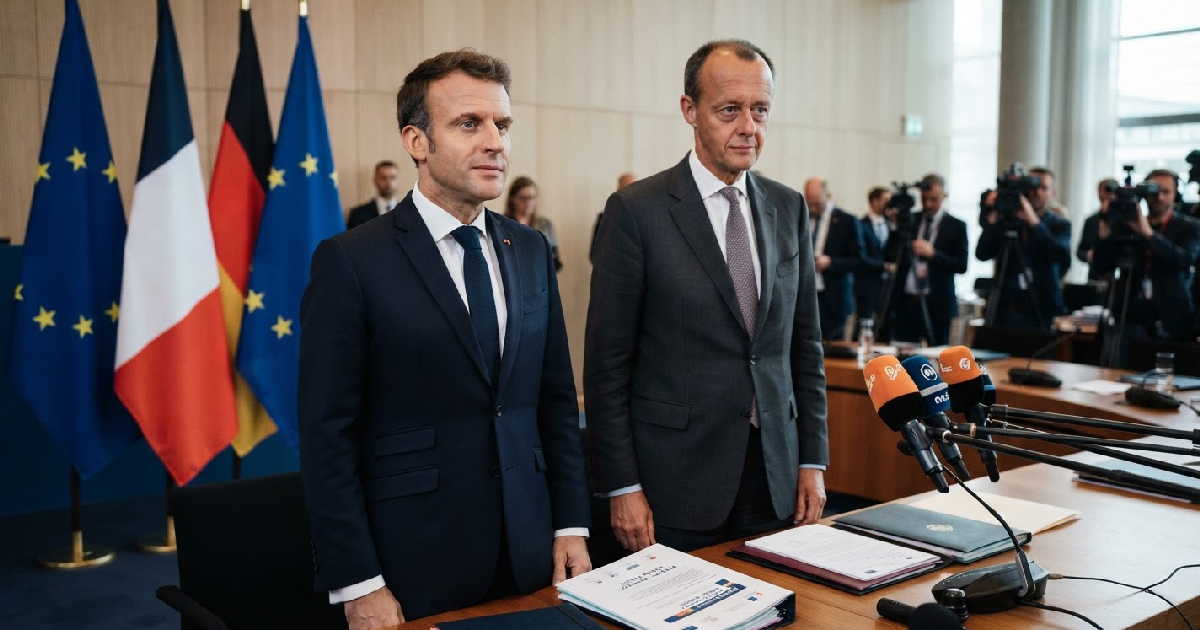
French President Emmanuel Macron and German Chancellor Friedrich Merz today declared a significant alignment on tougher trade measures against China, demanding new “emergency measures” to shield European industry. This united front emerged from a joint ministerial meeting near Cologne, Germany, amid escalating concerns over the European Union’s widening trade deficit and Beijing’s industrial practices, which leaders fear are destroying jobs.
The Franco-German leaders announced on July 17, 2026, they’ll prepare a joint roadmap on China by September. This initiative signals a critical shift, aiming to address the EU’s daily €1 billion trade deficit with China, attributed partly to undervalued currency and extensive state subsidies.
Paris and Berlin forge unified China trade policy
President Macron stated that France and Germany have “never been as aligned on the question of China,” marking a notable pivot in their diplomatic and economic strategies. This convergence comes after years of differing approaches, with Germany traditionally prioritising engagement.
The forthcoming joint roadmap will guide vital discussions with Beijing on critical issues like exchange rates and financial market access. It represents a concrete step towards a more coordinated European response to China’s growing economic influence.
Protecting European manufacturing from imports
Both leaders are pushing for “emergency measures” and “early-warning procedures” that the European Commission can implement immediately. These steps are designed to protect Europe’s industrial base from a surge in Chinese imports.
President Macron emphasised the need to safeguard European businesses, stating, “We are in favour of protecting our businesses.” Chancellor Merz echoed this sentiment, adding that the current trade imbalance “cannot carry on like this, because it is truly detrimental to the situation in Europe.”
EU trade deficit with China escalates
The urgency for action stems from alarming trade figures. The EU’s goods trade deficit with China hit a record €98 billion in the first quarter of 2026 alone.
This follows a 2025 where China’s goods trade surplus with the EU reached €360.6 billion, marking a 15% increase from 2024. Overall, the EU faces a staggering €1 billion (nearly $1.15 billion) trade deficit with China each day.
Since 2015, the value of Chinese exports to the EU has surged by 89%, quadrupling the trade deficit. This trend reflects a broader shift in global manufacturing, with China’s share increasing from 6% in 2000 to approximately 30%, while the EU’s share declined from 30% to 17%.
Macron warned that this daily deficit results in “tens of thousands of jobs destroyed” every day. Such a stark assessment underlines the significant economic toll on European economies.
Combating Chinese subsidies and overcapacity
A core grievance for Paris and Berlin involves Beijing’s industrial policies. European leaders cite China’s deeply undervalued renminbi and its extensive state subsidies as major contributors to market distortions.
China reportedly subsidises its companies on average eight times more than countries in the Organization for Economic Co-operation and Development (OECD). This massive state support creates an uneven playing field for European competitors.
Concerns also persist about China’s factory overcapacity, particularly in key green sectors. This oversupply pushes down global prices and threatens the viability of emerging European industries.
Reports indicate that approximately 70% of German manufacturing output faces risks from Chinese competitive practices. This highlights the vulnerability of a crucial sector within Europe’s largest economy.
Existing EU trade defense instruments
The EU has already deployed several trade defense measures against Chinese imports. In 2024, the bloc imposed tariffs of roughly 35% on Chinese electric vehicles, adding to the standard 10% Most Favored Nation (MFN) import tariff.
More recently, on May 5, 2026, definitive anti-dumping duties ranging from 29.1% to 42.3% were levied on Chinese adipic acid imports. These actions demonstrate a growing willingness by the EU to use its trade tools.
French advisers had previously floated proposals for a 30% tariff on Chinese goods, or a 20-30% depreciation of the euro. Such discussions underscore the range of options being considered to rebalance trade.
Of the 21 new anti-dumping and anti-subsidy investigations initiated by the EU, 18 target Chinese manufacturers. This data points to a concentrated effort to scrutinize Beijing’s trade practices across various sectors.
Strengthening EU internal market and competitiveness
Beyond immediate trade defense, France and Germany are advocating for broader reforms to bolster European economic resilience. They’ve agreed to continue simplifying EU regulations and deepening the single market.
Completing the Capital Markets Union, also referred to as the Savings and Investment Union, is a top priority for the current semester. This move aims to boost European competitiveness by facilitating greater capital flow within the bloc.
President Macron underscored its importance: “This is fundamental because if we want a Europe that can finance its disruptive projects and, ultimately, have the private financial component of what I just mentioned regarding AI, quantum computing, and other areas…” The push for a stronger financial infrastructure is increasingly vital.
Commission urged to act faster
The Franco-German push includes a call for the European Commission to move “much faster” in deploying its trade defense instruments. This reflects a desire for more agile and decisive responses to market distortions.
Denis Redonnet, the European Commission’s chief trade enforcement officer, confirmed that Brussels would “continue to deploy, where necessary and where legitimate, both structural and contingent trade protection measures.” He indicated that there are no signs of macroeconomic adjustment from China.
EU Trade Commissioner Maroš Šefčovič previously stated in June 2026 that “the status quo is not an option” regarding China trade imbalances. He has demanded “tangible results” from dialogue with China by October 2026.
Global trade implications and future outlook
The unified stance from Paris and Berlin signals a significant escalation in the European Union’s approach to China’s trade practices. This concerted effort could reshape global trade dynamics, prompting other nations to re-evaluate their own strategies.
Historically, Germany has maintained a more conciliatory stance with China, given its extensive export market there. This shift, with Chancellor Merz advocating for a “frank and open dialogue” while acknowledging the detrimental situation, represents a profound change in Berlin’s foreign economic policy.
The development also aligns with a global trend of increased scrutiny over China’s economic models, particularly after the US implemented various trade restrictions. The EU’s actions could now inspire similar or expanded measures from other key trading partners.
How Beijing responds to this more assertive European front will be crucial. The outcome of the joint roadmap discussions and the efficacy of any new EU measures will define the future of international trade relations for years to come.