

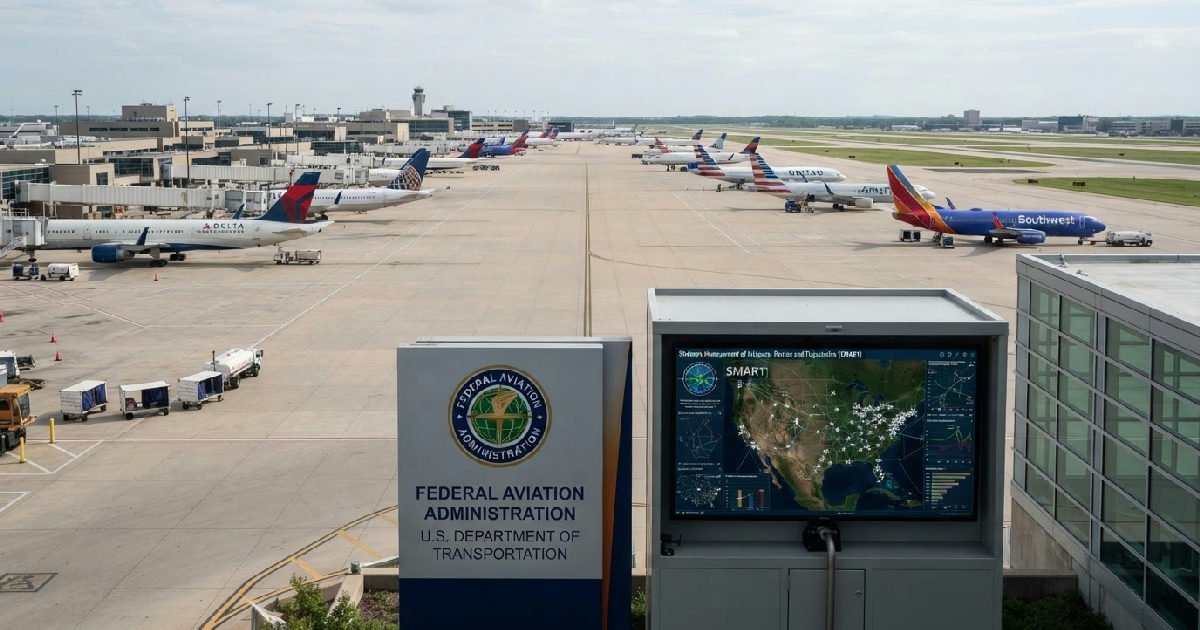
Federal Aviation Administration issues nationwide ground stop
The Federal Aviation Administration (FAA) issued a nationwide ground stop for all departing flights across the United States on November 13, 2026.
This unprecedented move, citing a serious telecommunications failure, unfolded just three days after the FAA expanded its artificial intelligence (AI)-assisted air traffic management system, known as Strategic Management of Airspace, Routes and Trajectories (SMART), to all 22 U.S. Air Route Traffic Control Centers.
AI system rollout precedes widespread Aviation Administration disruption
The incident prompted widespread disruption and immediate questions about the timing and potential connection between the new technology and the system failure.
The ground stop, initiated at approximately 4 p.m. Eastern Time and eventually lifted at 8:15 p.m. EST, lasted an exhaustive four hours and twenty-one minutes. It brought air travel to a standstill for thousands, affecting both domestic and international flights.
Officials attributed the stoppage to a “communication issue” and a “temporary telecommunications outage,” later specified by Transportation Secretary Sean Duffy as a telecommunications router crash caused by data overload within the FAA’s aging infrastructure.
The FAA’s ambitious integration of the SMART system into its core operations marked a significant milestone in its ongoing modernization efforts. The system, designed to enhance efficiency and safety, had seen its nationwide expansion on November 10, 2026. This followed an initial rollout on September 21, 2026, which covered major airports like Reagan National, Washington Dulles, and Baltimore/Washington International.
SMART acts as an AI-supported planning tool for air traffic controllers. It integrates approximately 200 data streams to help specialists anticipate potential traffic problems, thereby reducing delays, cancellations, and fuel consumption.
The system is credited with rerouting 180 flights since its initial deployment, reportedly saving an average of 10 minutes and nearly 80 gallons of fuel per flight, underscoring its potential benefits for the aviation industry.
However, it’s crucial to understand that SMART doesn’t autonomously control aircraft or replace human air traffic controllers. Instead, it provides recommendations and predictive analytics that FAA personnel review and act upon. The human element remains central to decision-making, with the AI serving as an advanced aid rather than a substitute for experienced oversight.
Telecommunications failure halts US air traffic
The immediate cause of the November 13 ground stop was a severe telecommunications failure that crippled the FAA’s air traffic control network nationwide. The issue first emerged at O’Hare International Airport and Midway International Airport in Chicago before cascading across all 22 Air Route Traffic Control Centers.
This forced the FAA to halt all departing flights, allowing inbound international flights to be managed on a case-by-case basis.
Transportation Secretary Sean Duffy minced no words, stating that the stoppage was a direct result of “an incredibly old air traffic control system.” He highlighted that outdated components, including antique routers and 1980s copper lines, became critically overloaded with data. This data surge led to inconsistencies within the system, ultimately triggering a shutdown and bringing air travel across the nation to an abrupt halt.
The consequences were immediate and far-reaching. By 5 p.m. on November 13, over 8,000 flights had been delayed and approximately 400 flights canceled. As the ground stop was eventually lifted, the full extent of the disruption became clearer, with more than 5,000 flights ultimately canceled and over 10,000 delays affecting approximately 11,000 US flights.
The ripple effects from this widespread disruption were expected to last for several days, impacting travel plans globally.
For passengers and airlines alike, this event was a stark reminder of the fragility of modern air travel infrastructure. It highlighted how a single point of failure within a critical system can have monumental consequences. This incident echoes broader industry discussions about technology upgrades and the financial commitments needed to maintain robust operational networks.
Scrutiny mounts over AI integration timing
The proximity of the SMART system’s nationwide expansion to the ground stop inevitably fueled speculation about a potential connection. While officials were quick to attribute the failure to aging infrastructure, the timing struck many as more than mere coincidence. CNN aviation analyst Mary Schiavo articulated this sentiment, suggesting that new computer systems frequently encounter difficulties when attempting to interface with older, legacy systems.
Despite the official stance, some high-profile figures acknowledged the need for thorough investigation into the matter. Department of Homeland Security Secretary Markwayne Mullin stated his agency was actively exploring any possible links between the SMART system and the outage. “We’re looking at that,” Mullin affirmed, adding, “You can’t rule out anything at this point.”
This underscores a cautious approach amidst calls for transparency regarding the incident.
Industry and political reactions to SMART system
The company behind SMART, Air Space Intelligence (ASI), vehemently denied any connection between its AI system and the telecommunications failure. They reiterated that SMART is an advisory tool and not directly involved in the real-time control of air traffic. Similarly, Microsoft, which experienced a separate Microsoft 365 outage starting November 12, 2026, also denied any link between its service disruption and the FAA’s ground stop.
The National Air Traffic Controllers Association (NATCA) previously stated they were not involved in the design, testing, or implementation of SMART. This lack of direct input from controllers themselves could be a point of concern for some.
Earlier congressional concerns about SMART’s safety evaluations, personnel training, and oversight were raised by over two dozen lawmakers in an October 9 letter, calling for a suspension of its initial rollout. These pre-existing anxieties now lend further weight to the scrutiny surrounding the system.
United Airlines CEO Scott Kirby, speaking at SMART’s initial launch in September, had championed the system’s potential. He declared that if it performed as expected, it could “do more to reduce delays and cancellations than anything that’s happened in decades.” This optimism now faces a rigorous test in the wake of the nationwide grounding.
The incident highlights the complex challenges involved in integrating advanced AI solutions into critical national infrastructure.
FAA’s long road to air traffic modernization
The recent ground stop isn’t an isolated event but rather a symptom of the deeper, long-standing challenges facing the Federal Aviation Administration’s efforts to modernize the U.S. National Airspace System (NAS). This overarching initiative, known as Next Generation Air Transportation System (NextGen), began in 2007 with an ambitious timeline stretching to 2030.
The SMART system, an $875 million project under a 12-year contract with Air Space Intelligence, is a component of this broader $12.5 billion modernization push.
The FAA has faced criticism for the slow pace of its modernization. It was only recently announced that the agency aims to phase out the use of floppy disks for storing critical information by 2028 – a testament to the scale of legacy technology still in use.
This commitment to updating antiquated systems is essential, but the sheer inertia of such a vast network makes rapid transformation difficult and prone to disruption.
Precedent of previous nationwide groundings
While rare, nationwide ground stops are not without precedent in US aviation history. The most notable occurred on September 11, 2001, following the terrorist attacks. More recently, on January 11, 2023, the FAA issued a ground stop due to an outage in its Notice to Air Missions (NOTAM) system. That incident, caused by contract personnel unintentionally deleting files during routine maintenance, corrupted a database file.
The 2023 NOTAM outage lasted approximately 90 minutes and resulted in over 10,000 flight delays and 1,300 cancellations. While significantly shorter in duration and less severe in terms of flight cancellations than the November 13, 2026, event, it served as a stark warning about the vulnerabilities within critical FAA systems.
These past events underscore the high stakes involved in any system failure within the intricate web of air traffic control.
Calls for investment and future outlook
In the aftermath of the ground stop, Transportation Secretary Sean Duffy wasted no time in calling for substantial congressional support to accelerate the modernization of the air traffic control system.
He advocated for an additional $50 billion in funding, emphasizing that such an investment is critical to prevent future disruptions and ensure the safety and efficiency of national air travel. This plea highlights the immense financial undertaking required to upgrade decades-old infrastructure.
Investigations into the root cause of the telecommunications failure are currently underway. FAA technicians are meticulously examining the communication issues, while the Federal Bureau of Investigation (FBI) is probing whether a recent software update might have triggered the system collapse.
The Department of Homeland Security’s continued interest in a potential link to the SMART system further complicates the narrative, suggesting that the full story is still unfolding.
The incident serves as a critical stress test for the FAA’s ambitious modernization agenda and its reliance on emerging technologies like AI. The long-term implications for the adoption of AI in critical infrastructure will largely depend on the findings of these investigations and the transparency with which they are communicated.
Ensuring public confidence in air travel requires not only addressing immediate technical failures but also clearly articulating how advanced systems can be integrated safely and effectively, especially given the rapid advancements in AI technologies that are driving significant demand for global data centers.
While the FAA maintains that AI tools like SMART are designed to assist, not control, the incident has undoubtedly sparked a renewed debate about the balance between technological advancement and robust, resilient infrastructure. The path forward will necessitate a delicate navigation of innovation, public safety, and significant capital investment to secure the future of US air travel.