

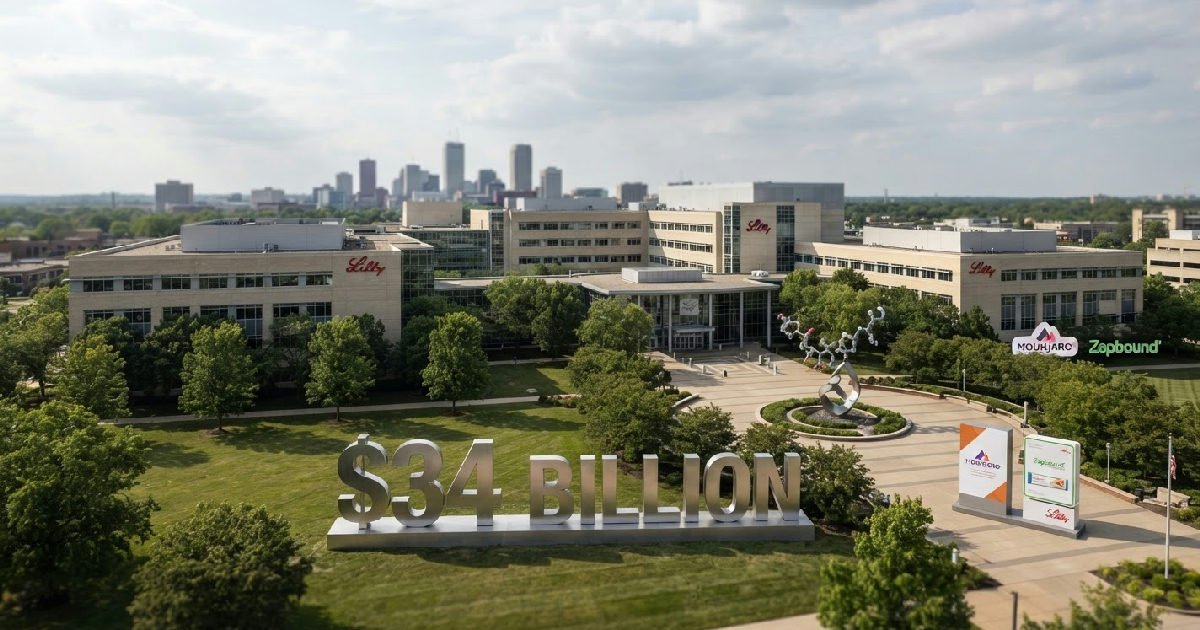
Eli Lilly and Company fuels $34 billion acquisition strategy
Eli Lilly and Company is in the midst of a historic $34 billion dealmaking spree, fueled by a massive cash windfall from its blockbuster obesity and diabetes drugs.
The pharmaceutical giant is aggressively acquiring and licensing assets to build out its future pipeline, aiming to diversify its revenue streams far beyond its current star performers, Mounjaro and Zepbound. This aggressive Eli Lilly acquisition strategy is designed to secure its long-term growth.
The scale of this investment strategy is staggering. The combined revenue from Mounjaro and Zepbound hit $36.5 billion in 2025 alone, catapulting Eli Lilly’s total revenue to $65.2 billion and making it the world’s top-earning pharmaceutical company. This level of spending is transformative, dwarfing even the high costs of a major shareholder campaign and fundamentally reshaping the company’s long-term outlook.
A strategic pivot beyond GLP-1 dominance
The acquisition spree is a calculated move to de-risk the company’s future. While the success of GLP-1 drugs like Mounjaro is undeniable, relying so heavily on a single class of treatments carries significant long-term risk. The company is proactively preparing for an eventual patent cliff and building new growth platforms that will sustain it for decades to come.
This strategy isn’t just about replacing future revenue; it’s about expansion into entirely new therapeutic areas. By purchasing companies with expertise in oncology, genetic medicine, and even psychedelics, Lilly is placing bets on the next wave of medical innovation. It’s a clear signal to investors that the company plans to be a leader, not just a follower.
The sheer volume of cash generated by its GLP-1 franchise affords Lilly the ability to make multiple high-value acquisitions without taking on excessive debt. This financial firepower gives it a distinct advantage over competitors who may need to be more conservative in their M&A activities. The market has responded positively, with the company’s valuation reflecting confidence in this forward-thinking strategy.
Early moves in 2023 set the stage
The foundation for this aggressive expansion was laid in mid-2023. In July of that year, Eli Lilly announced its plan to acquire Versanis Bio in a deal worth up to $1.925 billion. The acquisition, completed on August 14, 2023, brought bimagrumab, a promising treatment for cardiometabolic diseases, into Lilly’s portfolio.
That same period saw another key purchase. On June 29, 2023, Lilly revealed an agreement to buy Sigilon Therapeutics for an initial $34.6 million, with the deal potentially growing to over $300 million. This move gave Lilly full control of a partnered program for a Type 1 diabetes cell therapy, reinforcing its dominance in the diabetes space while exploring novel treatment modalities.
To cap off a busy year, Lilly announced its acquisition of Point Biopharma Global Inc. for $1.4 billion on October 3, 2023. Completed in early 2024, this deal marked Lilly’s significant entry into the radiopharmaceutical cancer therapy market, a fast-growing segment of oncology focused on precision-targeted treatments.
Accelerating the pace with a flurry of 2026 deals
What began in 2023 accelerated dramatically in 2026. The company has committed tens of billions to acquire a diverse range of biotechs, each providing a piece of a larger strategic puzzle. The acquisitions represent strategic technology moves designed to secure Lilly’s footing in next-generation medicine.
The year began with a $1.2 billion acquisition of Ventyx Biosciences in January, followed by a $2.4 billion agreement for Orna Therapeutics in February. The spending escalated in March with the massive $7.8 billion acquisition of Centessa Pharmaceuticals, one of the largest deals in the spree.
April 2026 was particularly active, with three significant announcements: a $300 million deal for CrossBridge Bio, a $7 billion acquisition of Kelonia Therapeutics, and a $2.3 billion purchase of Ajax Therapeutics Inc. These targets span a wide array of fields, from gene editing to novel cancer treatments, demonstrating the breadth of Lilly’s ambition.
Targeting novel technologies and therapies
Beyond acquiring entire companies, Lilly is also investing heavily in licensing and platform deals. A key example is the agreement with Profluent Bio, worth up to $2.25 billion, to discover new DNA editing tools. This move indicates a focus on foundational technologies that could underpin future drug development across its entire portfolio.
The company also acquired AtaiBeckley for up to $3.8 billion, a bold move into the field of psychedelics for mental health treatment. Similarly, the purchase of 4E Therapeutics, a developer of non-opioid pain drugs, shows a commitment to addressing major public health challenges with innovative science. These deals highlight a strategy that values cutting-edge platforms as much as late-stage drug candidates.
The financial engine: Mounjaro and zepbound’s growth
The financial power enabling this strategy cannot be overstated. Sales from the tirzepatide family of drugs, marketed as Mounjaro for diabetes and Zepbound for obesity, have been astronomical. In 2024, Mounjaro sales grew 124% to $11.5 billion, while Zepbound added another $4.9 billion in its first full year.
This incredible growth continued into 2025, with their combined revenue reaching $36.5 billion. By 2026, the numbers became even more pronounced. In the second quarter of 2026 alone, Mounjaro sales hit $10 billion, a 91% year-over-year increase, while Zepbound sales reached $5 billion.
This torrent of cash has propelled Eli Lilly’s overall financial performance to new heights. The company raised its full-year 2026 revenue guidance to between $91 billion and $92 billion. This immense profitability provides the capital needed to pursue an acquisition strategy of a scale rarely seen in the pharmaceutical industry.
What this acquisition strategy means for Eli Lilly’s future
Eli Lilly is using a once-in-a-generation commercial success to build a more resilient and diversified company for the 2030s and beyond. The strategy is twofold: protect its core business by acquiring complementary assets and venture into entirely new therapeutic areas to create future growth engines.
The push into oncology with the Point Biopharma deal and further investments in radioligand therapies is a clear attempt to become a major player in cancer treatment. Meanwhile, deals with companies like Kelonia and Orna position Lilly at the forefront of genetic medicine, a field with transformative potential.
Much like the financial world is exploring leveraging new technologies for payments, Lilly is betting on a diverse portfolio of scientific platforms.
The ultimate success of this $34 billion gamble will depend on execution. Integrating this many disparate companies, technologies, and cultures is a monumental challenge. But if successful, Eli Lilly will have transformed itself from a company defined by diabetes and obesity drugs into a diversified pharmaceutical powerhouse poised to lead across multiple frontiers of medicine for years to come.