

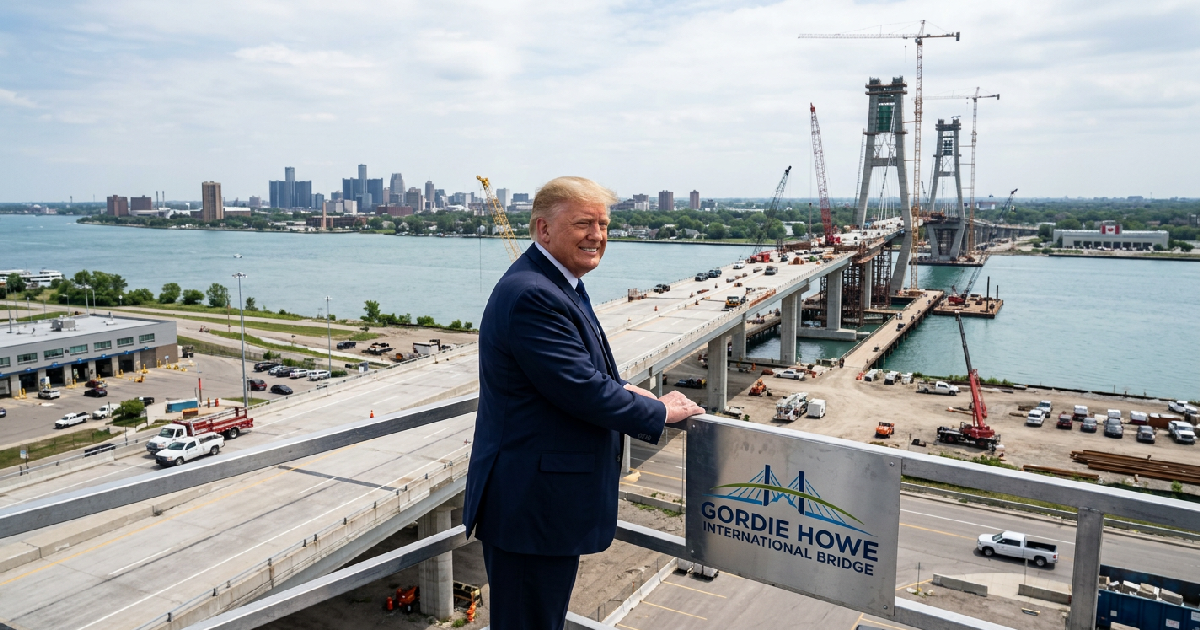
Donald Trump reportedly removes obstacles for
President Donald Trump has reportedly cleared the path for the completion of a $4.5 billion bridge between Canada and the United States, following years of cross-border negotiations. The project, which is identified as the Gordie Howe International Bridge in background reports, seeks to establish a new commercial artery between Detroit and Windsor.
This development, surfacing on July 11, 2026, appears to resolve lingering regulatory uncertainties that have surrounded the massive infrastructure undertaking during a period of shifting trade policies.
Strategic value of the Detroit-Windsor transit corridor
The bridge is scheduled to open on July 27, 2026, according to regional planning data, marking a significant milestone in North American logistics. By ensuring federal alignment, the administration has signaled a commitment to maintaining the flow of goods through one of the world’s busiest commercial corridors.
The timing is particularly relevant for the regional manufacturing sector, which depends on predictable border crossings to maintain “just-in-time” supply chains between the American Midwest and Ontario.
The Detroit-Windsor crossing is widely considered the most vital trade link between the United States and Canada. While newer assets like Posco International reveals plans for US rare earth plant facilities showcase the evolving industrial landscape, the physical transport of automotive parts and consumer goods remains the bedrock of the regional economy.
The current infrastructure has frequently struggled with congestion, and the addition of a new $4.5 billion span is intended to provide much-needed redundancy to the aging Ambassador Bridge.
Industry leaders have long argued that a secondary high-capacity crossing is essential for national security and economic resilience. A single point of failure at the border could potentially disrupt billions of dollars in trade. By clearing the administrative path for this bridge, the government is addressing long-standing concerns from logistics firms and manufacturers.
Investors monitoring regional performance, such as noted in reports where TFI International valuation rises after adjusted EPS beats expectations, often cite border efficiency as a primary factor in corporate profitability.
Integrating modern logistics with existing infrastructure
The project is designed to integrate directly with major highway systems on both sides of the border, providing a seamless transition for long-haul freight. This connectivity is a stark contrast to current transit routes that often require heavy machinery to navigate local municipal streets.
The new configuration is expected to drastically reduce idling times and fuel consumption for the thousands of trucks that cross the Detroit River daily.
And while digital shifts are occurring elsewhere—with some analysts noting Bitcoin (BTC) price drops to $75,406 as AI and quantum tech divert capital—the demand for physical infrastructure remains robust. The Gordie Howe International Bridge represents a massive bet on the future of North American manufacturing. It treats the border not as a barrier, but as a gateway for integrated industrial production.
Political climate surrounding the $4.5 billion bridge
The decision to facilitate the completion of the bridge comes amid broader discussions regarding “America First” policies and international trade agreements. Historically, infrastructure projects of this magnitude have faced intense scrutiny over labor standards and sourcing.
However, supporters of the bridge have emphasized the use of domestic materials and the creation of thousands of construction jobs as key factors that aligned the project with the administration’s economic goals.
Despite the “America First” rhetoric, the bi-national nature of the Gordie Howe International Bridge has seen continued support due to its substantial economic benefits for both Canada and the United States. Its Canadian funding model for much of the project’s cost also likely eased some financial strain on US federal budgets.
The complex process of cross-border infrastructure often involves intricate negotiations between federal, provincial, and state governments. Successfully navigating these layers of bureaucracy highlights a rare consensus on a major shared economic initiative.
The diplomatic maneuverings in early July 2026 suggest a pragmatic approach to binational cooperation. By allowing the project to proceed to its scheduled July 27 opening, the administration avoids potential friction with Canadian officials during a sensitive period for trade relations.
The bridge serves as a rare example of a multi-billion dollar project that has maintained momentum across different political cycles in both Washington and Ottawa.
Final preparations for the July 27 opening
As the opening date in late July approaches, crews are focusing on the final technical requirements for the customs plazas and tolling systems. The Gordie Howe International Bridge is expected to utilize advanced screening technology to expedite the crossing for pre-approved commercial travelers.
These “smart” border features are intended to minimize human error and reduce the manual inspection backlog that has historically plagued the Detroit-Windsor corridor. Such innovations are crucial for managing the anticipated surge in commercial traffic across the busy trade artery.
The bridge’s completion represents a major infrastructure upgrade for both Detroit, Michigan, and Windsor, Ontario, enhancing regional connectivity. It will not only relieve pressure on the aging Ambassador Bridge but also enhance the overall efficiency of North American trade routes, a critical need for modern commerce.
Once operational, the bridge will likely alter the competitive landscape for regional logistics. Shortened transit times could lead to lower overhead for shipping companies and, eventually, lower costs for consumers. For now, the successful navigation of federal hurdles ensures that one of North America’s most ambitious construction projects is finally ready to serve as the backbone of the continental trade network.