

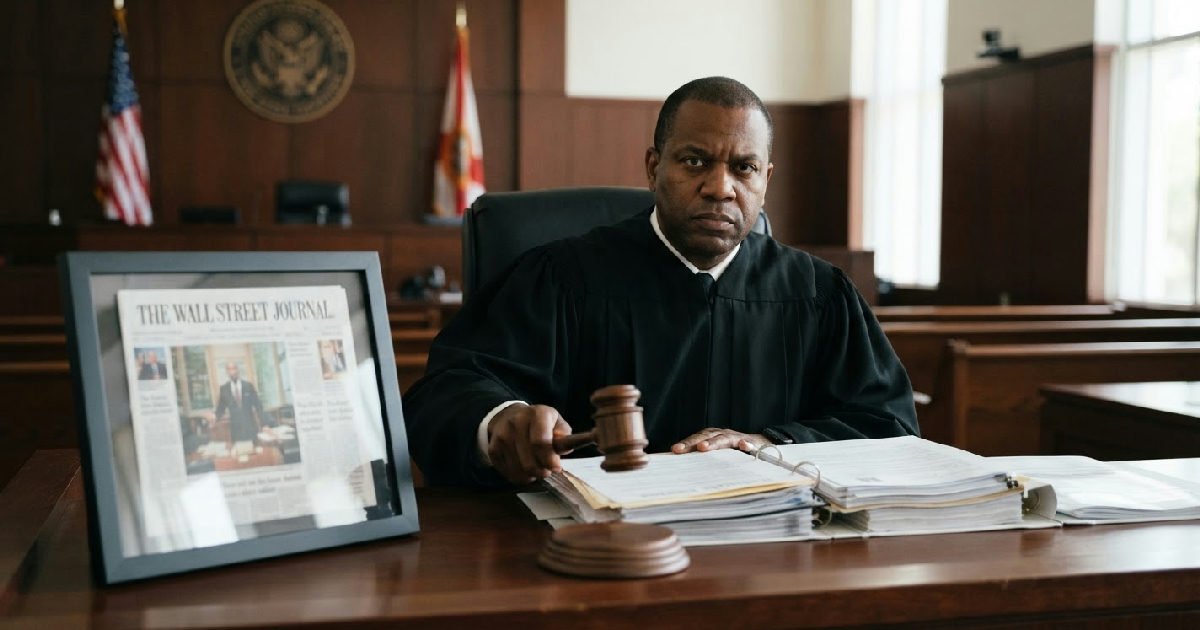
Judge Darrin Gayles Dismisses Trump WSJ Suit
U.S. District Judge Darrin Gayles permanently dismissed Donald Trump’s defamation lawsuit against The Wall Street Journal on Saturday, October 31, 2026. S. District Judge Darrin Gayles, presiding over a federal court in Miami, Florida, permanently dismissed Donald Trump’s defamation lawsuit against The Wall Street Journal on Saturday, October 31, 2026.
The ruling, handed down “with prejudice,” means the former U.S. President cannot refile or amend his complaint, bringing a definitive end to the contentious legal battle over an article concerning disgraced financier Jeffrey Epstein.
The dismissal marks the second time Judge Gayles has rejected Trump’s claims, with the court asserting that the plaintiff failed to prove the defendants acted with “actual malice.” This high legal bar, crucial for public figures alleging defamation, requires evidence that statements were published either with knowledge of their falsity or with reckless disregard for the truth.
Darrin Gayles Rejects Defamation Claim
Judge Darrin Gayles delivered a comprehensive 20-page ruling, stipulating that Donald Trump’s legal team did not plausibly allege that The Wall Street Journal or its co-defendants made defamatory statements with the requisite “actual malice.” The judge specifically noted that the lawsuit was “grasping at straws,” attempting to “manufacture” flaws in the Journal’s investigative reporting, an indication of the court’s perception of the merits.
The court highlighted that The Wall Street Journal had made efforts to obtain Trump’s response prior to the article’s publication. Crucially, the Journal included his denials within its story, a detail Judge Gayles cited as evidence of adherence to appropriate reporting standards. This practice demonstrated a commitment to journalistic integrity, undermining the claims of malicious intent.
The ‘Actual Malice’ Threshold
Central to the ruling was the “actual malice” standard, a legal principle established by the U.S. Supreme Court in its landmark 1964 decision, New York Times Co. v. Sullivan.
This precedent sets a high bar for public figures seeking to win defamation lawsuits, requiring them to demonstrate that false statements were published with knowledge of their falsehood or with reckless disregard for the truth. It’s a cornerstone of American press freedom.
Judge Gayles, in his written opinion, stated clearly: “As President Trump has not plausibly alleged that each Defendant made defamatory statements with actual malice, the Amended Complaint must be dismissed.” This underscores the court’s view that the allegations, even in the amended complaint, fell short of the necessary legal threshold for such a high-profile case.
The legal system places a heavy burden on public figures to protect robust public discourse.
Journal’s Reporting Scrutiny
The court meticulously examined the Journal’s reporting process. Evidence that the publication sought and included Donald Trump’s denials was pivotal. The judge rejected the argument that the Journal should have withheld the story after Trump’s denial, finding such a requirement would infringe upon First Amendment protections. This outcome reaffirms protections for media organizations when reporting on significant public interest matters.
This scrutiny affirms that media outlets are not required to censor themselves based on a public figure’s denial, provided they act responsibly in their reporting. It provides important clarity in an era where AI search evolution challenges ad revenue, underscoring the ongoing value of traditional journalistic practices and legal precedents.
The Core Dispute: Epstein Letter Allegations
At the heart of the lawsuit was a July 2025 Wall Street Journal article titled “Jeffrey Epstein’s Friends Sent Him Bawdy Letters for a 50th Birthday Album. One Was From Donald Trump.” The piece detailed a sexually suggestive letter and drawing, allegedly bearing Donald Trump’s name, found within a 2003 birthday album compiled for Jeffrey Epstein’s 50th birthday by Ghislaine Maxwell, the disgraced British socialite.
The letter, according to the article, featured typewritten text framed by the outline of what appeared to be a hand-drawn naked woman. It concluded with the phrase: “Happy Birthday — and may every day be another wonderful secret.” This specific content formed the basis of Trump’s claims of defamation, which he vigorously denied as “false, malicious, and defamatory.”
A Controversial Publication
The publication of the article ignited a fierce response from Donald Trump. He sought $10 billion in damages, with some reports even suggesting a figure of $20 billion, demonstrating the high stakes he placed on the lawsuit. Before the article ran, Trump reportedly contacted media mogul Rupert Murdoch, chairman emeritus of News Corp, in an attempt to halt its release.
Trump’s legal team alleged that Murdoch had told the former president, “I will handle it,” which Trump interpreted as an assurance the story would be suppressed. This alleged interaction underscores the intense pressure and high-level engagement surrounding the article, highlighting the sensitivity of reporting on such politically charged figures. Such interventions are rare in the editorial process.
Trump’s Vehement Denials
Throughout the legal proceedings, Donald Trump maintained his innocence regarding the letter’s authorship. He consistently labelled the story as “false, malicious, and defamatory” and a “FAKE,” denying both writing the letter and drawing the picture. This steadfast denial formed the emotional core of his legal challenge against The Wall Street Journal and its various entities.
The lawsuit named a broad array of defendants beyond the publication itself, including its parent company News Corp, its CEO Robert Thomson, the specific reporters Khadeeja Safdar and Joseph Palazzolo, and Rupert Murdoch. This comprehensive targeting reflected the severity with which Trump viewed the allegations, seeking to hold all perceived responsible parties accountable for the report.
A Second Dismissal and Legal Precedent
The recent dismissal wasn’t the first time Judge Darrin Gayles had weighed in on Donald Trump’s suit. The judge initially dismissed the lawsuit in April 2026. At that time, the dismissal was “without prejudice,” offering Trump the opportunity to file an amended complaint, which he subsequently did in an effort to strengthen his legal arguments.
This second, and now permanent, dismissal “with prejudice” closes the door on Trump’s ability to pursue these specific defamation claims against The Wall Street Journal in this court. It signifies that the court found fundamental deficiencies that could not be remedied through further amendments, drawing a decisive line under the legal challenge.
Previous Legal Hurdles
When the lawsuit was first dismissed in April 2026, Judge Gayles criticized Trump’s initial complaint for relying on “formulaic” assertions of malice. He stated that the arguments were “nowhere close” to meeting the stringent legal standard required for a public figure. This initial ruling set the stage for the current decision, indicating the court’s consistent application of the “actual malice” doctrine.
The opportunity to amend the complaint is a common procedural step, allowing litigants to rectify perceived shortcomings in their initial filings. However, the subsequent “with prejudice” dismissal signals that even with revisions, the core legal arguments were deemed insufficient to proceed, underscoring the formidable challenge faced by public figures in defamation cases.
Landmark Precedent for Public Figures
The judge’s invocation of the 1964 Supreme Court ruling in New York Times Co. v. Sullivan underscores the profound legal underpinnings of this case. This landmark decision established the “actual malice” standard, a critical safeguard for journalists reporting on public officials and figures. It protects the press from being unduly hampered by libel suits, fostering open public debate.
The ongoing relevance of this nearly 60-year-old precedent demonstrates its enduring impact on media law. For public figures, proving actual malice remains an exceedingly difficult task, designed to prioritize press freedom over individual reputation in instances where public interest is high. The dismissal reinforces this delicate balance, which allows for robust, if sometimes uncomfortable, reporting on powerful individuals.
Trump’s History of Media Lawsuits
Donald Trump has a well-documented history of initiating lawsuits against media organizations, frequently alleging defamation. These actions often highlight a broader strategy to challenge negative reporting and push back against critical coverage. His willingness to pursue legal avenues against news outlets has been a defining characteristic of his post-presidency and political career.
This pattern of litigation extends across various major news entities. For instance, he sued CNN in 2022 for $475 million, alleging a “campaign of dissuasion in the form of libel and slander.” These high-value claims often draw significant media attention, regardless of their ultimate legal outcome.
In a broader context, the tech industry is also grappling with new challenges, as evidenced by OpenAI lowering its funding target amid economic anxieties.
A Pattern of Litigation
Beyond CNN, Donald Trump has targeted other prominent media institutions. In 2022, he sued 20 members of the Pulitzer Prize Board for defamation, stemming from their refusal to revoke the 2018 Pulitzer Prize awarded to The New York Times and The Washington Post for their coverage of Russian interference in the 2016 election.
These suits often aim to discredit not just the reporting, but the institutions themselves.
Another notable case occurred in 2024 when Trump sued ABC News for defamation. This followed an interview where host George Stephanopoulos incorrectly stated Trump had been found “liable for rape” in the E. Jean Carroll case. ABC News later reached a settlement, agreeing to pay $15 million towards Trump’s presidential library and an additional $1 million in legal fees.
Settlements and Continued Actions
The ABC News settlement offers a rare glimpse into the financial resolutions of some of these high-stakes disputes, though most are dismissed or withdrawn. Trump also filed a $15 billion defamation lawsuit against The New York Times, four reporters, and publisher Penguin Random House in 2025, concerning a book and articles about his finances.
While a federal judge initially dismissed this suit, an amended complaint was allowed to proceed, indicating ongoing legal efforts.
In addition, Trump initiated a $10 billion lawsuit against the BBC in 2025 for defamation and deceptive trade practices. This specific action was related to an edited segment of a January 6, 2021, speech.
His persistent legal challenges against a range of media outlets, both domestic and international, underscore his consistent approach to perceived negative press, leveraging the courts as a key arena for these battles.
Broader Implications for Press Freedom and Public Figures
The permanent dismissal of Donald Trump’s defamation lawsuit against The Wall Street Journal carries significant implications for press freedom and the boundaries of reporting on public figures. The ruling reinforces the high bar set by the “actual malice” standard, reaffirming protections for investigative journalism even when the subject is a powerful former head of state.
It’s a victory for news organizations facing legal challenges from influential individuals.
This decision suggests that courts continue to uphold the principle that journalists must have room to report on matters of public interest without fear of excessive litigation, as long as they adhere to ethical reporting standards and lack malicious intent. It serves as a reminder that robust public discourse sometimes requires reporting that is critical or uncomfortable for those in power.
Protecting Investigative Journalism
Investigative journalism, by its nature, often uncovers information that powerful individuals or entities prefer to keep private. The Wall Street Journal’s article, delving into Jeffrey Epstein’s connections and correspondence, exemplified this type of reporting. The court’s dismissal validates the diligent work of reporters Khadeeja Safdar and Joseph Palazzolo, and the editorial judgment of the publication.
This outcome provides a degree of reassurance for newsrooms that are committed to pursuing challenging stories. It reinforces the legal framework that safeguards their ability to inform the public, even when facing legal pressure from well-resourced plaintiffs. The ruling helps to insulate the press from what some might consider retaliatory lawsuits designed to silence or intimidate.
The Enduring Challenge for Public Figures
For public figures like Donald Trump, the “actual malice” standard remains an enduring challenge in defamation cases. While they have recourse for genuinely false and maliciously published statements, the legal system is intentionally structured to make it difficult for them to win such suits against media organizations. This design ensures that public figures are subject to scrutiny and accountability in the public square.
The continuous efforts by politicians and other prominent individuals to litigate against media reports highlight the ongoing tension between a free press and the reputations of public figures. Ultimately, the Miami court’s decision reiterates that, under existing law, a public figure’s denial alone is not sufficient to establish defamation without concrete proof of malicious intent from the publisher.