

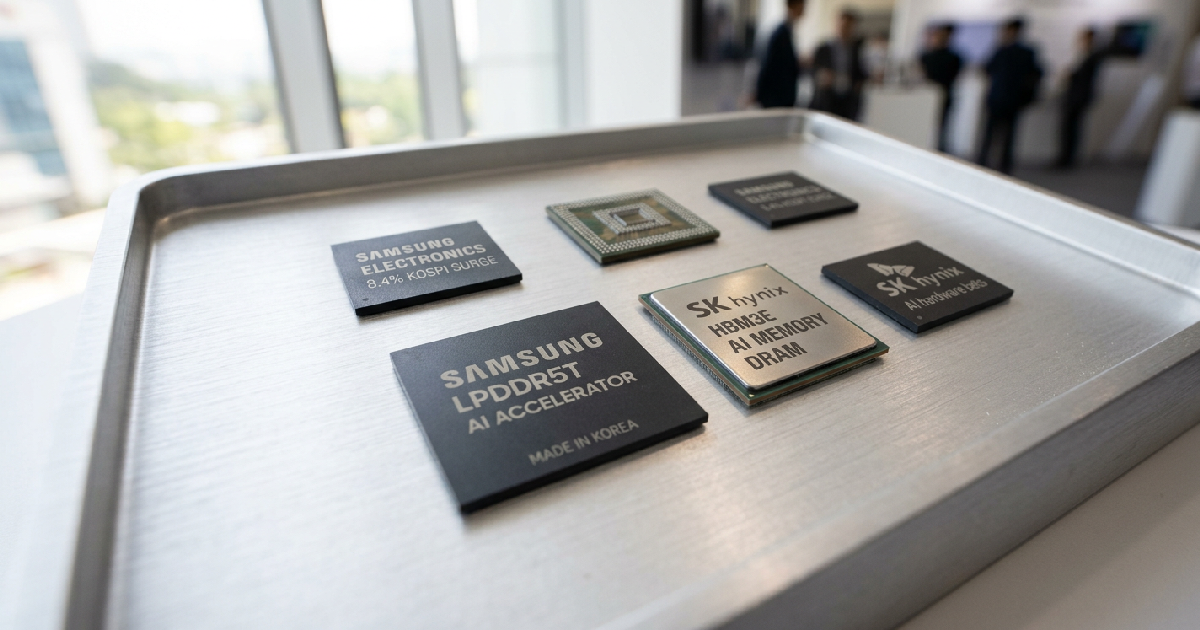
Samsung, SK Hynix lead 8.4% KOSPI surge on AI hardware bets
Global semiconductor stocks surged on Tuesday, June 9, 2026, as investor enthusiasm for artificial intelligence hardware triggered a massive rebound across international exchanges. South Korea’s KOSPI index closed up 8.4%, recovering nearly all the ground lost during a brutal sell-off on Monday.
The rally was so aggressive that it triggered “sidecars” — temporary suspensions of program buy orders — a stark reversal from the previous day’s trading halts caused by plunging prices.
The market turnaround was led by South Korean memory giants Samsung Electronics, which climbed 9%, and SK Hynix, which soared 15%. Confidence in the sector was bolstered by a multiyear partnership between SK Hynix and Nvidia Corp. to develop next-generation AI memory systems.
Nvidia CEO Jensen Huang punctuated the deal with a visit to Seoul, meeting with SK Group chairman Chey Tae-won and engaging in highly publicised media appearances.
This tech-led optimism comes amid a broader institutional shift in the sector. Analysts note that UBS Asia President Iqbal Khan views AI as a transformative force for traditional industries, reinforcing the idea that current gains are based on evolving economic fundamentals. Despite Friday’s 10.
26% plunge in the Philadelphia Semiconductor Index (SOX), the largest one-day drop since 2020, major investment banks like UBS and Morgan Stanley describe the volatility as a healthy correction.
CMA opens competition probe into Paramount and Warner Bros Discovery
While tech shares dominated headlines, British regulators launched a formal inquiry into a massive media consolidation. The UK Competition and Markets Authority (CMA) announced on Tuesday a Phase 1 investigation into the anticipated acquisition of Warner Bros. Discovery Inc. (WBD) by Paramount Skydance Corp. (PSKY). The regulator intends to determine if the deal could result in a substantial lessening of competition within the United Kingdom.
The CMA has set a deadline of August 7, 2026, to deliver its Phase 1 decision. If the initial probe identifies serious competition concerns, the body can escalate to a Phase 2 investigation, which typically lasts up to 24 weeks. This scrutiny follows a trend where supply chain resiliency and market diversity are being prioritised by government bodies over simple cost efficiencies during large-scale mergers.
The deal carries an enterprise value of approximately $110 billion, including a substantial amount of debt assumed by the buyer. Under the current agreement terms, Paramount Skydance Corp. will pay $31.00 per share in cash for all outstanding Warner Bros shares. Warner Bros.
shareholders approved the transaction in April, and both companies currently expect the deal to close in the third quarter of 2026, pending global regulatory approvals.
Semiconductor exports drive robust recovery in global trade
In the United States, the Philadelphia Semiconductor Index rose 1.8% in early Tuesday trading, following a 5.6% rally on Monday. Individual companies saw sharp gains, with Intel Corp. rising 2.1% after reports surfaced that Google plans to use the firm for more than 3 million specialised AI chips by 2028. Nvidia Corp.
shares edged up 0.5%, while Micron Technology Inc. saw a 5.6% rebound as momentum-chasing traders returned to the market.
The recovery is supported by strong industrial data coming out of Asia. China’s chip exports more than doubled on an annual basis in May, showing a 110.9% increase. Total exports from China rose 19.4% year-on-year, significantly outpacing the 14.1% growth seen in April.
This suggests that the global appetite for AI hardware and data processing machines remains high, even as certain segments of the market face price volatility.
Market analysts are revising their outlooks upward despite recent turbulence. Citigroup Inc. strategist Scott Chronert raised the year-end target for the S&P 500 to 8,100, citing a “big step up” in earnings expectations.
Similarly, Oxford Economics told its clients that the recent tech slide was a “healthy unwinding” of sentiment and presented an attractive opportunity for investors to add to their positions in American AI equities.
OpenAI files for trillion-dollar IPO amid tech boom
The AI sector narrative is shifting toward a monumental wave of new public listings. OpenAI has confidentially filed for an initial public offering on the US stock market, with projections suggesting the ChatGPT creator could be valued at over $1 trillion.
This filing places the company in a high-stakes race with rivals like Anthropic and Elon Musk’s SpaceX, the latter of which is expected to float on the market this Friday.
These upcoming floats are already impacting investor behaviour, as many build up cash piles in anticipation of the new tech offerings. Kathleen Brooks, research director at XTB, noted that the OpenAI filing will provide the first clear look at the company’s revenue streams versus its massive operational cash burn.
The “brat summer” for AI firms marks a period of extreme valuations alongside high-speed development in generative technology.
The financial environment is also receiving a boost from easing energy pressures. Oil prices fell on Tuesday following indications that Donald J. Trump reportedly requests edits to a proposed Iran peace deal, which officials say is in its “final throes.” This development helped narrow the US trade deficit to $55.
9 billion in April, largely due to a $6.4 billion surge in petroleum exports during the Middle East conflict.