

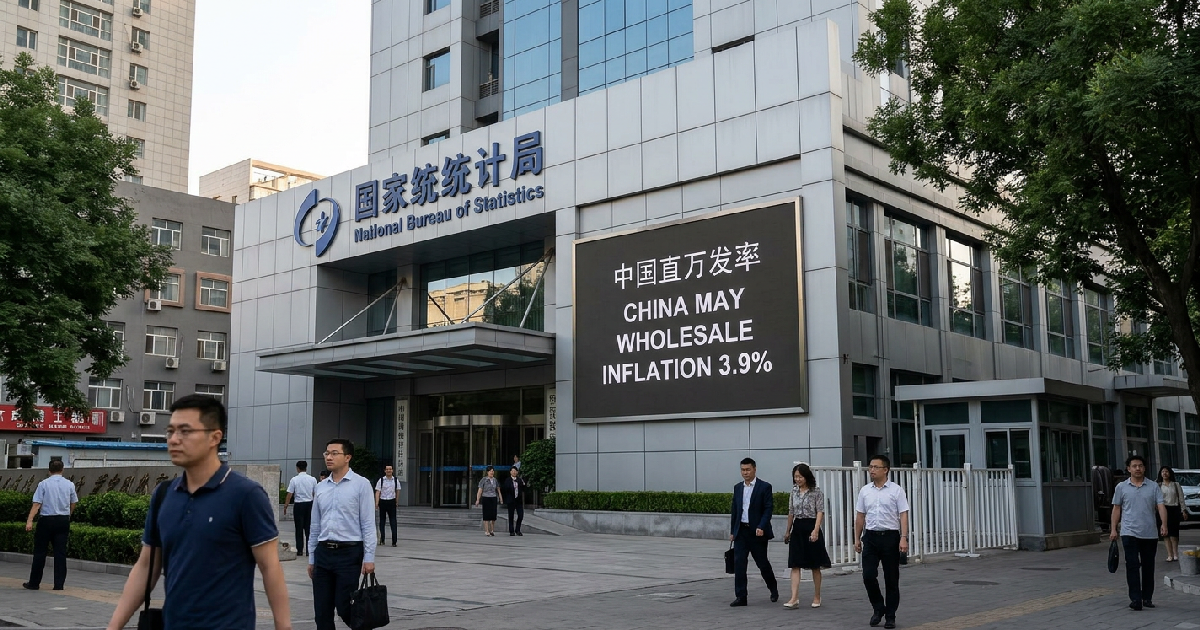
China’s Producer Price Index climbs 3.9% in May 2026, fastest in four years
China’s Producer Price Index (PPI) climbed 3.9% in May 2026, marking its fastest pace in nearly four years as industrial costs surged under the weight of the US-Israel war on Iran and a global push for artificial intelligence infrastructure.
Data released Wednesday by the National Bureau of Statistics (NBS) showed wholesale inflation reaching levels not seen since July 2022. While the PPI beat the 3.8% rise expected in a Reuters poll and by Wind economists, the Consumer Price Index (CPI) missed forecasts, rising 1.2% year-on-year against an anticipated 1.3% increase.
The divergence between factory-gate prices and consumer costs highlights a complex economic environment. While manufacturers face a sharp 5.2% acceleration in production material costs, they appear unable to pass these expenses to a cautious public. Many firms are prioritising com/international-news/supply-chain-resiliency-perma-crisis-era-logistics-shift/”>supply chain resiliency over immediate profits as geopolitical instability threatens the flow of critical resources. This mismatch suggests corporate margins are being squeezed as the gap between industrial reality and retail demand widens.
Energy shocks and the impact of the Iran conflict
The primary catalyst for the wholesale spike remains the ongoing military conflict involving the US, Israel, and Iran, which began on February 28, 2026. As a major supplier of crude to Beijing, Iran’s exports have been severely hampered by the closure of the Strait of Hormuz.
This has created a shortfall of approximately 1 million to 1.4 million barrels per day in China’s oil imports. The resulting global oil shock saw Brent crude oil prices climb from an average of $71 per barrel in February to roughly $100 in March 2026.
The impact on China’s industrial base has been immediate. Mining sector costs jumped 15.8% in May, while raw material prices rose by 9.2%. Domestic energy consumers have felt the sting as well, with retail gasoline prices in China rising 39% between early March and mid-April 2026.
To mitigate the blow, Beijing has restricted fuel exports and intervened in price adjustment cycles, capping increases at roughly half the standard level. Despite these efforts, Liquefied Natural Gas (LNG) prices in China still surged by 42% over the same period.
Artificial intelligence investments drive industrial demand
Beyond energy, the rapid expansion of the AI sector is inflating the price of electronic and metallic components. Strong global demand for AI-related electrification is pushing copper prices higher, compounding the costs for China’s electrical machinery and electronics manufacturing plants. These sectors contributed nearly 0.5 percentage points to the overall PPI increase.
Furthermore, a global shortage of AI-specific chips has driven up equipment costs across the board.
The demand for computing power has even triggered price hikes in infrastructure components. In April, optical fiber manufacturing saw price increases exceeding 20%. This technological boom provides a sharp contrast to the broader economy, as high-tech needs compete for resources with traditional manufacturing. This shift aligns with current findings that com/international-news/ubs-khan-china-business-ai-impact-analysis-2026/”>AI represents a massive transformation for global business structures, though in China’s case, it is currently adding to the inflationary burden at the factory level.
Consumer demand remains sluggish despite producer spikes
While factory costs soar, the CPI remains subdued. Core CPI, which excludes volatile food and energy, rose just 1.1% in May. Food prices actually fell by 1.8%, while clothing and daily-use goods both saw declines of 1.0%.
This indicates that the domestic population is not yet sharing the inflationary heat felt by the industrial sector. The month-on-month CPI actually decreased by 0.1%, matching expectations but confirming that consumer confidence has not yet recovered.
Zhao Wei, Chief Economist at China International Capital Corporation (CICC), noted that “high inflation was amplifying the suppression of consumer demand.” The persistent gap between what it costs to make a product and what a customer is willing to pay represents a significant hurdle for the National Bureau of Statistics (NBS) to monitor.
With hopes for a regional deal still impacting market sentiment, the pressure on Chinese policymakers to stimulate demand while managing industrial costs is intensifying.
Strategic reserves and the road ahead
China has attempted to insulate itself from the worst of the energy crisis by pre-emptively boosting crude oil imports by nearly 16% year-on-year during the first two months of 2026. These strategic reserves currently provide about three to four months of import cover. However, as processing costs continue to rise—climbing 2.
3% in May compared to 1.5% in April—these buffers may not be enough if the geopolitical situation remains stagnant.
The industrial sector’s ability to absorb these costs is not infinite. If wholesale inflation continues at this near four-year high, the “near-zero” inflation environment for consumers may eventually break. For now, the Chinese economy remains caught between an expensive energy and tech-driven production environment and a domestic market that is simply unwilling or unable to pay the difference.