

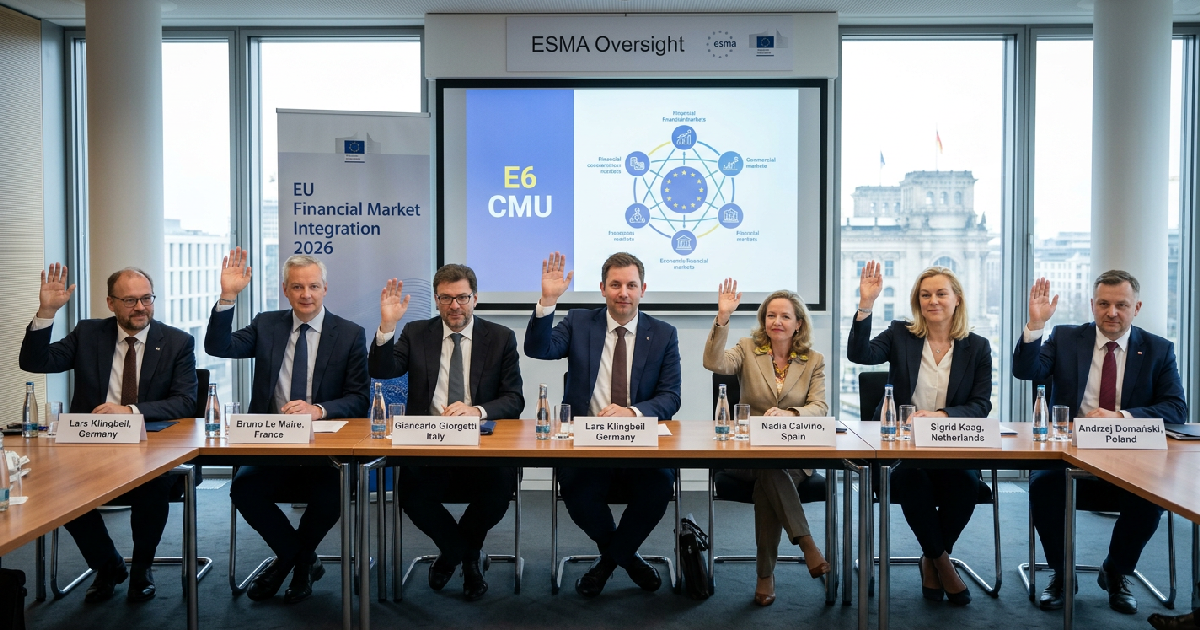
German Finance Minister Lars Klingbeil and E6 ministers target unified capital markets
Finance ministers from the European Union’s six largest economies have reached a common position to accelerate the long-standing Capital Markets Union (CMU) initiative. During a high-level meeting in Berlin today, May 29, 2026, ministers from Germany, France, Italy, Spain, the Netherlands, and Poland (the E6) forged a joint strategy to integrate the bloc’s fragmented financial systems. The group, including German Finance Minister Lars Klingbeil and French Finance Minister Roland Lescure, intends to present these compromises to the wider EU-27 to break years of regulatory deadlock.
The ministers outlined their proposal in a letter addressed to European Commission Vice-President Valdis Dombrovskis and Eurogroup President Paschal Donohoe. This unified front among the “E6” represents a major push to centralize financial oversight and remove persistent cross-border investment barriers. While the CMU was originally launched by Former President of the European Commission Jean-Claude Juncker, it has struggled to gain traction until this recent intervention by the bloc’s economic heavyweights.
And the timing is notable. The move comes as the EU seeks more efficient ways to channel private capital into digital and green initiatives. Some experts suggest that without a more integrated system, European finance risks falling behind global competitors. This sentiment echoes recent industry movements, such as when Brian Armstrong warned finance must move on-chain to maintain institutional relevance in the coming decade.
Reported plans for centralized market supervision
A central pillar of the E6 position involve a reported agreement to empower the European Securities and Markets Authority (ESMA) with joint capital market supervision. Under these reported terms, the Paris-based regulator would take a lead role in harmonizing rules that are currently split across 27 national authorities. The plan reportedly suggests that ESMA should assume oversight of major market infrastructures to ensure consistency across the Eurozone.
Negotiators in Berlin reportedly agreed to cut barriers for cross-border funds, a move designed to make company financing more fluid across member states. Currently, diverging national rules often make it difficult for venture capital or pension funds to invest outside their home country. By standardizing these processes, the E6 hopes to unlock new pools of liquidity for European businesses that might otherwise seek funding in the United States.
The reported agreement also extends to newer financial sectors. Sources indicate the E6 has proposed that powers of EU supervisory authorities in crypto-assets trading be strengthened. This alignment of digital finance regulation is a core component of the broader plan to modernize the European financial landscape. Such regulatory shifts often impact broader market valuations, similar to how a Lincoln International valuation showed 79% discount during recent period of pricing corrections.
Building compromise among the EU-27 member states
The Berlin meeting was specifically designed to prepare compromises that the remaining 21 EU member states could support. Smaller nations have often resisted centralization, fearing a loss of national sovereignty over their local financial hubs. However, the presence of Netherlands’ Minister of Finance Eelco Heinen and Poland’s Minister of Finance Andrzej Domański suggests a broader geographic consensus than previous Franco-German attempts.
Italy’s Minister of Economy and Finance Giancarlo Giorgetti and Spain’s Minister of Finance Carlos Cuerpo have emphasized that integrating these markets is essential for industrial competitiveness. The group argues that a “Single & Investment Union” is the only way to scale European startups into global leaders. All 27 EU Member Ministers had previously agreed on the general concept of completing the capital market during a recent Eurogroup meeting, but the E6 proposal now adds technical specifics to that goal.
Implementation and the role of the European Commission
The path forward now lies with the European Commission, led by President Ursula von der Leyen. The Commission is expected to evaluate the E6 proposal and determine how much of the reported framework can be translated into formal legislative text. Because the E6 represents the bulk of the EU’s economic output, their “common position” carries significant weight in the Brussels legislative machine.
If the reported plan to empower ESMA and reduce fund barriers is adopted, it could lead to more robust corporate valuations across the continent. Investors often reward markets that demonstrate clear, unified regulatory structures. For instance, when TFI International valuation rose following strong adjusted earnings, it highlighted the appetite for transparent, well-regulated stocks in the international arena.
But the transition will not happen overnight. The E6 ministers must still navigate a complex landscape of technical implementation and political negotiation. The goal remains to create a seamless financial environment that allows capital to flow as freely as goods and people do within the single market. For now, the Berlin deal serves as a significant signal of intent from the EU’s most powerful economies.