

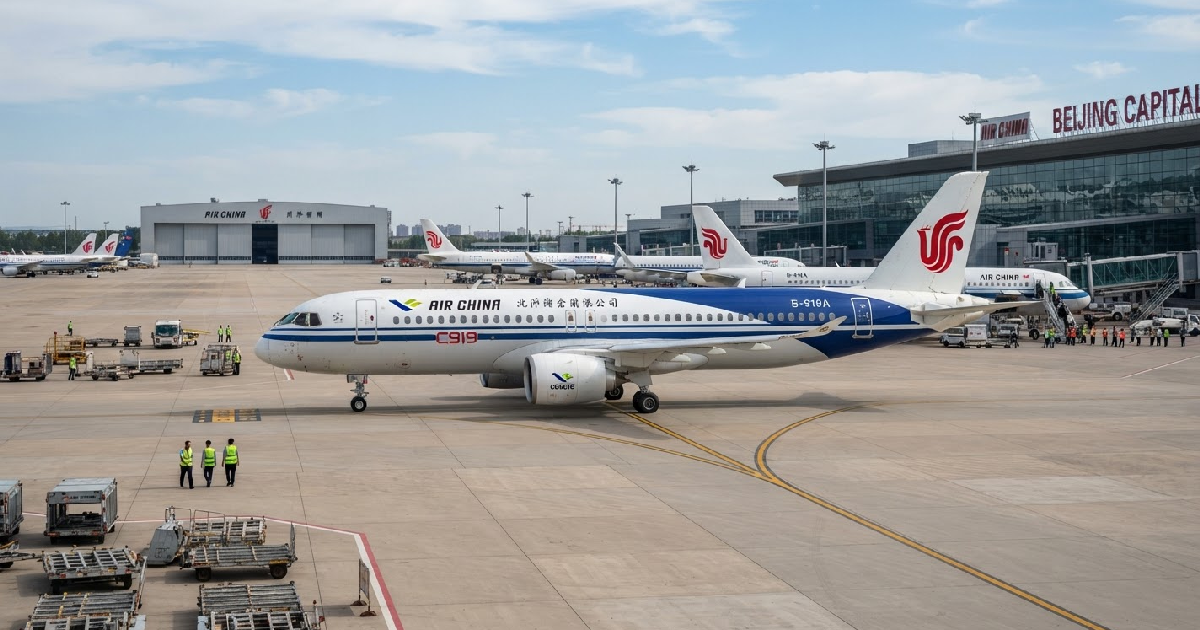
C919 aircraft launches first international route to Mongolia via Air China
The Commercial Aircraft Corporation of China (COMAC) C919 aircraft will commence its inaugural routine international passenger service to a foreign country on August 12, 2026. Air China is set to operate a daily round-trip flight using the C919 between Beijing Capital International Airport in China and Ulaanbaatar in Mongolia.
This significant development marks a pivotal moment for China’s domestically developed large passenger aircraft as it expands its operational footprint beyond domestic and Special Administrative Region routes.
Air China inaugurates Beijing-Ulaanbaatar service
This new route underscores China’s accelerating ambition to become a major player in global aviation manufacturing, directly challenging the long-standing dominance of aerospace giants like Airbus and Boeing. It signals a strategic step in demonstrating the C919’s capabilities on a true international stage. Tickets for the new service are already available, indicating a readiness for immediate uptake.
Air China will launch the C919’s first routine international service, connecting Beijing Capital International Airport (PEK) with Ulaanbaatar in Mongolia. The airline has confirmed a daily round-trip flight schedule, strengthening ties between the two nations through direct air travel. This operation represents a concrete expansion of the C919’s commercial utility.
The outbound flight, designated CA723, will depart Beijing Capital International Airport at 3:00 p.m. local time, arriving in Ulaanbaatar at 5:15 p.m. local time. The return journey, flight CA724, is scheduled to leave Ulaanbaatar at 6:30 p.m. local time, touching down in Beijing at 8:35 p.m. local time the same day. This consistent schedule aims to cater to both business and leisure travellers.
While this marks the C919’s debut on a routine service to a foreign country, the aircraft has previously handled cross-border flights. Notably, China Eastern Airlines began daily return services between Shanghai and Hong Kong in January 2025, which were described as the C919’s first cross-border route.
Air China also flies the C919 on a daily Beijing Capital-Hong Kong regional route. Flights between Hong Kong, a Special Administrative Region of China, and mainland China utilize international sections of airports, highlighting the nuanced definition of “international” in this context.
C919’s journey to commercial aviation
The C919 represents a monumental effort by China to achieve self-sufficiency in commercial aircraft production, a project initiated by COMAC in 2008. The aircraft’s development timeline spans over a decade, culminating in its commercial deployment. This long gestation period reflects the complexities inherent in designing and certifying a large passenger jet from scratch.
Production for the C919 began in December 2011, with the first prototype rolling out on November 2, 2015. Its maiden flight took place on May 5, 2017, a crucial step in its certification process. The aircraft subsequently received its CAAC type certificate on September 29, 2022, paving the way for commercial operations.
The first production airframe was delivered to China Eastern Airlines on December 9, 2022, ushering in a new era for Chinese aviation. It officially entered commercial passenger service on May 28, 2023, with China Eastern Airlines flight MU9191 from Shanghai Hongqiao Airport to Beijing Capital Airport.
By the end of April 2026, the C919 had already operated more than 42,000 commercial passenger flights, demonstrating its growing reliability and acceptance in the domestic market.
Fleet expansion and operational performance
As of December 2024, COMAC had delivered 14 C919 planes to domestic airlines, with nine going to China Eastern, and the others distributed between Air China and China Southern Airlines. Air China alone has taken delivery of 12 C919 aircraft, signifying their increasing integration into the national fleet. All scheduled C919 flights within China are currently operated by these three major carriers.
The C919’s baseline version boasts a seating capacity of 158 to 192 passengers and a range of 4,075 to 5,555 kilometers. It’s powered by two CFM International LEAP turbofan engines, specifically the LEAP 1C28 engines for the STD variant.
Its dimensions include a length of 38.9 meters, a wingspan of 35.8 meters, and a cruise speed of Mach 0.785, making it competitive with similar narrow-body aircraft.
Challenging the aerospace duopoly
The C919’s entry into international service is a key component of China’s broader strategy to disrupt the global aircraft manufacturing duopoly held by Boeing and Airbus. For decades, these two companies have dominated the market for large commercial jets. COMAC aims to carve out a significant share by offering an alternative, particularly to developing nations and within the rapidly expanding Asian aviation market.
COMAC has been actively promoting the C919 to airlines in countries such as Cambodia, Indonesia, and Kazakhstan. These efforts include extensive demonstration flights across Southeast Asia, with the C919 having showcased its capabilities in Vietnam, Laos, Cambodia, Malaysia, and Indonesia. These tours are vital for building confidence and securing international orders, crucial for long-term success.
A notable early success came in September 2023 when GallopAir, a Brunei-based startup, signed a preliminary agreement for 30 COMAC aircraft, including the C919. Such agreements are essential for establishing an international customer base and validating the aircraft’s appeal beyond China’s borders.
The push for international sales aligns with China’s broader economic strategy of global engagement, even as some sectors face China trading curbs that impact foreign assets.
Securing airworthiness certification from international regulatory bodies remains a critical hurdle. China has already achieved mutual recognition of airworthiness certification with several countries, including Singapore, Indonesia, and Myanmar. However, the C919 is still undergoing evaluation by the European Union Aviation Safety Agency (EASA), a key gatekeeper for entry into major global markets.
What this means for China’s aviation industry
The C919’s international debut is more than just a new flight route; it