

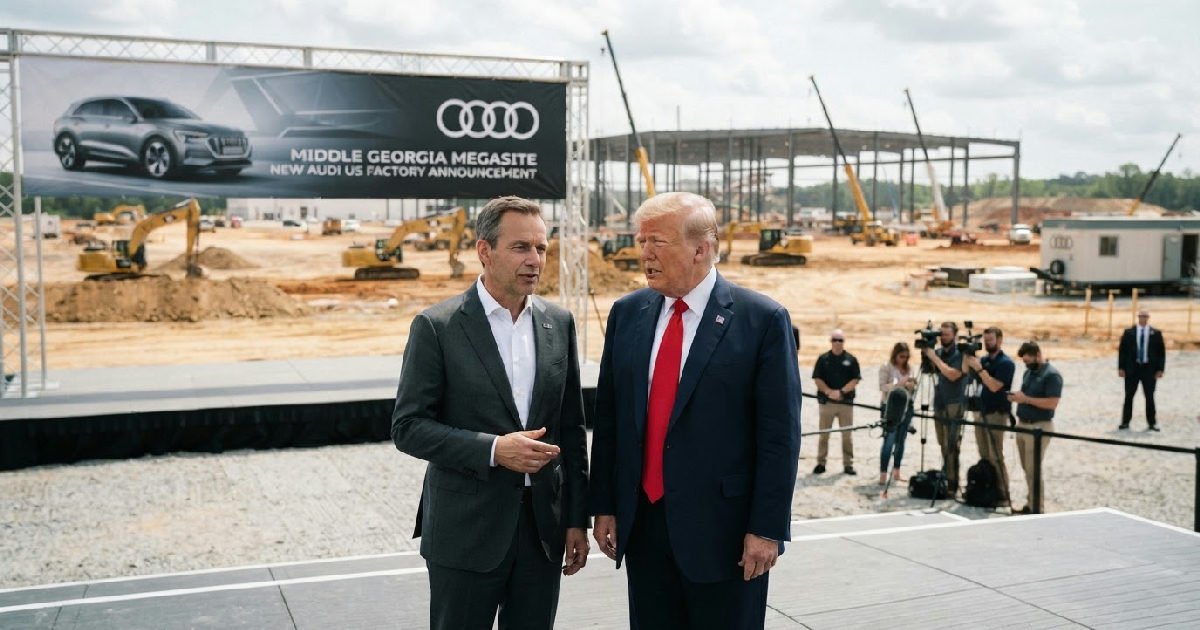
Audi CEO announces Audi US factory
Audi, the premium brand of the Volkswagen Group, will build its first US factory in Georgia with a $4 billion investment, creating 4,500 jobs. The surprising announcement was made by Audi Chief Executive Officer Gernot Döllner, who appeared alongside President Donald Trump at a campaign rally on Saturday, October 24.
This major American expansion stands in stark contrast to the company’s plans in Germany. Volkswagen is simultaneously undertaking a massive restructuring that could see up to 100,000 jobs eliminated as it grapples with intense competition and the costly shift to electric vehicles.
The new Audi US factory: A strategic pivot to the American market
The new plant, to be located at the Middle Georgia Megasite in Peach County, near Macon, is a direct response to a complex web of economic pressures and market opportunities.
For years, Audi has been exposed to steep US tariffs on European auto imports, which dealt the brand a €1.2 billion ($1.4 billion) blow in the last year alone. By producing vehicles stateside, Audi can circumvent these costly trade barriers.
Audi’s sales have struggled recently, falling 7% in the first half of 2026, with US sales down a sharp 16%. The company attributes this to pressure from both US tariffs and growing competition from Chinese automakers.
Volkswagen Group CEO Oliver Blume has been blunt, stating in July that “US tariffs create a significant burden and restrict international trade.” The automotive sector’s financial performance across the industry reflects these broader market shifts.
This new factory represents a decisive move to de-risk its American operations and capitalize on the market for large vehicles. The Georgia facility will focus on the models most in-demand in the US: large, premium SUVs.
Production will include the Q7, Q8, and the upcoming, larger Q9, which is being designed with the American market specifically in mind. This will shift some production from Bratislava, Slovakia, directly to the heart of its target market.
“We are planning to bring our biggest and most premium SUVs, and produce them here in Macon, Georgia,” Döllner said at the announcement event. “This is a long-term investment because we believe in the American market.” Preparatory work for the plant is set to begin in 2027, with the goal of starting full-scale production in 2031 with a capacity of 200,000 vehicles per year.
Political dimensions of the Georgia plant
The choice of venue for the announcement—a political rally just days before the US midterm elections—was highly unusual for a major European corporation. Döllner’s appearance on stage with President Trump immediately intertwined the business decision with American politics. Trump has long argued that his protectionist trade policies and tariffs would force foreign companies to move production to the US.
The President seized on the announcement as a vindication of his strategy, even as critics point out that overall US vehicle and parts employment has declined during his term. For Audi, the move is a pragmatic calculation to gain political favour and market access.
Döllner explained his presence at the rally as a matter of “respect for the US,” but it clearly serves to align the company with the current administration.
Beyond the Georgia plant, Audi also intends to build 25,000 vehicles annually in South Carolina. These will be assembled at Volkswagen’s off-road brand Scout Motors’ $2 billion plant, currently under construction in Blythewood, near Columbia. This dual approach underscores a broader strategy to significantly expand American manufacturing footprint.
The complexities of international trade and tariffs often intersect with broader regulatory environments. Companies globally must adapt to shifting compliance demands, similar to how regulatory bodies outline new priorities annually.
Volkswagen’s grim outlook in Germany
While Audi expands in the US, its parent company, Volkswagen Group, is implementing drastic cost-cutting measures across its German operations. The board of directors approved a plan on September 3, 2026, aimed at eliminating 50,000 jobs and ceasing auto production at four German plants to counter intense competition from Chinese manufacturers and the headwinds from US tariffs.
This ambitious restructuring, championed by Volkswagen Group CEO Oliver Blume, could ultimately result in up to 100,000 job cuts across the global group, representing approximately 15% of its workforce, which stood at over 600,000 people at the end of 2025.
The plan also includes reducing the number of available models by about 50%, reflecting a need to streamline production and focus on profitability amid an estimated 500,000 vehicle excess production capacity in Europe.
Four German plants face potential closure or a staggered end to current production between 2031 and 2034. These include Emden, Zwickau, Hanover, and Audi’s own site in Neckarsulm. Such closures highlight the severe pressures facing the European automotive sector, compelling companies like Volkswagen to reassess their global manufacturing strategies.
Audi’s specific job reductions
Within Volkswagen’s broader cuts, Audi has announced its own plan to reduce 7,500 jobs in Germany by the end of 2029. This initiative seeks to save over €1 billion (approximately $1.1 billion) annually. The first 6,000 positions are slated for elimination by 2027, with an additional 1,500 reductions by 2029.
Crucially, Audi has pledged no forced layoffs and extended employment guarantees for its remaining German employees until the end of 2033. Most of these cuts will target administrative and non-production roles, as the company works to become “faster, more agile, and more efficient,” according to Audi CEO Gernot Döllner.
The company also confirmed a reduction in employee bonuses, which saw payouts of €8,840 ($9,700) in 2024 but are expected to be lower going forward.
Union and government reactions
The German union IG Metall has voiced strong concerns over the job losses, despite welcoming the overall restructuring agreement. Christiane Benner, head of IG Metall and Volkswagen’s deputy supervisory board chair, emphasized the need for “firm prospects for workers at all sites, particularly those here in Germany.”
The union orchestrated actions nationwide involving around 175,000 workers on September 21, 2026, demanding job protection and measures against unfair Chinese competition.
IG Metall is pushing for potential import duties on hybrid vehicles and regulations that would encourage more production within Europe. Jörg Schlagbauer, Audi’s deputy board chairman, has also insisted on long-term guarantees for German production before fully endorsing US expansion. This reflects a delicate balance the Volkswagen Group must strike between global market demands and domestic labor stability.
The German government, for its part, welcomed the initial restructuring agreement between Volkswagen’s board and employee representatives. This indicates a recognition of the severe challenges facing the German automotive industry. However, the political tightrope walk remains, as the government seeks to protect a vital industrial sector while also allowing companies the flexibility needed to compete globally.
Navigating a turbulent global automotive landscape
Volkswagen’s dual strategy of aggressive cost-cutting in Germany and significant investment in the US underscores the profound shifts reshaping the global automotive sector. The company is battling not only the direct impact of US tariffs but also intense price competition from Chinese automakers, particularly in the electric vehicle segment. This has forced a strategic re-evaluation of where and how vehicles are produced.
An internal document from the Volkswagen Group, titled “Group Target Landscape,” revealed a broader directive: the vast majority of its 600,000 global employees will not receive salary increases before 2030, with variable pay and bonuses also set to decrease. These measures illustrate the depth of the financial pressures driving Volkswagen’s decisions.
Despite earlier intentions, Audi plans to continue investing in internal combustion engine production at its Ingolstadt plant beyond 2030. This adjustment reflects a slower-than-anticipated adoption of electric vehicles in some markets, highlighting the complexities of the transition away from fossil fuels. It’s a stark reminder that even with significant EV investments, the path to full electrification remains uneven across different regions.
The US Inflation Reduction Act, which offers substantial incentives for domestic electric vehicle and battery manufacturing, is a significant factor in Audi’s decision to build its first US plant. This legislation, coupled with President Trump’s efforts to push manufacturing to the US, has created a compelling economic case for localization, even as it creates tension with existing European operations.