

abu dhabi national oil company explores third pipeline
The United Arab Emirates is actively exploring the development of a third major crude oil pipeline designed to circumvent the strategically vital, yet increasingly volatile, Strait of Hormuz.
This potential project by the Abu Dhabi National Oil Company (ADNOC) signals a significant acceleration of the UAE’s long-term strategy to safeguard its energy exports and drastically reduce dependence on the narrow waterway.
Dhabi National Oil Company export routes
The move comes as geopolitical tensions continue to reshape global energy security, underscored by the 2026 Iran war and its profound impact on shipping through the Strait.
Sources familiar with the matter indicate that ADNOC is weighing the construction of this new pipeline to run from the UAE’s western coast eastward to the port of Fujairah.
This would complement an existing pipeline and a second conduit already under construction, further bolstering the nation’s capacity to deliver crude to international customers even in the face of potential disruptions at Hormuz. The consideration highlights the Gulf producers’ evolving view of the Strait as a permanent risk factor in oil transportation.
The UAE has been steadily building its bypass infrastructure to counter the inherent risks associated with the Strait of Hormuz. The existing Abu Dhabi Crude Oil Pipeline (ADCOP), also known as the Habshan-Fujairah pipeline, has been operational since 2012. It moves Murban crude from Abu Dhabi’s onshore fields to Fujairah on the Gulf of Oman, outside the Strait.
With an operational capacity of approximately 1.8 million barrels per day (bpd), the ADCOP pipeline offers a crucial alternative. However, recent events have spurred the need for even greater capacity. This has led to the fast-tracking of a second major pipeline project.
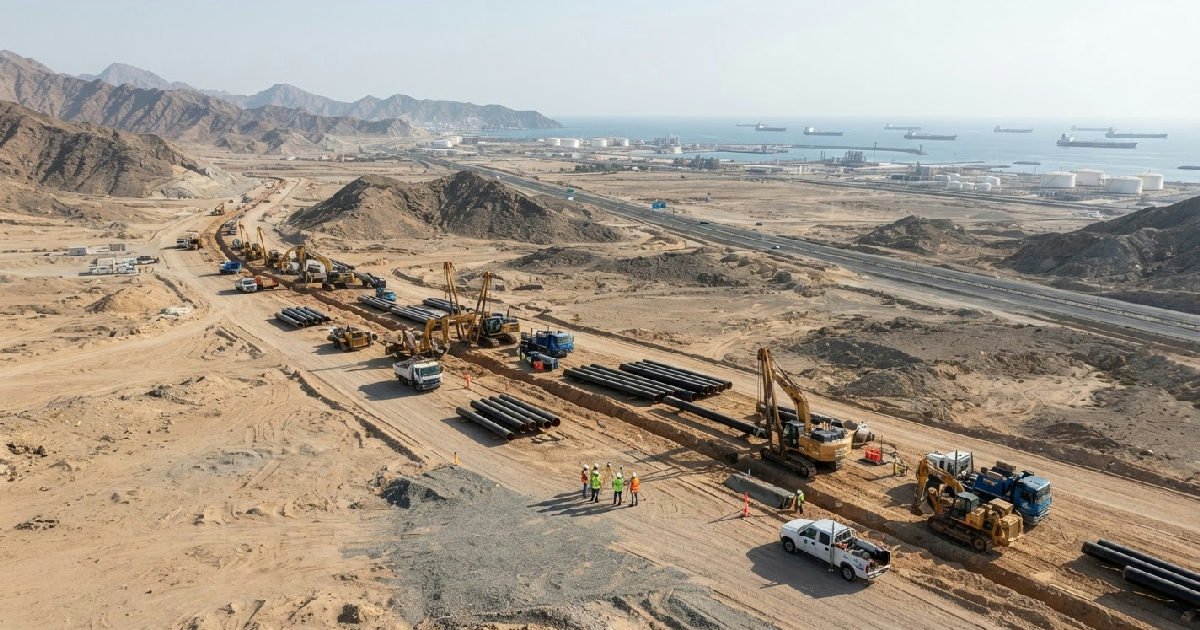
This second line, referred to as the “West-East pipeline” or “West-East 1,” is designed to transport Upper Zakum crude from offshore fields to the Fujairah terminal. Construction was notably accelerated in May 2026, with ADNOC informing Asian refiners that supplies via this new 48-inch pipeline could commence as early as the second quarter of 2027.
The project was nearly 50% complete by May of this year, pushing toward its targeted early 2027 operational date.
The Geopolitical Imperative: Hormuz Risks
The impetus for the UAE’s expanded pipeline infrastructure is clear: the escalating geopolitical risks surrounding the Strait of Hormuz. The 2026 Iran war, which began on February 28, 2026, with US and Israeli attacks on Iran, drastically altered the shipping landscape.
In a retaliatory move, Iran largely blocked commercial shipping through the Strait, creating unprecedented disruptions to global oil and gas supplies. This blockade has caused a significant global fuel crisis, with Brent crude prices surging past $120 per barrel.
Crude and condensate flows through the Strait of Hormuz plunged dramatically during this period, reaching approximately 9.44 million bpd in the first 25 days of October 2026. This figure represents only about 65% of pre-war levels, highlighting the severe constriction of a vital trade artery.
The blockade in March 2026 saw UAE oil exports fall to a record low of 2.13 million bpd, showcasing the vulnerability of routes reliant on the Strait.
Against this backdrop, US Treasury Secretary Scott Bessent reportedly commented in October 2026 that the Strait of Hormuz “will be a worthless piece of water” within two years.
His projection suggests that up to 70% of the energy volumes typically transiting the Strait could instead be rerouted through pipelines, underscoring the long-term strategic shift by Gulf producers away from the chokepoint. The ongoing crisis has forced a re-evaluation of energy security, prompting commodity market participants to adjust to new realities.
Bolstering Export Capacity and Operational Resilience
The construction of the West-East 1 pipeline, coupled with the consideration of a third, is poised to significantly enhance the UAE’s oil export capacity. The new 1.5 million bpd pipeline will effectively double ADNOC’s crude export capacity through Fujairah. This expansion would bring the total crude pipeline capacity to Fujairah, combining with the existing Habshan-Fujairah pipeline’s 1.8 million bpd, to approximately 3.3 million bpd.
Some sources even suggest that the total crude export capacity from the port of Fujairah could ultimately rise to as much as 4 million bpd when accounting for planned storage and terminal infrastructure upgrades. This robust expansion aligns with ADNOC’s broader objective to increase its overall oil production capacity to 5 million bpd by 2027.
The company views resilient infrastructure as critical to meeting this ambitious target.
Strategic Directives and Infrastructure Investment
The urgency behind these projects was underscored when the Crown Prince of Abu Dhabi, Sheikh Khaled bin Mohamed bin Zayed Al Nahyan, directed ADNOC on May 15, 2026, to fast-track the West-East Pipeline.
Just days later, on May 20, 2026, ADNOC Managing Director and Group CEO Sultan Al Jaber confirmed the pipeline’s rapid progress and its expected operation in 2027. Al Jaber also acknowledged that some ADNOC facilities had been directly targeted during recent conflicts, with ongoing assessments of the damage.
Beyond crude oil, ADNOC also announced plans for its first multi-fuel pipeline to Fujairah in June 2026. This initiative, driven by the crisis, aims to safeguard exports of refined products, further diversifying the UAE’s energy export capabilities.
The broader project pipeline, valued at $55 billion and slated for awards between 2026 and 2028, reflects a concerted effort to fast-track the national growth strategy and cement the UAE’s position as a reliable energy supplier.
Wider Regional Bypass Efforts Underway
The UAE isn’t alone in its pursuit of alternative export routes; other Gulf nations are also strategically developing infrastructure to bypass the Strait of Hormuz. These regional efforts underscore a collective recognition of the enduring risks associated with the narrow chokepoint and a concerted drive to bolster energy supply resilience across the Middle East.
The goal is to minimize the economic fallout from potential future disruptions.
Saudi Arabia, a major global oil producer, is actively considering expanding its East-West pipeline, which currently boasts a substantial capacity of 7 million bpd. This pipeline, which transports crude to the Red Sea, offers a critical alternative to Hormuz. Furthermore, the Kingdom is reportedly exploring the possibility of an additional pipeline extending to Oman’s Duqm port, signaling a comprehensive approach to securing its export pathways.
Elsewhere, Iraq and Syria are working to revive a pipeline that sustained damage during the 2003 US-led invasion. This refurbishment project aims to re-establish a viable northern route for Iraqi oil exports, reducing reliance on southern terminals that are more exposed to Strait of Hormuz dynamics. The initiative reflects a broader regional push for energy independence.
Closer to home for the UAE, the Sharjah National Oil Corporation (SNOC) is planning a roughly 100-kilometer pipeline corridor. This project would run from Al Hamriyah port to locations like Kalba, Khor Fakkan, or Fujairah, designed to carry both crude and refined products. SNOC’s broader strategy includes achieving gas self-sufficiency by 2030, further integrating energy infrastructure development with national economic goals.
Long-Term Outlook and Economic Implications
The UAE’s significant investment in its oil export infrastructure, particularly the consideration of a third pipeline to bypass the Strait of Hormuz, holds substantial long-term implications for global energy markets and the nation’s economic stability.
By securing alternative routes, the UAE aims to insulate itself from the volatility that has plagued the region and ensure consistent supply to its international partners. This strategic foresight could mitigate some of the severe economic consequences seen during recent disruptions.
The recent market anxiety stemming from geopolitical events highlights the importance of diversified energy pathways. Experts suggest that while these new pipelines enhance the UAE’s specific resilience, their global market effect is bounded by the much larger volume normally carried through Hormuz. However, the collective bypass capacity being developed across the Gulf could cumulatively offer greater stability to global energy prices over time.
The UAE’s departure from OPEC in May 2026 is also viewed by some analysts as a strategic move. This exit could grant the country greater production flexibility, allowing it to pursue its ambitious plan to ramp up oil exports without being constrained by OPEC quotas.
This independence would complement its expanding infrastructure, enabling the UAE to maximize its export potential and solidify its role as a reliable global energy provider, even amidst regional uncertainties.