

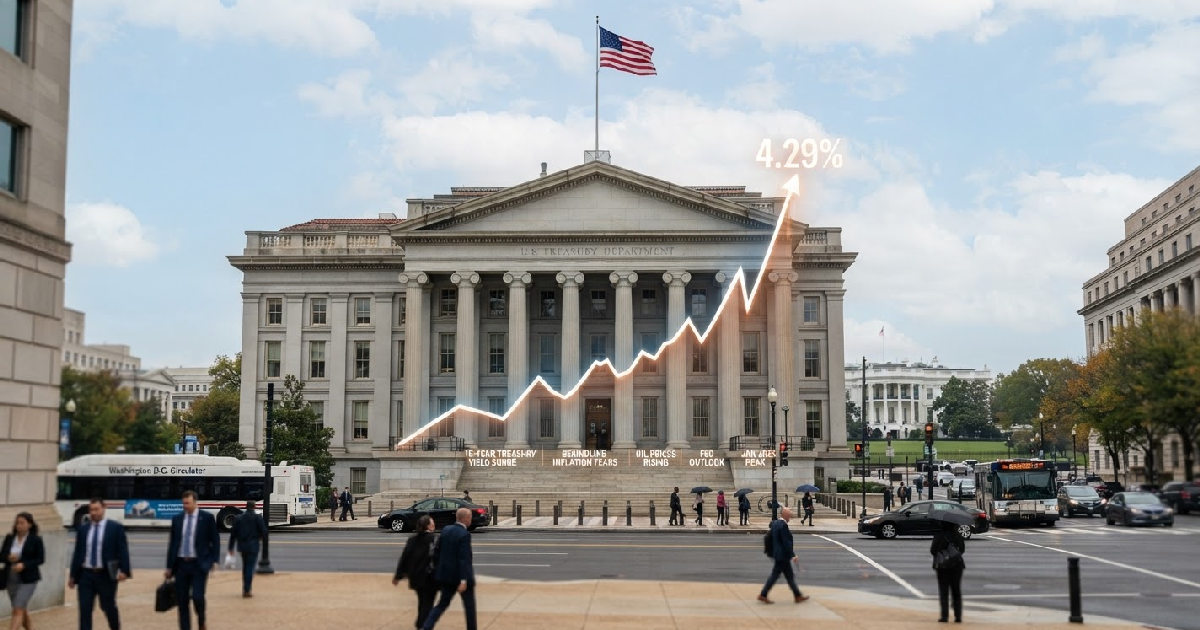
10-year Treasury yield surges to January 2025 high as oil rekindles inflation fear
The 10-year U.S. Treasury yield reached 4.72% on Thursday, July 23, 2026, its highest point since January 2025. S. Treasury yield climbed to its highest level since January 2025, reaching 4.72% as Brent crude oil futures surged to $100 a barrel. This sharp increase in borrowing costs and energy prices has reignited inflation fears, largely driven by escalating geopolitical tensions in the Middle East.
The sudden spike reflects growing market anxiety over the economic outlook, forcing investors to reassess the potential for central bank actions amidst a volatile global landscape. It suggests a renewed debate for the Federal Reserve on whether to raise interest rates again this year.
Middle East tensions escalate oil prices
The current volatility in financial markets stems significantly from intensifying geopolitical conflicts. On Thursday, Brent crude futures reached $100 per barrel, marking a substantial increase from just above $70 a barrel earlier this month.
This surge means oil prices have climbed nearly 31% above their pre-conflict levels seen earlier in July. U.S. Secretary of State Marco Rubio highlighted the severity of the situation on Wednesday, July 22, stating that Iran was not negotiating in good faith over the vital Strait of Hormuz.
Geopolitical instability fuels energy market fears
This critical waterway typically handles about a fifth of global oil and gas exports. The United States confirmed its 11th consecutive night of airstrikes against Iran on Wednesday, July 22, part of a wider conflict that began in February.
Defense Secretary Pete Hegseth stated on Tuesday that the war with Iran has already cost the U.S. $37.5 billion. Further exacerbating supply worries, Iran-backed Houthi militants announced a blockade of Saudi Arabia this week, sending crude prices to a seven-week high on Thursday.
Kuwait’s power, water, and oil facilities have also reportedly suffered repeated Iranian strikes, pushing prices higher. Earlier in the week, Brent crude closed above $90 a barrel on Tuesday, July 21, for the first time in over a month, then continued to climb towards $94 on Wednesday. Meanwhile, hopes for a US-Iran deal had offered some market relief.
Brent crude futures for July delivery gained 5% to trade above $99 a barrel, reaching its highest point since before the U.S. and Iran had reached a tentative peace agreement last month. Front-month U.S. West Texas Intermediate crude futures also advanced about 4% to more than $90 a barrel.
US Treasury yields reflect inflation concerns
The renewed specter of inflation, fueled by soaring energy costs, has directly impacted U.S. Treasury yields. The bellwether 10-year U.S. Treasury note yield rose 5.2 basis points to 4.709% by 8:50 a.m. ET on Thursday.
It subsequently reached 4.72% later that day, a 0.05 percentage point increase from the previous session. This marks the highest point for the 10-year yield since January 2025, specifically since it reached a peak of 4.79% on January 14, 2025.
Wider bond market adjusts to new realities
The yield was below 4% before the war with Iran started in February, underscoring the conflict’s impact. Other U.S. government debt instruments also saw notable movements on Thursday, July 23.
The yield on the two-year note, often a proxy for short-term Federal Reserve interest rate policy, grew by 5.1 basis points to 4.353%. This followed an advance of 1.12 basis points to 4.272% on Wednesday.
The longer-dated 30-year bond yield wasn’t far behind, jumping by 3.9 basis points to 5.186% on Thursday. These widespread increases signal the bond market’s adjustment to heightened inflation risks, where yields and prices move inversely.
Over the past four weeks, the 10-year Note Bond Yield gained 30.70 basis points. In the last 12 months, it increased 29.60 basis points, reflecting persistent underlying pressures.
Federal Reserve grapples with potential rate hikes
The sudden and sharp rise in both oil prices and Treasury yields presents a significant challenge for the Federal Reserve. The central bank now faces revived debate over whether it may need to raise interest rates again this year to curb inflationary pressures.
If energy prices remain high, inflation could easily accelerate, making it difficult for the Fed to justify any interest rate reductions. Traders are now pricing in fewer rate cuts or expecting them much later than previously forecast.
Central bank leadership and economic outlook
Market probabilities for a rate hike have dramatically shifted. Fed funds futures traders are currently pricing in a 26% chance of a rate hike when the central bank concludes its two-day meeting on July 29. This probability increases significantly, reaching 71% for an increase by September and 88% by year-end, indicating a rapid repricing of expectations.
Fed Governor Christopher Waller recently signaled a potential shift, stating last week that the central bank might need to raise rates “in the near term.” This would happen if incoming data showed inflation running well above the target of 2%. Natixis Chief U.S. Economist Christopher Hodge remarked that “the Fed’s reaction function under its new leader is far from certain.”
The bond market is also adjusting to the start of Kevin Warsh’s term as Fed chairman, considered a significant driver by Tom Tzitzouris, head of fixed income research at Baird Strategas. Chris Rupkey, FWDBONDS chief economist, warned that “half of Federal Reserve officials are concerned enough about the inflation risks to pencil in a rate hike this year.”
Global financial markets and domestic indicators
The impact of rising energy costs and inflation fears extends beyond American borders. Government bond yields climbed across Asia and Europe on Thursday, illustrating the global nature of these economic pressures. For instance, the yield on the U.K. 10-year government bond rose 4 basis points, surpassing 5%.
This rise occurred as new Prime Minister Andy Burnham enacted property tax cuts for hospitality venues, a measure expected to cost £100 million ($134 million). Broader market activity saw TFI International valuation changes reflect shifts in corporate performance.
Mixed signals from labor market and future data
Despite the gloomy inflation outlook, some economic indicators show resilience. Weekly jobless claims for the week ending July 18 registered 187,000, falling below the 212,000 economists polled by Dow Jones had anticipated. This suggests a robust U.S. labor market, providing some counterpoint to the broader economic headwinds.
Chris Rupkey added that “the economy isn’t out of the woods yet from the dangers posed to either growth or the affordability crisis and higher prices.” Investors will now keenly await the S&P Global Flash U.S. purchasing managers index report, due Friday.
This report measures the economic health of American manufacturing and services sectors, and its findings could offer further insights into the economy’s underlying strength amid these new challenges. These global challenges are unfolding as China Airlines announced record profits for 2025.
The prospect of stagflation — high inflation coupled with stagnant economic growth — remains a tangible concern for policymakers worldwide. The delicate balance between managing inflation and supporting economic growth has rarely seemed so precarious.