

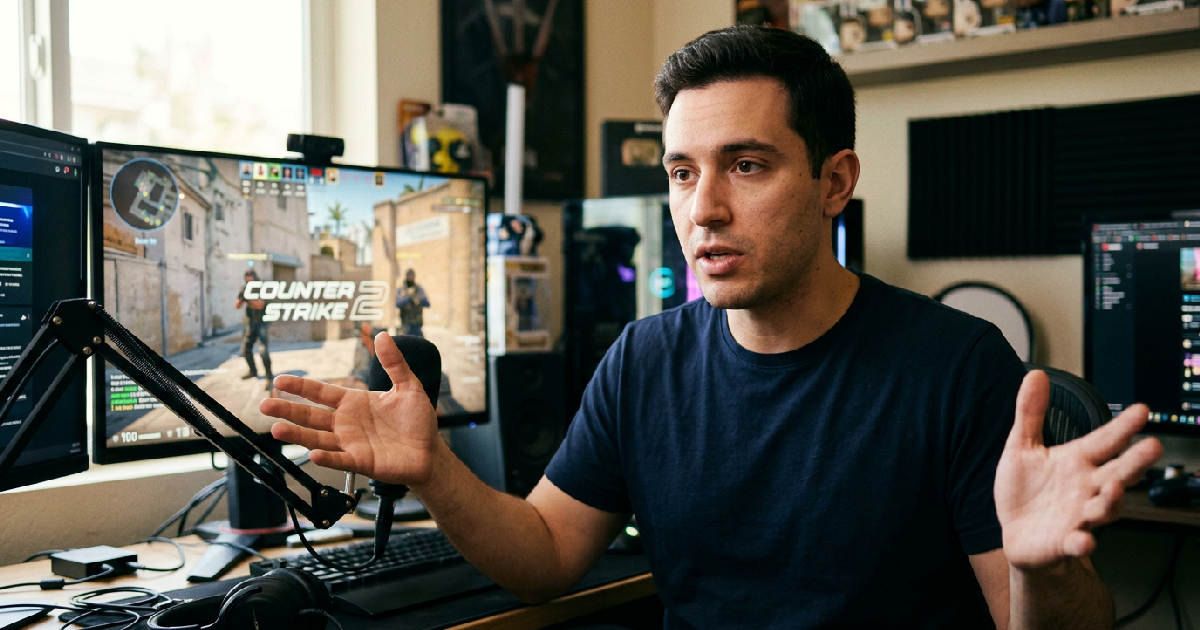
Ryan Abadir reveals Valve developers acknowledge Counter-Strike 2 subtick issues
Ryan “freakazoid” Abadir recently revealed during a live stream that Valve developers have reportedly admitted to significant issues with the “subtick” netcode architecture in Counter-Strike 2 (CS2).
According to the American professional player, Soham “valens” Chowdhury, who currently serves as the Head of Gaming for Evil Geniuses, visited Valve’s headquarters in Bellevue recently and held discussions regarding the state of the game.
Valve developers reportedly acknowledge Counter-Strike 2 subtick issues
Ryan “freakazoid” Abadir claims these developers are not only aware of the community’s frustration but are also considering an update to improve the system, with a return to a “128-tick” server refresh rate reportedly on the table.
The report, first highlighted by news outlets on June 29, 2026, suggest a potential shift in Valve’s internal stance after years of defending the subtick system as a technical evolution. Since CS2 replaced Counter-Strike: Global Offensive (CS:GO) in late 2023, the community has remained deeply divided over hit registration and movement consistency.
If the account from Soham “valens” Chowdhury is accurate, it would indicate that sustained feedback from professional players and analysts has finally reached the technical leads at Valve.
Subtick: a persistent source of player dissatisfaction
The revelation from Ryan “freakazoid” Abadir comes as frustration over the online experience in Counter-Strike 2 remains a frequent topic of debate. The Subtick system was designed to provide better responsiveness by processing actions instantly, regardless of the traditional 64-tick server rate.
However, players have consistently reported “sliding” models and inconsistent hit registration since the game’s launch. This frustration was quantified in 2025 when a survey by ThourCS2 found that many professional players cited Subtick as their primary technical grievance.
Elite players and casters have been vocal about these issues since CS2’s release in late 2023. Chad “SPUNJ” Burchill, a prominent Australian-British caster, has repeatedly called for Valve to restore 128-tick servers, a standard highly favored in the competitive scene.
The core problem has been traced back to the Subtick system’s reliability, which community tests, such as those conducted by “SebCs2” in July 2025, showed could be “wildly inconsistent.” This inconsistency often worsens during longer game sessions, exacerbating player frustration.
The technical change from 128-tick to subtick
Counter-Strike 2, launched on September 27, 2023, replaced its predecessor, CS:GO, and introduced Valve’s Source 2 engine. A key component of this overhaul was the new Subtick server architecture, which aimed to process player actions like movements and shots with greater precision.
In CS:GO, official matchmaking servers operated at a 64 Hz tick rate, meaning the game state updated 64 times per second. This was in contrast to competitive third-party platforms like ESEA and FACEIT, which used 128-tick servers, updating twice as frequently.
The Subtick system was designed to assign precise timestamps to player inputs, theoretically making gameplay more responsive by registering actions between ticks. Valve’s official CS2 servers still maintain a 64 Hz update cycle for general synchronization, but the ambition was for Subtick to achieve or even surpass the responsiveness of older 128 Hz systems.
Despite these intentions, the actual performance has fallen short for many. The instantaneous processing, meant to be an improvement, has instead led to widespread complaints about kill delays, “rubberbanding,” and a perceived “peeker’s advantage” for those with high ping.
Valve’s evolving stance on netcode architecture
The news from Ryan “freakazoid” Abadir about Valve’s internal admissions marks a significant shift. As recently as January 13, 2026, content creators reported a previous Valve stance that Subtick was “here to stay.” Developers had reportedly believed it was superior to 128-tick from CS:GO, based on their own testing and analysis.
Even earlier, in November 2023, Valve Senior Software Engineer John McDonald addressed some Subtick issues, specifically inconsistent jump heights. McDonald acknowledged the connection to `cl_showpos` and the Subtick system but suggested that a fix could decrease game performance.
He argued that more players would benefit from increased frames per second (FPS) over a fixed jump height. This earlier perspective highlighted a perceived trade-off between technical accuracy and broader player experience.
Valve did release a CS2 update on November 9, 2023, which directly addressed some Subtick elements. This update included changes to visual feedback for movement and muzzle flashes, synchronized random numbers for shooting spread, and a fix for inconsistent jump height when pressing a movement key right after jumping.
Implications for the future of Counter-Strike 2
During his stream, Ryan “freakazoid” Abadir indicated that the reported visit by Soham “valens” Chowdhury led to an admission of “significant issues” from the engineering team. This is a departure from previous years where Valve maintained that the system was fundamentally better than the 128-tick servers favored by third-party platforms.
While developers often rush to stabilize new tech, Valve has historically been more reserved about admitting flaws in its core netcode. This reported acknowledgment could signal a more proactive approach to player feedback.
The explicit mention of a potential return to 128-tick servers, even as a possibility “on the table,” is particularly noteworthy. Such a move would be a substantial reversal and a costly undertaking for Valve, requiring considerable investment in server infrastructure to handle the increased data processing.
It also brings to mind the ongoing discussions around other major game releases, such as the Grand Theft Auto 6 release date confirmed for November 2026, where the technical stability at launch is a key concern for players. Developers across the industry are continually balancing innovation with player expectation.
What this means for the player base
Even with this new information, players should manage their expectations for an immediate rollout. The phrase “on the table” suggests that Valve is in an evaluation phase rather than an implementation phase. Transitioning the global matchmaking infrastructure to 128-tick would require a substantial increase in bandwidth and processing power.
It remains unknown how Valve would balance these hardware demands with their goal of keeping the game accessible to players on lower-end PCs. Any such change would likely necessitate extensive testing to ensure stability and performance across a wide range of hardware configurations.
What is clear is that the conversation has moved beyond mere speculation. With Soham “valens” Chowdhury reportedly bringing direct feedback from the Bellevue office, the technical future of Counter-Strike 2 appears more fluid than it has been since its late 2023 launch.
Whether this leads to a “Subtick 2.0” or a full return to the 128-tick standard, the acknowledgment of specific flaws is the first step toward a potential solution for the game’s competitive elite.
This development could reinvigorate the player base, many of whom have felt unheard since the game’s transition from CS:GO. Addressing core netcode issues is vital for the long-term health of CS2 as a competitive esports title.