

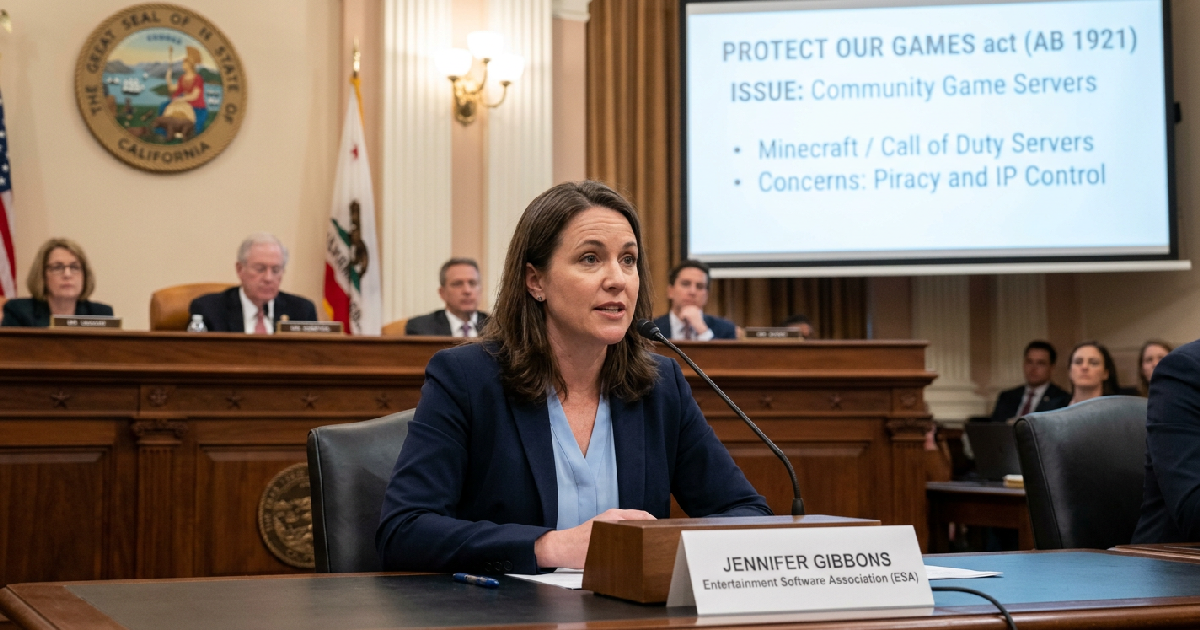
Jennifer Gibbons calls community game servers “illegal” at June 29 hearing
\” The comment occurred during a debate over the Protect Our Games act (AB 1921), a bill introduced by Assemblyman Chris Ward designed to preserve access to video games after official support ends. The hearing has sparked significant debate within the gaming industry, particularly as the ESA equated these third-party servers with piracy despite games like Minecraft providing tools specifically for players to host their own environments.
The tension surrounding the legality of community game servers highlights a growing divide between corporate software control and consumer preservation efforts. While Assemblyman Chris Ward argued that private servers could keep games functional once publishers abandon them, the ESA maintains that these servers lack corporate safety standards and intellectual property authorization. The legislative session saw a divided response, ultimately resulting in the AB 1921 bill failing to pass its current stage, though it remains eligible for future reconsideration.
ESA links community game servers to piracy and safety risks
During the June 29 hearing, Jennifer Gibbons interrupted Assemblyman Chris Ward to characterize community game servers as “illegal” and a form of “piracy.” She argued that because these servers are not affiliated with companies like Microsoft, they do not employ the same safety standards required to protect players.
Gibbons further noted that the United States Trade Representative has labeled \”some of these big private servers as a notorious market.\”
To support this hardline stance, Jennifer Gibbons pointed to two pending lawsuits against private server operators. The ESA’s position suggests that the industry views unauthorized hosting as a threat to their digital ecosystems, even for legacy titles that are no longer commercially supported.
Key details
This stance comes at a time when major industry shifts are occurring, such as when Bobby Kotick claimed a lawsuit regarding the Activision-Microsoft deal impacted corporate strategies.
The contradiction of Minecraft hosting tools
The ESA’s labeling of Minecraft servers as illegal has drawn specific criticism because the game officially provides players with the software needed to run their own servers. Critics argue the ESA’s testimony ignores the technical reality that many developers encourages community-led infrastructure. For example, Valve Corporation has a history of supporting custom servers to allow for unique gameplay experiences not available on official hardware.
In many cases, these community efforts are the only way to play older titles that have been delisted. The debate mirrors other high-stakes corporate moves in the industry, including when Strauss Zelnick confirmed Grand Theft Auto 6 release windows, highlighting how much control publishers exert over the lifecycle of their products.
If community servers are categorized strictly as piracy, thousands of archival projects could face legal jeopardy.
Stop Killing Games movement critiques ESA testimony
The Stop Killing Games campaign, a consumer movement advocating for the right to keep playing games after support ends, accused the ESA of using \”fear\” to influence the hearing outcome. A representative for the group stated that the ESA’s claims were designed to frighten legislators who lack the technical expertise to verify allegations of piracy.
The campaign gained momentum after games like The Crew were taken offline by Ubisoft, rendering the software completely unplayable for those who purchased it.
According to the group, the ESA \”did not fight this with facts\” during the California hearing. They contend that the association’s rhetoric worked \”just well enough\” in this instance to stall the legislation. Despite the setback, the movement plans to pursue similar legislative protections in other states, hoping to establish a legal framework that prevents publishers from \”bricking\” software that remains popular with community members.
Legislative status of the Protect Our Games act
The effort to turn the AB 1921 bill into law faced a significant hurdle following the hearing. The bill failed to move forward, receiving four \”yes\” votes, three \”no\” votes, and four members choosing not to vote. State Senator Caroline Menjivar participated in the session, asking follow-up questions to Jennifer Gibbons regarding the industry’s stance on these private environments.
However, the bill has been granted a reconsideration, meaning its supporters have another opportunity to present evidence or amendments. This legislative struggle occurs as other sectors face similar regulatory scrutiny, such as when the Clarity Act advances to Senate to define rules for emerging digital assets. The outcome of the reconsideration will likely determine if California becomes a testing ground for software ownership rights.
Impact of the notorious market label on gaming
By using the term \”notorious market,\” the ESA is attempting to align community servers with large-scale copyright infringement operations. Traditionally, community servers have been tolerated unless they infringe on intellectual property or allow players to bypass subscription fees, common in MMORPGs. The current rhetoric suggests a shift toward more aggressive enforcement, even against hobbyist groups that do not generate profit from their hosting duties.
Safety remains the primary justification cited by the ESA for this crackdown. Jennifer Gibbons emphasized that children on community servers are not protected by the same moderation tools found on official corporate platforms.
While safety is a valid concern for parents, preservationists argue it should not serve as a catch-all reason to declare all independent hosting illegal, especially for games that no longer have official servers available to the public.
The future of game preservation rests heavily on how these legal definitions evolve. If the ESA successfully frames all third-party hosting as piracy, it could lead to the permanent loss of hundreds of multiplayer titles.
For now, the \”Stop Killing Games\” group and Assemblyman Chris Ward remain focused on the reconsideration of AB 1921, looking to prove that community servers are a vital tool for digital history rather than a threat to the industry.