

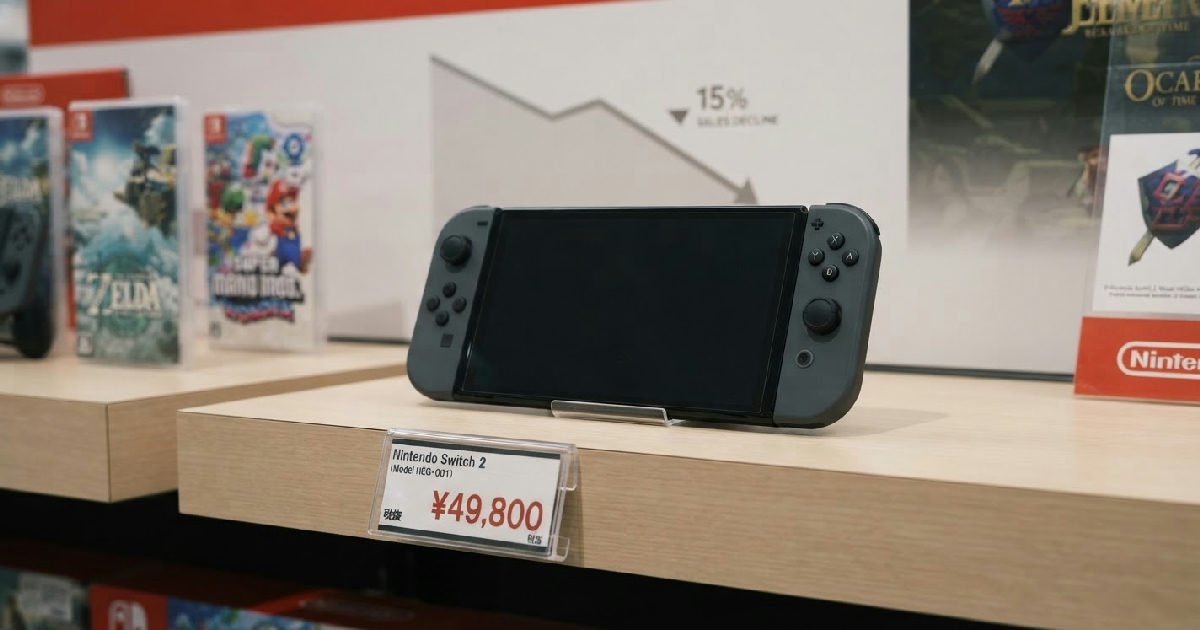
nintendo holds switch 2 price steady amidst 15% sales decline
Nintendo has reaffirmed its commitment to the current pricing of its Switch 2 console, ruling out any further increases despite reporting a significant drop in console sales and reduced operating profit. The announcement comes as the gaming giant navigates a challenging market environment marked by a global memory shortage and a tougher comparison period following the console’s record-breaking launch.
During the three months ending September 30, 2026, Nintendo’s operating profit saw a 16% decline, settling at 73.9 billion yen, which translates to approximately $467 million. This drop occurred in conjunction with a 15% fall in overall sales. The company sold 2.67 million Switch 2 units in the quarter, a sharp 41% decrease compared to the same period last year.
Price steady amidst sales
The latest financial disclosures paint a picture of decelerating growth for Nintendo’s latest hardware offering. Following an initial quarter (April to June 2026) where 3.82 million units of the Switch 2 were sold, the second quarter’s figures indicate a noticeable slowdown.
Cumulatively, for the first half of the current financial year (April to September 2026), Nintendo sold 6.49 million Switch 2 units. This represents a substantial decrease from the 10.36 million units shifted during the corresponding period last year.
Despite these recent dips, the Nintendo Switch 2 maintains an impressive overall trajectory. Its lifetime sales have now reached 26.35 million units. This figure shows the console is still outpacing the original Nintendo Switch in terms of launch-aligned sales, specifically within its first six quarters post-release.
The Switch 2 enjoyed a phenomenal debut, fueled by strong demand and ample stock availability, quickly becoming the fastest-selling console ever.
This record-setting initial performance inevitably set a high bar for subsequent years. Comparisons to its second year were always going to be challenging, as the console is now up against its own unprecedented launch success. Investors are closely monitoring the situation, particularly given the console’s relatively recent price hike in September.
Navigating the ‘RAMpocalypse’ and market pressures
Nintendo previously increased the Switch 2 price in September 2026. This adjustment was largely attributed to the ongoing ‘RAMpocalypse,’ a global shortage of computer memory that has significantly impacted the technology sector. The phenomenon, which began in 2025, has led to substantial price escalations for DRAM and NAND flash components, essential for modern electronics.
The current ‘RAMpocalypse’ differs from previous chip shortages, primarily driven by surging demand for artificial intelligence infrastructure. Manufacturing capacity has been reallocated to serve AI data centers, leading to scarcity in consumer and enterprise markets.
This has resulted in DRAM contract prices soaring by approximately 90% in the first quarter of 2026 alone, with overall price increases for memory components ranging from 200% to 400%. This economic backdrop has seen commodities like copper prices slip due to broader market uncertainties.
This global supply crunch has not only affected Nintendo but has also prompted competitors like Microsoft and Sony to raise the prices of their respective consoles. Despite these industry-wide pressures and Nintendo’s own recent price adjustment, Nintendo President Shuntaro Furukawa has remained steadfast.
He insists that Nintendo possesses sufficient memory reserves to meet its projected Switch 2 sales target of 16.5 million units for the financial year ending March 2027.
Furukawa emphasized the company’s commitment to accessibility during an earnings call, stating, “We want to make sure that as many people as possible can enjoy our unique entertainment, and we are not considering price increases at this point.” This statement signals Nintendo’s strategic choice to prioritize market accessibility and customer goodwill over immediate profit maximization through further hardware price adjustments.
Game releases and investor outlook
The role of compelling software titles is crucial for driving console sales, especially during periods of hardware sales slowdown. Nintendo launched the highly anticipated Ocarina of Time remake today, November 5, 2026. Investors are hopeful this significant release will provide a much-needed boost to Switch 2 sales during the critical holiday season.
However, concerns persist among investors regarding the memory situation and a perceived “lack of high-profile titles” for the Switch 2 this fiscal year. Serkan Toto, CEO of Kantan Games, a Tokyo-based game industry consultancy, voiced these sentiments to CNBC. He noted that the Ocarina of Time remake is “Nintendo’s only real blockbuster this fiscal year.”
Toto elaborated, “It’s not enough to make investors happy, especially after the device is now as expensive as it is. It’s getting harder and harder to sell video game hardware these days, and only hits help.”
His analysis underscores the growing importance of a robust software lineup to sustain console momentum in a competitive and economically challenging market. Despite the game release, Nintendo’s share price dropped by 2.2% today following the earnings report, reflecting cautious investor sentiment, similar to anxieties seen in crypto market anxiety.
Nintendo’s strategic play amidst market headwinds
Beyond hardware, Nintendo’s software sales continue to demonstrate the power of its established franchises. Mario Kart World, a launch title for the Switch 2, continued its steady performance, adding another 1.78 million units during the two quarters. StarFox, released in June, sold 1.17 million units.
These figures highlight Nintendo’s consistent ability to generate sales from its diverse portfolio of exclusive titles. The company also has future blockbusters in the pipeline, with fan expectations high for the next mainline Super Mario game in 2027.
Nintendo’s decision to hold the line on the Switch 2 price, despite falling sales and profit, suggests a longer-term strategic vision. By absorbing the increased costs associated with the ‘RAMpocalypse’ rather than passing them directly to consumers, Nintendo aims to maintain the console’s market reach and nurture its player base.
This approach aligns with Furukawa’s stated goal of making unique entertainment accessible to as many people as possible.
The road ahead for Nintendo’s flagship console
The coming months, particularly the holiday sales season, will be a crucial test for the Switch 2 and Nintendo’s strategy. The launch of the Ocarina of Time remake is expected to be a significant sales driver, but the console will need sustained software support to overcome investor concerns about a perceived lack of high-profile releases this fiscal year.
Nintendo’s commitment to its sales forecast of 16.5 million units for the financial year ending March 2027, coupled with assurances about memory supply, indicates confidence in its ability to navigate current market challenges.
However, industry analysts will be watching closely to see if the planned releases for 2027, including new Pokémon titles and a potential Super Mario game, can reignite the momentum seen during the console’s initial launch period.
The market for dedicated gaming hardware is increasingly competitive, with various factors impacting consumer purchasing decisions. While Nintendo has managed to make its Switch 2 the fastest-selling console of all time, the ongoing economic shifts and supply chain issues, exemplified by the ‘RAMpocalypse,’ present continuous hurdles.
The company’s ability to deliver a consistent stream of compelling software and maintain an attractive price point will be key to sustaining its growth in the long term.