

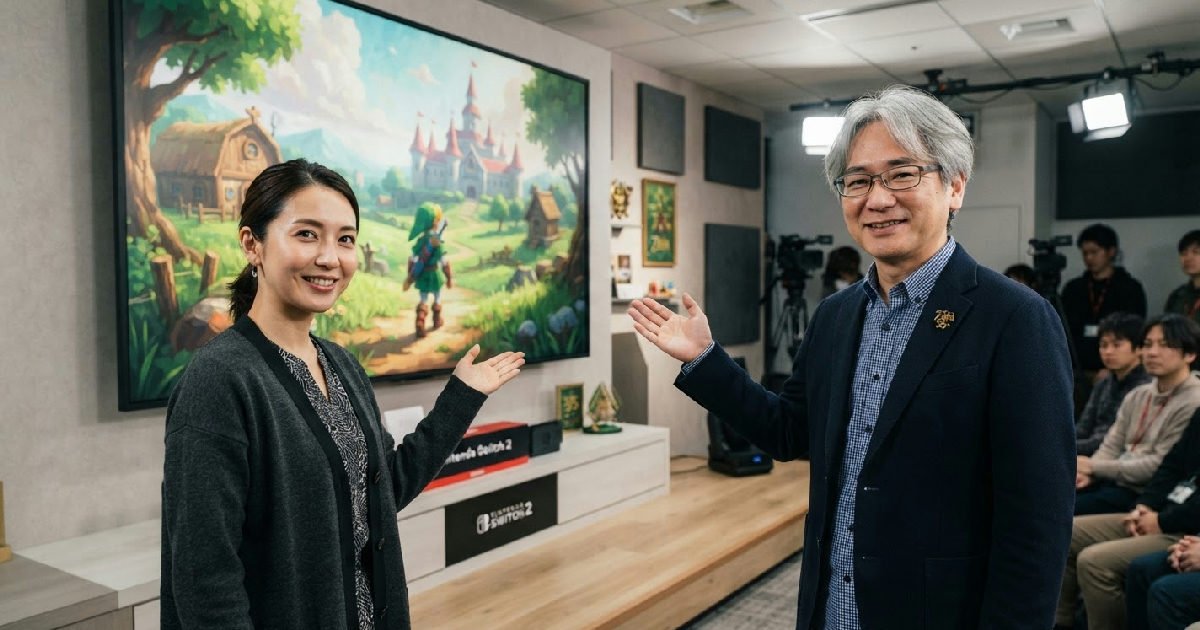
Aya Shida and Eiji Aonuma detail Ocarina of Time remake look
Nintendo has officially addressed the polarizing art direction for the upcoming remake of The Legend of Zelda: Ocarina of Time, slated for release on Nintendo Switch 2 this week. Art Director Aya Shida and series Producer Eiji Aonuma offered insights into the stylistic choices, which have drawn both praise and criticism from longtime fans.
The developers described the visual approach as having a distinct “puppet-show feel” and an “analog feel of practical effects films.” This aesthetic departs significantly from a purely photorealistic ambition, aiming instead for a unique blend of modern detail and nostalgic charm. Players are eager to see this vision in action as the game launches soon.
Crafting Hyrule’s new vision in the Ocarina of Time remake
Aya Shida, serving as Art Director for The Legend of Zelda: Ocarina of Time remake, explained Nintendo’s approach to leveraging the advanced capabilities of the Nintendo Switch 2. The goal was to build a richly detailed world that felt truly existent, yet avoided simple realism. Shida emphasized a desire to retain the original game’s mysterious, dreamlike charm.
She highlighted the contrast in the Nintendo 64 original between Hyrule’s dark, beautiful setting and its colorful, quirky characters. For the remake, the team sought to rebuild Hyrule as a dense, rich environment, ensuring its vibrant cast felt like a natural part of that world. Crafting unique character rosters is an ongoing challenge across game development.
Shida revealed that specific keywords guided the team’s artistic direction early on. Phrases like “a puppet-show feel” and “the analog feel of practical effects films” became fundamental. These terms aimed to create a convincing sense that the characters genuinely inhabit their fantasy environments.
Early in the process, artists drew sketches of Link, Zelda, and other characters. Simultaneously, a highly detailed 3D model of the Great Deku Tree was created, with careful attention paid to lighting and textures. This was to establish the kind of world the characters would inhabit, demonstrating how they would blend seamlessly into it.
Nostalgia as a Driving Force for Artistic Choices
Series Producer Eiji Aonuma provided a critical perspective on the remake’s visual style, linking it directly to developer nostalgia. He acknowledged that when the original Ocarina of Time was developed for the Nintendo 64, the team focused on creating cutting-edge visuals for its time. Nostalgia was not part of that initial creative process.
However, Aonuma noted that the current development team views the original game through a lens of fondness and remembrance. This generational shift in perspective led them to pursue the analog, puppet-show-like feel for the remake. For Aonuma, an original developer, this progression made inherent sense.
The original The Legend of Zelda: Ocarina of Time, released in November 1998, set new benchmarks for 3D gaming. It garnered widespread critical acclaim, famously receiving a perfect score from Famitsu magazine and achieving the highest Metacritic score of all time. The game’s innovations, such as the Z-targeting system, became industry standards.
Aonuma previously stated one reason for revisiting Ocarina of Time was to allow younger developers to study its structure and development style. He believes this process could spark fresh insights for future titles in the venerable series. The remake serves as both a tribute and a learning experience.
The Nintendo Switch 2’s Canvas
The Ocarina of Time remake arrives on the Nintendo Switch 2, Nintendo’s powerful new console that launched on June 5, 2025. With over 23 million units sold worldwide as of June 2026, it stands as Nintendo’s fastest-selling console to date. It boasts significantly upgraded graphical capabilities, powered by a custom NVIDIA processor.
This new hardware includes dedicated RT Cores for real-time ray tracing and Tensor Cores for AI-driven enhancements like Deep Learning Super Sampling (DLSS). NVIDIA claims the Switch 2 offers ten times the graphics performance of its predecessor. However, the Ocarina of Time remake reportedly utilizes AMD FSR 1.0 and SMAA for upscaling and anti-aliasing.
This technical decision has generated some disappointment among fans who expected DLSS support for a flagship title on the new console. Despite the console’s raw power, the artistic choice for a “puppet-show feel” prioritizes style over purely pushing photorealistic boundaries. This shows a deliberate design choice over raw fidelity.
The Nintendo Switch 2 supports up to 4K resolution at 60 Hz when docked and 1080p at 120 Hz in handheld mode, complete with HDR and variable refresh rate (VRR) capabilities. This advanced display technology provides a vibrant stage for the remake’s unique visual style. Nintendo’s newest console has become its fastest-selling, moving over 23 million units worldwide by June 2026.
A History of Divisive Aesthetics in Zelda
The divisive reaction to the Ocarina of Time remake’s graphics is not new territory for the Zelda franchise. The series has a track record of challenging fan expectations with bold artistic shifts. Initial reactions to trailers and screenshots have varied, with some players finding Link’s appearance unsettling or comparing it to mobile game aesthetics.
This mirrors the initial reception of The Legend of Zelda: The Wind Waker, whose cel-shaded graphics were highly controversial upon reveal. Yet, Wind Waker later earned widespread acceptance and critical acclaim, becoming a beloved entry in the series. It proved that distinctive art styles can ultimately triumph over initial skepticism.
More recently, the 2019 remake of The Legend of Zelda: Link’s Awakening for the original Nintendo Switch also sparked debate with its “retro-modern” art style. This remake featured toy-like character designs and diorama-like world visuals, complemented by tilt-shift effects. Producer Eiji Aonuma explained this choice evoked the Game Boy original’s sense of a small, yet vast world.
Developed by Grezzo, the Link’s Awakening remake successfully embraced its stylized visuals, selling over 6.46 million copies worldwide by December 2022. It demonstrated that a stylized approach, when thoughtfully executed, can resonate with a broad audience. The game also included fan-favorite features like the Color Dungeon and new Chamber Dungeons.
The ongoing debate between stylized and photorealistic graphics is a consistent theme across the gaming industry. While photorealism aims for lifelike experiences, stylized art offers creative freedom and can age better. Games like Spider-Man: Into the Spider-Verse demonstrate the critical and commercial success of highly stylized visuals.
Looking Ahead to Hyrule’s Return
As The Legend of Zelda: Ocarina of Time remake prepares for its debut, its artistic direction serves as a potent reminder of Nintendo’s willingness to innovate. The company consistently opts for distinctive visual identities rather than simply chasing raw graphical fidelity. This approach defines much of its iconic game design philosophy.
The reception of this remake will undoubtedly influence future artistic choices within the Zelda franchise and other Nintendo titles. It provides a real-world case study for balancing how to honor a classic while reimaging it for a new generation. Every creative decision, spanning art direction and development structure, significantly shapes a game’s lasting legacy.
Ultimately, the “puppet-show feel” aims to immerse players in a Hyrule that is both familiar and fresh. It brims with a charm that resonates with the original’s dreamlike quality. Fans will soon decide if Nintendo has struck the right balance, as narrative pacing decisions also shape player reception.