

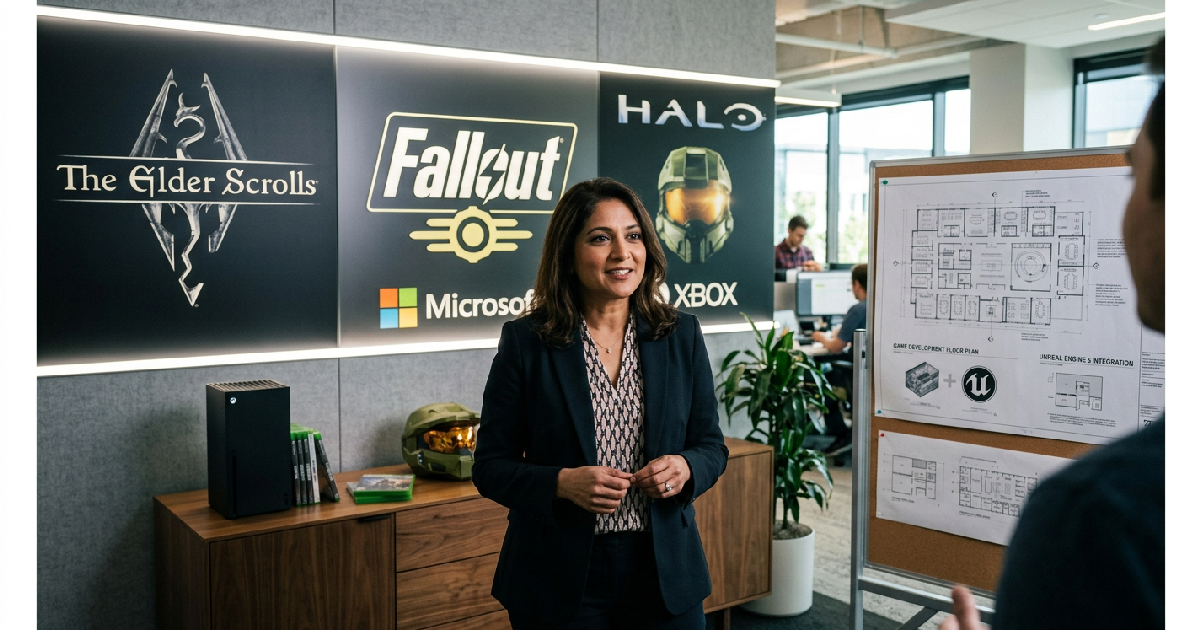
Asha Sharma spearheads Microsoft plan to boost Elder, Halo game development
Asha Sharma, CEO of Microsoft Gaming, is reportedly spearheading a strategic mission to accelerate development for the company’s most lucrative franchises, including The Elder Scrolls, Fallout, and Halo.
According to internal reports published on June 12, 2026, Microsoft CEO Satya Nadella and CFO Amy Hood have approved a plan to increase spending on these core series.
The initiative, expected to begin in the July fiscal year, represents a major “reset” for the Xbox brand following the February 2026 retirement of longtime executive Phil Spencer.
The move comes as Microsoft struggles to reverse a period of financial decline. In January 2026, the company reported a 9% year-on-year drop in total gaming revenue and a 32% collapse in Xbox hardware sales.
Satya Nadella later acknowledged on April 30, 2026, that the division had seen revenue declines in four of the last six quarters. By pumping extra funding into Bethesda Game Studios and Halo Studios, leadership aims to bridge the long gaps between major releases and deliver sequels to gamers faster than currently observed.
Asha Sharma admitted in a recent email to employees that the gaming division had become “over-extended.” To sharpen focus, Microsoft plans to redeploy resources to its top-tier projects, potentially at the expense of lower-performing studios and experimental work.
While specific budgeting isn’t finalized, the overall game development budget for the 2027 fiscal year should remain flat. This shift mirrors broader industrial trends where supply chain resiliency increasingly prioritised over cost has become a necessity to maintain a steady flow of high-value products.
Addressing the development gap for Bethesda franchises
A primary catalyst for this plan is the prolonged production of The Elder Scrolls 6. It has been eight years since its announcement in 2018, and Bethesda lead Todd Howard has publicly wished development went “a lot faster.”
Howard recently noted that while most of the studio is now working on the sequel, Bethesda traditionally overlaps development with long pre-production phases. Studio Design Director Emil Pagliarulo has maintained that the game will take as long as necessary to be great.
Fallout has faced a similar hiatus, with no mainline entry since 2018’s Fallout 76. While a Fallout 3 Remastered is reportedly in development, Fallout 5 is not expected until well after the next Elder Scrolls title. Microsoft’s new strategy seeks to provide the capital required to shorten these years-long production cycles.
The push for efficiency is critical as the division navigates soaring hardware costs, including a reported 700% rise in wholesale memory prices for Xbox Series X|S consoles.
Refining technology and cutting software friction
The acceleration plan also involves significant technical changes to reduce friction for players and developers. Asha Sharma stated that Xbox will cancel Copilot development on consoles and wind down the AI assistant on mobile platforms. This allows the team to focus on “fewer, better features” as a near-term priority.
These moves follow a period where AI as ‘biggest transformation’ in other sectors hasn’t yet translated into streamlined production for the gaming giant’s complex engines.
To further manage costs, Microsoft is reportedly looking at leveraging in-house engines over external vendors. This focus on proprietary technology is intended to help Bethesda and Halo Studios maintain control over their development pipelines while managing the rising expenses of modern game production.
By consolidating resources, Microsoft hopes to produce the “hit” software needed to revive the brand after a series of underperforming hardware and software cycles.
Transforming the Halo franchise and Xbox hardware strategy
The Halo series is undergoing its own transformation as part of this reset. Following the end of new content for Halo Infinite in 2025, the studio is moving toward Unreal Engine 5 for future projects. The next major release is Halo: Campaign Evolved, a remake of the 2001 original, set to launch on July 28.
Notably, this title will release on Xbox, PC, and PlayStation 5, though Microsoft is reportedly looking to reintroduce exclusive titles to the platform elsewhere.
Beyond remakes, reports indicate at least two other Halo projects are in development, including remakes of Halo 2 and Halo 3. This nostalgic focus coincides with efforts to stabilize the Game Pass subscription service, which recently recovered from a subscriber loss following a price cut.
Microsoft remains under pressure to deliver high-quality content to retain these members. The competition remains fierce, with many fans hunting for Xbox deals to access current titles while waiting for the next generation of blockbusters.
Industry reports also suggest Microsoft is considering even deeper structural changes. Rumors indicate leadership may spin off the Xbox division as a standalone company or a wholly-owned subsidiary to increase operational flexibility. This restructuring would follow the February appointment of Asha Sharma and the departure of Phil Spencer.
As the July fiscal year approaches, the focus is clearly on ensuring that Xbox’s most valuable intellectual properties remain the central pillar of the company’s gaming future.