

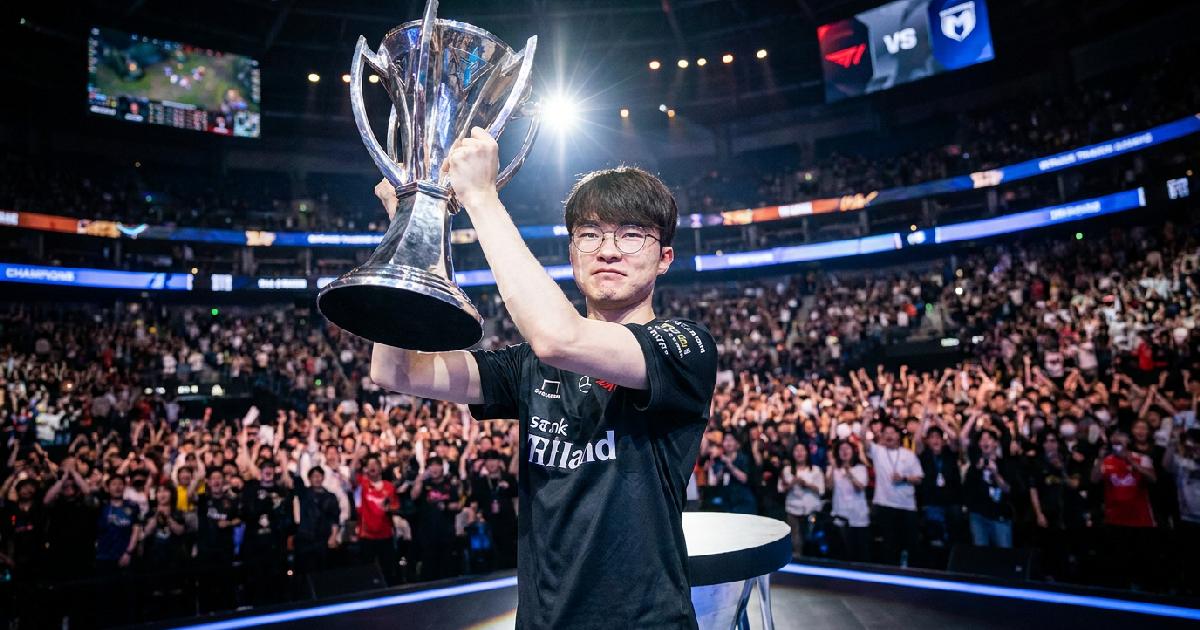
Faker solidifies GOAT status with unmatched League of Legends records
Lee “Faker” Sang-hyeok, the mid laner for South Korean esports powerhouse T1, has decisively cemented his status as the Greatest of All Time (GOAT) in League of Legends.
With a staggering six World Championship titles, two Mid-Season Invitational (MSI) titles, an Esports World Cup, an Asian Games gold medal, and 10 League of Legends Champions Korea (LCK) championships, Faker’s career achievements are simply unparalleled in competitive gaming.
Faker’s unparalleled championship dominance
His dominance stretches for over a decade, navigating countless game updates, meta shifts, and generations of elite opponents, all while remaining with the same organization. This extraordinary blend of sustained excellence, adaptability, and an ever-growing list of records makes his case for GOAT status undeniable in the esports world.
Faker’s trophy cabinet alone tells a story of unmatched success. He holds a record six League of Legends World Championship titles, securing victories in 2013, 2015, 2016, 2023, 2024, and 2025. This includes a historic three-peat from 2023 to 2025, a feat no other player has achieved.
Beyond the Summoner’s Cup, Faker has also claimed two Mid-Season Invitational (MSI) titles in 2016 and 2017. These victories, along with his 2024 Esports World Cup win and the 2022 Asian Games gold medal, highlight his consistent international success. His presence in a record eight Worlds finals further underscores his ability to perform under immense pressure.
A decade of dominance across shifting eras
What sets Faker’s championship run apart is its incredible longevity across vastly different iterations of League of Legends. He’s the only player to win Worlds across three distinct eras of competitive League, demonstrating a rare ability to adapt his play to evolving game mechanics.
Faker’s success isn’t just about individual skill; it’s also about his ability to elevate diverse rosters. He led legendary SK Telecom T1 lineups with teammates like Bengi, Bang, and Wolf to glory. Years later, he returned to the pinnacle with a new core featuring Zeus, Oner, Gumayusi, and Keria, proving he is the constant around which championship teams are built.
Adaptive brilliance in a dynamic esport
The nature of League of Legends, with its constant updates and meta shifts, makes sustained dominance incredibly challenging. Many star players shine brightly for a few seasons before fading as the game evolves. But Faker has repeatedly reinvented his playstyle, remaining an elite mid laner through every major change.
In his early years, Faker became famous during the assassin meta, terrorizing opponents with champions such as Zed and LeBlanc. His iconic outplay against Ryu’s Zed in 2013 remains a legendary moment in esports history. As the game shifted, he seamlessly transitioned to control mages like Azir and Orianna, dictating teamfights with superior positioning and decision-making.
Pioneering mid lane strategies and champion mastery
Later, as utility and supportive mid laners became prominent, Faker embraced champions such as Galio and Lissandra, sacrificing personal resources to empower his teammates. His Galio performances during SKT’s 2017 MSI run were groundbreaking, influencing how the role was perceived. This chameleon-like adaptability is a cornerstone of his legacy.
He’s not merely proficient with a wide champion pool; he has mastered them across various metas. His gameplay on champions like Sylas and Taliyah in modern League continues to set the benchmark for aspiring professionals. This constant evolution is a big reason his influence remains so pervasive, even as new game updates roll out.
Record-breaking longevity and consistency
Faker’s career span of over 13 years at the highest level is an anomaly in esports, where professional careers often peak and end within a few seasons. Since his debut in 2013 with SK Telecom T1 K, he has remained with the same organization, now simply T1, an incredible feat of loyalty and consistent performance.
This sustained excellence is backed by an extraordinary list of statistical records. He is the first player to reach 1,000, 2,000, and 3,000 kills in the LCK, and the first to achieve 5,000 assists. In 2025, he became the first person to play 1,000 LCK games, having played well over 1,500 professional games across all tournaments.
Consistency against elite competition
Through every competitive era, Faker has faced and conquered multiple generations of world-class opponents. Mid laners like Pawn, Rookie, Scout, ShowMaker, Chovy, and Knight have all enjoyed periods of being the best, but none have maintained Faker’s level of consistent excellence for over a decade. His ability to continually adapt and win against fresh talent underscores his enduring skill.
He has never placed lower than fourth at a World Championship, a remarkable testament to his consistency on the biggest stage. This consistent presence at the top, year after year, in an ever-evolving and intensely competitive game, makes his longevity one of the strongest arguments for his GOAT status.
Beyond trophies: Faker’s cultural and strategic impact
Faker’s influence transcends his in-game achievements. He’s become a global icon, shaping League of Legends as an esport and inspiring millions. His nickname, “The Unkillable Demon King,” was coined by OMG mid laner Cool during the 2013 World Championship, reflecting his formidable presence and ability to survive seemingly impossible situations.
His aggressive laning, mechanical precision, and astute decision-making redefined the mid lane role. Players worldwide study his gameplay to improve their own wave management, trading patterns, and teamfighting. Figures like ShowMaker and Chovy have cited him as a primary inspiration for their own careers.
Hall of Legends induction confirms lasting influence
In 2024, Riot Games recognized his profound impact by making him the first-ever inductee into the Hall of Legends, akin to a Hall of Fame for League of Legends esports. This honor acknowledges not just his unmatched trophy count, but also his influence on the game’s competitive landscape and his role as a global ambassador.
Faker’s professionalism, discipline, and humble personality have made him a role model both within and outside the game. He’s been featured on the Forbes 30 Under 30 list in Asia Entertainment & Sports (2019) and the TIME 100 Most Influential People in Sports list (2026).
On January 2, 2026, the South Korean government awarded him the Cheongryong (Blue Dragon) Medal, the highest honor in the Order of Sport Merit, making him the first esports athlete to receive such recognition.
The enduring GOAT debate: Why Faker stands alone
While many players have carved out legendary careers in League of Legends, none possess Faker’s complete resume. When comparing achievements, longevity, peak performance, and consistency, he remains unmatched. Other esteemed players, such as Chovy, Rookie, ShowMaker, Caps, and Deft, have all had their moments of brilliance and sustained periods of high performance.
But Faker’s six World Championship titles dwarf the single international titles many of these players hold. In terms of sheer duration at the top, only Deft comes close, having debuted in the same year. Yet, Faker’s sustained championship success throughout that period sets him apart.
It’s an unprecedented combination of peak skill and enduring relevance that no other professional has managed. Esports news often celebrates individual brilliance, but Faker’s career provides a benchmark for an entire generation.
A legacy unlikely to be surpassed
Could anyone ever surpass Faker’s legacy? It’s incredibly unlikely. While current stars like Chovy and Knight possess immense talent, matching Faker’s unique blend of achievements would demand more than individual skill. It would require winning multiple World Championships, dominating a domestic league for a decade, adapting through numerous meta shifts, and maintaining elite performance with various teammates and coaching staffs.
The sheer demands of over 13 years at the pinnacle of esports, requiring exceptional consistency, adaptability, and even health, are qualities few careers can sustain. His status as the League of Legends GOAT isn’t just about numbers; it’s about setting a benchmark that seems almost impossible to reach.